


This article was automatically translated from the original Turkish version.
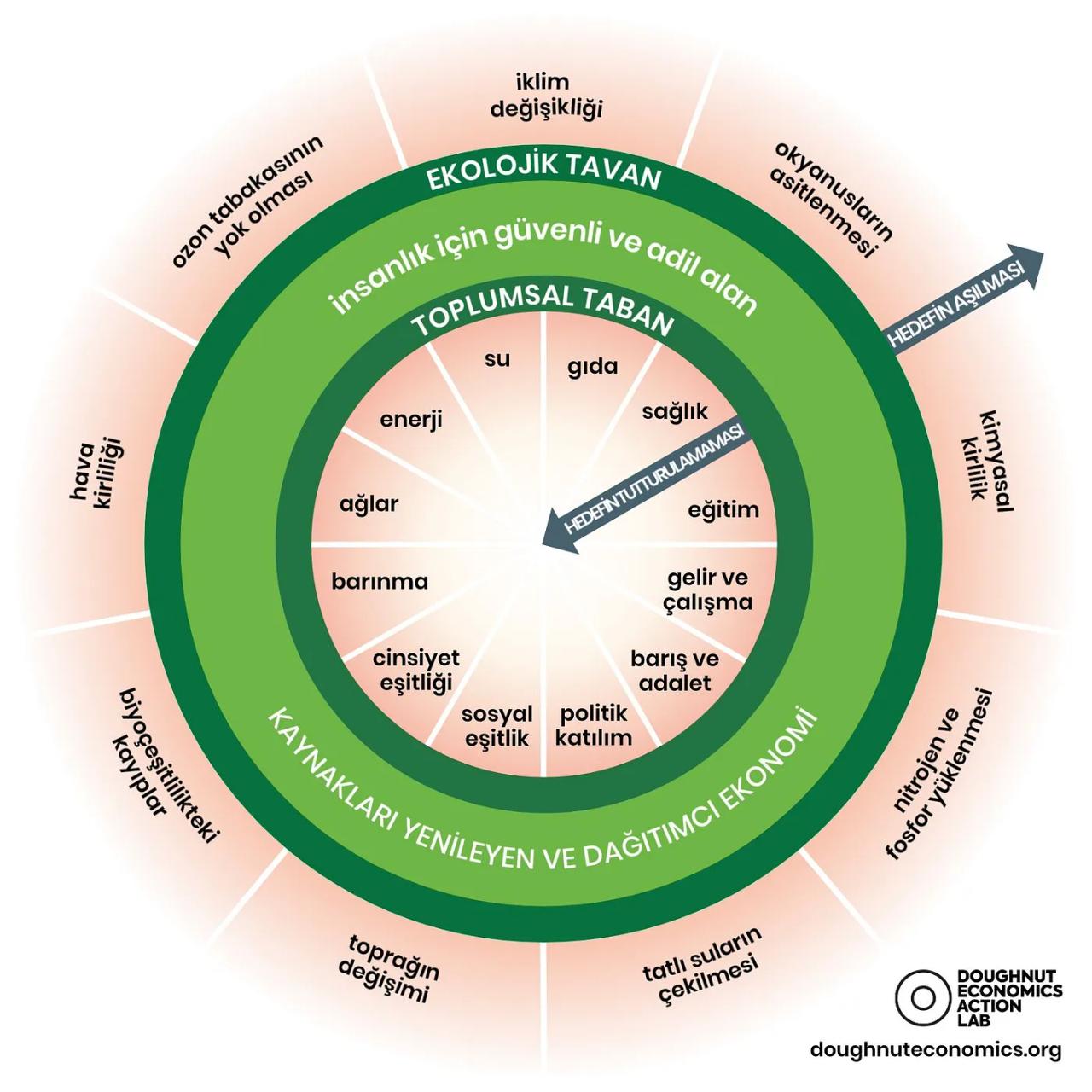
Simit Economy Model
History | 2012-10-30 | ||||||||
|---|---|---|---|---|---|---|---|---|---|
Inventor | Kate Raworth | ||||||||
Place(s) | Oxfam | ||||||||
First Article Published | A Safe and Just Space For Humanity: Can We Live Within the Doughnut? | ||||||||
Number of Boundaries | 2 | ||||||||
Simit Economy, originally known as the doughnut economy, is an innovative economic model developed by British economist Kate Raworth that centers on nature and people, with justice and equity as its core focus. This model moves away from industrial, growth-obsessed, and destructive economic paradigms to offer a sustainable development approach that enhances social well-being while respecting ecological limits.
Raworth first introduced this model in a 2012 report titled "A Safe and Just Space for Humanity: Can We Live Within the Doughnut?" written for Oxfam. The model was later detailed in her 2017 book, Doughnut Economics: Seven Ways to Think Like a 21st-Century Economist.
The model’s name and shape are represented by a simit figure. This graphical structure consists of two circular boundaries:
This represents the minimum standards of access to fundamental human rights and services. Falling below this boundary results in social deprivation. The inner foundation encompasses essential rights such as education, healthcare, housing, access to clean water and food, energy use, social equity, and political participation. Raworth draws on the indicators of the United Nations Sustainable Development Goals (SDGs) and defines this social foundation through twelve basic needs.
The outer boundary represents the carrying capacity of our planet. Exceeding this limit triggers ecological crises. It is grounded in the Planetary Boundaries framework developed by the Stockholm Resilience Centre. This framework includes critical environmental thresholds such as climate change, biodiversity loss, ocean acidification, disruption of nitrogen and phosphorus cycles, and deforestation.
This area between the inner and outer rings represents the ideal zone in which humanity can thrive without harming the natural environment. The goal of the model is to ensure that all people live within this space.
The seven key modes of thinking for the transition to a 21st-century economy, as defined by Kate Raworth, are:
The Simit Economy model proposes replacing the system of continuous growth and consumption with an economy that meets people’s basic needs without exceeding ecological limits and that ensures social justice. In this way, it places not only economic indicators but also social and environmental health at its center.
Doughnut Economics Action Lab (DEAL). "About Doughnut Economics." Doughnut Economics Web Sitesi. Accessed May 26, 2025. https://doughnuteconomics.org/about-doughnut-economics
Doughnut Economics Action Lab (DEAL). "Business Enterprise." Doughnut Economics Web Sitesi. Accessed May 26, 2025. https://doughnuteconomics.org/themes/business-enterprise
Doughnut Economics Action Lab (DEAL). "Principles & Guidelines." Doughnut Economics Web Sitesi. Accessed May 26, 2025. https://doughnuteconomics.org/principles-and-guidelines
Raworth, Kate. "A Safe and Just Space for Humanity: Can We Live Within the Doughnut?" Oxfam Discussion Papers. Accessed May 26, 2025. https://www-cdn.oxfam.org/s3fs-public/file_attachments/dp-a-safe-and-just-space-for-humanity-130212-en_5.pdf
Raworth, Kate. Simit Ekonomisi: 21. Yüzyıl İktisatçısı Gibi Düşünmenin Yedi Yolu. Çev: Akın Emre Pilgir. İstanbul: Tellekt Yayınları, 2017
Rockström, Johan et al. "Planetary Boundaries: Exploring the Safe Operating Space for Humanity". *Nature* 461, 472–475 (2009). Accessed May 26, 2025. https://www.nature.com/articles/461472a

Simit Economy Model
History | 2012-10-30 | ||||||||
|---|---|---|---|---|---|---|---|---|---|
Inventor | Kate Raworth | ||||||||
Place(s) | Oxfam | ||||||||
First Article Published | A Safe and Just Space For Humanity: Can We Live Within the Doughnut? | ||||||||
Number of Boundaries | 2 | ||||||||
Graphical Structure: The Meaning of the “Simit”
Inner Ring – Social Foundation
Outer Ring – Ecological Ceiling
Central Area – Safe and Just Space
Thinking According to the Seven Principles of Simit Economics
Goal of Transformation