

+1 More

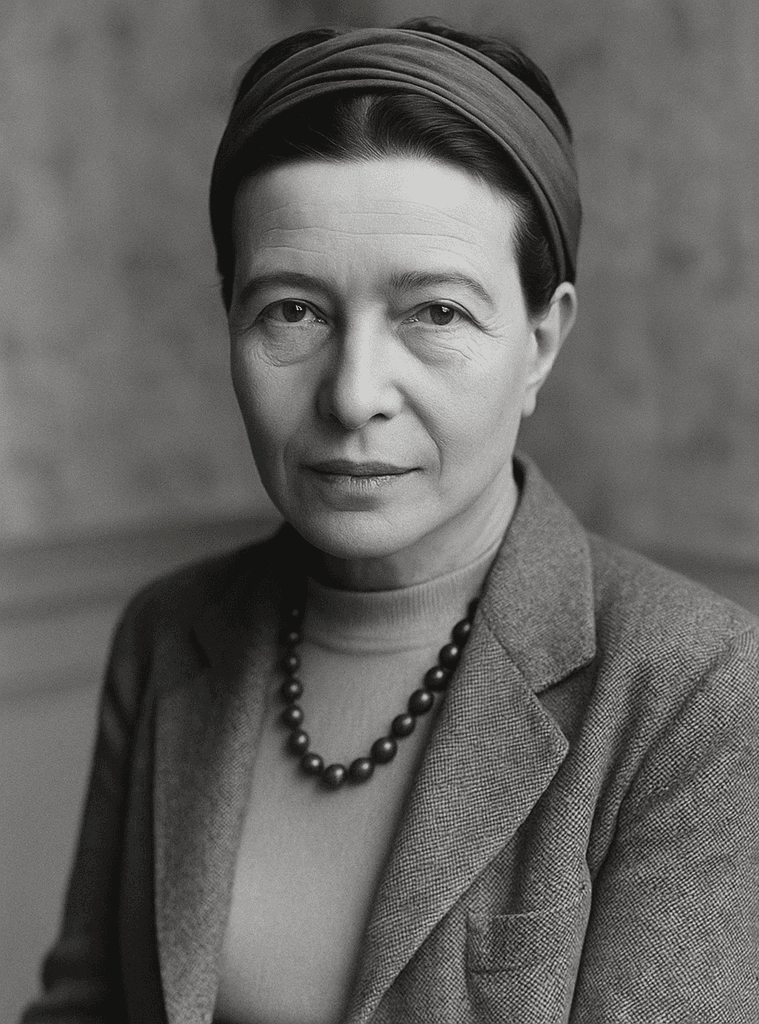
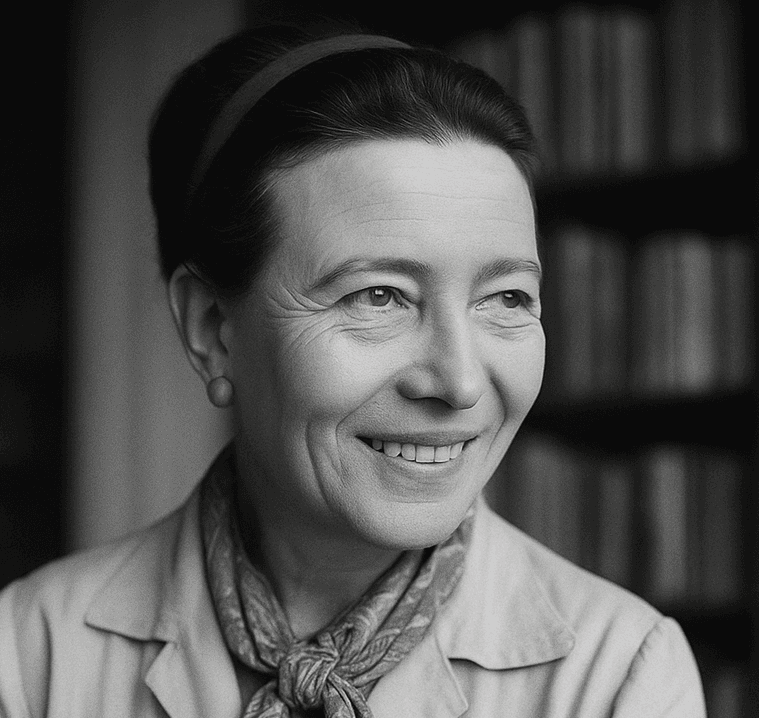
Simone de Beauvoir
Full Name | Simone Lucie Ernestine Marie Bertrand de Beauvoir | ||||||||
|---|---|---|---|---|---|---|---|---|---|
Doğum tarihi | 1908-01-09 | ||||||||
Place of Birth | Paris / France | ||||||||
Ölüm tarihi | 1986-04-14 | ||||||||
Profession(s) | Writer Teacher Essayist Philosopher | ||||||||
Education | Sorbonne University (Philosophy) | ||||||||
Philosophical Orientation | Existentialism | ||||||||
Fields | Feminist thought Social theory Literature Philosophy | ||||||||
Simone de Beauvoir was a writer whose works made significant contributions to 20th-century French philosophy and social theory. Within the framework of existentialism, she explored themes such as freedom, social gender, and otherness. In her literary and philosophical texts, she focused on the interaction between individual experience and social structures, generating theoretical content by integrating multiple disciplines.
Simone Lucie Ernestine Marie Bertrand de Beauvoir was born on 9 January 1908 in Paris, France. Although raised in a Catholic environment, she questioned religious belief at an early age. She received her philosophical education at the Sorbonne University. In 1929 she completed her philosophy degree and successfully passed the agrégation, one of France’s most prestigious academic examinations, qualifying her to become a philosophy teacher. During this period she met Jean-Paul Sartre and established an intellectual relationship that would last for decades.
Beauvoir’s intellectual framework was shaped by existentialist philosophy. She placed themes such as freedom, responsibility, bodily existence, time and otherness at the center of her philosophical inquiries. Her 1949 work Le Deuxième Sexe (The Second Sex) is regarded as one of the foundational texts of feminist theory. In this work she examines how women have historically, culturally and socially been relegated to the position of “the Other,” and opens a discussion on the distinction between biological sex and social gender.
Beauvoir’s work was not only theoretical but also politically engaged. During the 1950s and 1960s she expressed interest in anti-colonial movements and publicly denounced the torture and repression methods employed by the French military during the Algerian War. Her 1962 book Djamila Boupacha, co-authored with Gisèle Halimi, stands out as a key work in this context.
Beauvoir documented her six-week visit to China in 1955 in the book The Long March, where she observed the policies and social transformations of the Chinese Communist Party. While the work takes the form of a travelogue, it also offers a materialist analysis of the political and social structure of the era. Although written from the perspective of a Western observer with inherent limitations, the book demonstrates a critical distance toward different cultural systems.
Beauvoir continued to engage philosophical concepts in her fictional works. In her novel All Men Are Mortal (1946), she explores the relationship between human beings and time, as well as ethical responsibility, through the theme of immortality. Her 1964 work A Very Easy Death, written after her mother’s death, and her 1981 book Adieux: A Farewell to Sartre, which addresses the final years of Sartre’s life, examine concrete human experiences such as aging, illness and death through a phenomenological approach.
Published in 1970, The Coming of Age examines old age not merely as a biological condition but as a cultural and social positioning. In this work Beauvoir argues that elderly individuals are socially marginalized and that their freedoms are constrained.
Beauvoir’s four-volume autobiography (Memoirs of a Dutiful Daughter, The Prime of Life, Force of Circumstance) and her diaries (Diary of a Philosophy Student, Wartime Diaries) document the development of her philosophy and the intellectual transformation of her personal experiences. The concept of “situation” — the totality of historical, social and bodily conditions in which an individual exists — plays a central role in these texts. In writing her life story, she sought to reveal the layered nature of existence and the subject’s ethical responsibility.
Simone de Beauvoir died in Paris on 14 April 1986. After her death, her intellectual legacy continued to influence the fields of social gender theory, feminist philosophy and existentialism. Moreover, her treatment of themes such as aging, death, ethical responsibility and individual freedom, both philosophically and literarily, has laid the groundwork for interdisciplinary research.
Aydınalp, Esra Başak. “Varoluşçu Özgürlük Bağlamında Kadın: Simone De Beauvoir Ve İkinci Cinsiyet”. *Litera: Journal of Language, Literature and Culture Studies* 30, no. 2 (2020): 465–88. Accessed May 15, 2025. https://dergipark.org.tr/en/download/article-file/1464291
Bergoffen, Debra and Megan Burke. “Simone de Beauvoir.” Stanford Encyclopedia of Philosophy. Accessed May 15, 2025. https://plato.stanford.edu/entries/beauvoir/
Mussett, Shannon. “Simone de Beauvoir.” *Internet Encyclopedia of Philosophy.* Accessed May 15, 2025. https://iep.utm.edu/simone-de-beauvoir/

Simone de Beauvoir
Full Name | Simone Lucie Ernestine Marie Bertrand de Beauvoir | ||||||||
|---|---|---|---|---|---|---|---|---|---|
Doğum tarihi | 1908-01-09 | ||||||||
Place of Birth | Paris / France | ||||||||
Ölüm tarihi | 1986-04-14 | ||||||||
Profession(s) | Writer Teacher Essayist Philosopher | ||||||||
Education | Sorbonne University (Philosophy) | ||||||||
Philosophical Orientation | Existentialism | ||||||||
Fields | Feminist thought Social theory Literature Philosophy | ||||||||
Early Life and Education
Philosophical Approach and Major Works
Political Writings and Observational Role
Literary Works and Human Finitude
Autobiographical Writings
Legacy and Influence