


This article was automatically translated from the original Turkish version.
+2 More
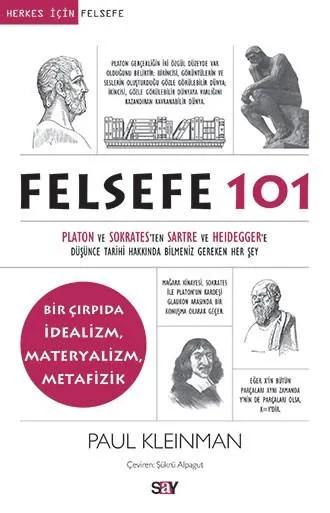
Philosophy 101 (Book)
Author(s) | Paul Kleinman | ||||||||
|---|---|---|---|---|---|---|---|---|---|
Publisher(s) | Say Yayınları | ||||||||
Translator(s) | Şükrü Alpagut | ||||||||
Number of Pages | 296 pages | ||||||||
Genre | Philosophy | ||||||||
Philosophy 101: A Basic Introduction to Ethics and Metaphysics from Plato and Socrates to the History of Thought, written by Paul Kleinman, is a work that explains the fundamental concepts and historical development of philosophy in simple language. Published in 2013 by Adams Media, the book aims to introduce the main figures, theories, and concepts of Western philosophy. Kleinman has created a guiding resource for newcomers to philosophy by presenting complex philosophical ideas in an accessible manner. The book invites readers into philosophical inquiry through short chapters, explanatory diagrams, and thought experiments.
Paul Kleinman was born and raised in New York and graduated in 2009 from the University of Wisconsin with a degree in Arts and Communication Arts (Radio, Television, and Film). In addition to Philosophy 101, he has authored popular science books such as Psych 101 and History 101. Kleinman is known for his ability to simplify complex subjects, and in this work he presents philosophical concepts in a way that appeals to a broad audience. The book serves as an introduction for readers interested in philosophy but unfamiliar with the subject, examining the foundational pillars of Western philosophy from a chronological perspective.
Philosophy 101 is structured around six main branches of philosophy: metaphysics, logic, epistemology, aesthetics, politics, and ethics. The book traces the development of philosophical thought from ancient Greece to the modern era. It covers a wide range of thinkers, beginning with classical philosophers such as Socrates, Plato, and Aristotle, and extending through the Stoics, Epicureans, medieval scholastics, Enlightenment thinkers, and modern philosophers. The book summarizes each philosopher’s core ideas and contributions in concise and understandable terms.
The book begins with the emergence of philosophy in ancient Greece. It examines in detail Socrates’ method of inquiry, Plato’s theory of forms, and Aristotle’s views on logic and metaphysics. Kleinman emphasizes how these philosophers laid the foundation of Western thought. For example, Plato’s allegory of the cave is highlighted in the book as a thought experiment that clarifies the difference between reality and perception.
The book explores how Aristotle’s works were integrated with Christian theology during the Middle Ages to form scholasticism. In the modern period, it introduces the ideas of philosophers such as Descartes, Kant, Hegel, and Heidegger. Contemporary philosophical movements including existentialism, postmodernism, and feminism are also addressed. Kleinman explains these movements in simple language and provides examples to help readers apply these ideas to their own lives.
While Philosophy 101 is an accessible resource for those seeking an introduction to philosophy, some critics have argued that the book remains superficial and occasionally fails to fully convey the core ideas of certain philosophers. The book’s thematic approach, rather than a strictly chronological structure, has been found confusing by some readers. Nevertheless, its clear language and visual aids are widely regarded as positive features for beginners in philosophy.
Kleinman, Paul. Felsefe 101: Platon ve Sokrates’ten Etik ve Metafiziğe, Düşünce Tarihine Temel Bir Giriş. Çev. Şükrü Alpagut. İstanbul: Say Yayınları, 2015.

Philosophy 101 (Book)
Author(s) | Paul Kleinman | ||||||||
|---|---|---|---|---|---|---|---|---|---|
Publisher(s) | Say Yayınları | ||||||||
Translator(s) | Şükrü Alpagut | ||||||||
Number of Pages | 296 pages | ||||||||
Genre | Philosophy | ||||||||
No Discussion Added Yet
Start discussion for "Philosophy 101 (Book)" article
Author and Background of the Work
Content and Themes
Ancient Greece and the Origins of Philosophy
Medieval and Modern Philosophy
Critical Evaluation