This article was automatically translated from the original Turkish version.
Type of Geographical İndication | Origin Name | ||||||||
|---|---|---|---|---|---|---|---|---|---|
Registration Number | 1491 | ||||||||
Registration Date | 30.10.2023 | ||||||||
Product / Product Group(s) | Processed and unprocessed fruits vegetables and mushrooms | ||||||||
Province(s) | Balıkesir | ||||||||
Applicant/Registrant(s) | Sındırgı Municipality | ||||||||
Sındırgı Çıtır Kavun is a local melon variety cultivated exclusively in the villages of Çakıllı and Küçükbükü in the Sındırgı district of Balıkesir Province, Türkiye, and officially registered under its geographical origin name. It has been granted geographical indication protection under Law No. 6769 on Industrial Property as of 30 October 2023. The registration process was carried out by the Sındırgı Municipality.
This unique melon variety is grown only within a specific geographical boundary, namely the two villages of Sındırgı district. The region’s high rainfall and fertile chernozem soils play a decisive role in developing the melon’s distinctive characteristics. Particularly, these soils, known locally as boz and kara soils, determine the product’s unique flavor and texture.
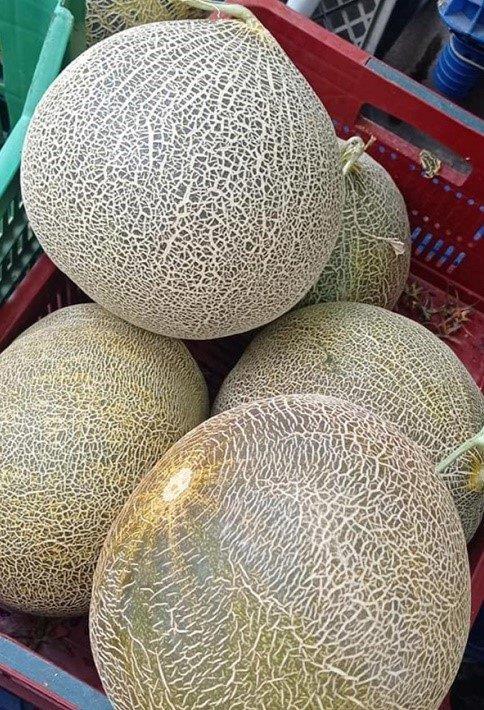
The Sındırgı Çıtır Kavun is derived from seeds of the seledyn variety. Hybrid seeds are not used, and seedling transplantation is avoided. The outer rind is thin, veined, and firm, which is why it is commonly referred to as “çıtır” (crisp). The rind color is a mixture of yellow and green. Its average diameter ranges between 10 and 15 cm. Its chemical composition includes a pH value of 5.7–6.3, total acidity of 0.07–0.1 g/100 g (expressed as citric acid), and soluble dry matter content of 9–9.42%.
The production process follows traditional methods specific to the region. After the first harvest, mature melons are selected and their seeds are stored in cloth bags under dark and cool conditions to be used as seed stock for the next season. This method is known as “bez süzme.”
Planting is completed by mid-May. After plowing the soil and creating furrows, 8 to 10 seeds are placed in each hole and covered with aged manure. Germination typically begins by the end of the first week, and seedlings emerge from the soil within 15 days. Subsequent weeks involve weeding, thinning, and intertillage. Flowering occurs in early July; irrigation may be required when temperatures exceed 35 °C.
Melons begin to ripen by the end of July, entering the maturation phase alongside fruit development. The first harvest occurs approximately 76 to 81 days after planting. Indicators of maturity include the formation of cracks on the underside and the shedding of fine hairs on the rind. Harvesting continues until the end of September, during which most of the produce is collected. Plants remaining after September may show signs of rot, locally called “kül.” After harvest, melons can be stored for up to one month in cool, shaded environments. They are not suitable for long-term storage.
The production and marketing of the product are monitored by a three-member oversight committee established under the coordination of the Sındırgı Municipality. The committee includes experts from the municipality, the district directorate of agriculture, and the local agricultural development cooperative. Inspections are conducted at least once per year, with additional checks carried out as needed or upon complaint.
During inspections, the suitability of seed stock, adherence to production methods, the physical and chemical properties of the product, and the correct use of the geographical origin emblem are evaluated. In necessary cases, expert support may be obtained from public or private institutions.
Turk Patent and Trademark Office. *Sındırgı Çıtır Kavun: Coğrafi İşaret Sicil Belgesi*. Turk Patent and Trademark Office. Accessed October 19, 2025. https://ci.turkpatent.gov.tr/Files/GeographicalSigns/e823c7e0-4dba-4782-9335-52ead2d3d3b0.pdf.
Turkish Patent and Trademark Office. "Sındırgı Çıtır Kavun." *Geographical Indications Portal.* Accessed October 19, 2025. https://ci.turkpatent.gov.tr/cografi-isaretler/detay/3194.

Type of Geographical İndication | Origin Name | ||||||||
|---|---|---|---|---|---|---|---|---|---|
Registration Number | 1491 | ||||||||
Registration Date | 30.10.2023 | ||||||||
Product / Product Group(s) | Processed and unprocessed fruits vegetables and mushrooms | ||||||||
Province(s) | Balıkesir | ||||||||
Applicant/Registrant(s) | Sındırgı Municipality | ||||||||
No Discussion Added Yet
Start discussion for "Sındırgı crisp melon" article
Origin and Growing Area
Botanical Characteristics
Traditional Production Process
Monitoring and Protection