This article was automatically translated from the original Turkish version.
+1 More
Product / Product Group(s) | Tahini / Other | ||||||||
|---|---|---|---|---|---|---|---|---|---|
Geographical Indication Type(s) | Mahreç mark | ||||||||
Applicant/Registrant(s) | Şırnak Provincial Directorate of Agriculture and Forestry | ||||||||
Geographical Boundary | Kumçatı Village Şırnak Province Central District | ||||||||
Production Characteristic | Grinding in a water-powered stone mill, roasting in a special stone quarry, no additives | ||||||||
Shelf Life | Approximately 2 years at room temperature | ||||||||
Şırnak Dergul Tahini has been registered as a geographical indication under Law No. 6769 on Industrial Property. The registering authority is the Şırnak Provincial Directorate of Agriculture and Forestry, with the registration date being 29 August 2023 (Registration No: 1460). The product is produced within the boundaries of the Kumçatı Village in the central district of Şırnak, and bears the geographical indication emblem along with the label “Şırnak Dergul Tahini” on its packaging or directly on the product.
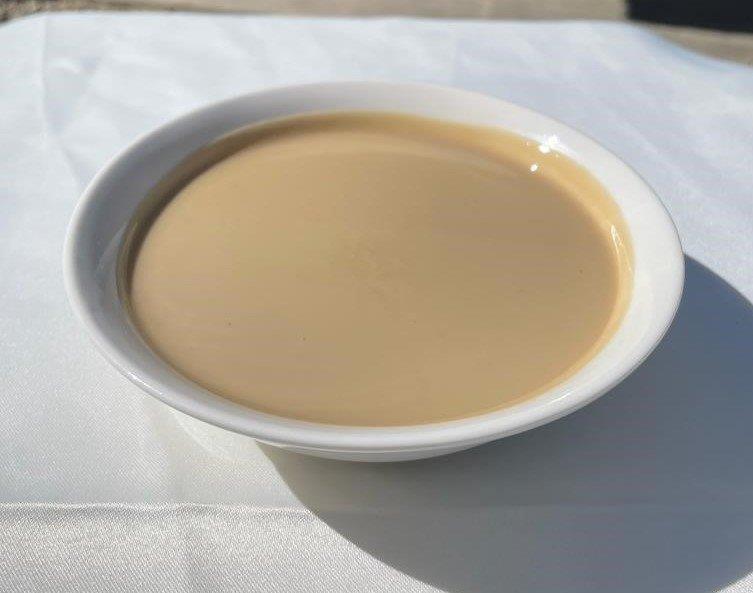
Şırnak Dergul Tahini (Turkish Patent and Trademark Office)
Şırnak Dergul Tahini is a traditional tahini made by harvesting, drying, dehulling, roasting in stone ovens, and grinding in stone mills. Only water-powered mills are used in production; electric mills are avoided because the friction heat they generate can impart a burnt taste to the tahini. The grinding stones are sourced from local rocks and prepared to ensure safe contact with food.
Since no additives or sweeteners are used, the tahini retains the natural aroma of sesame. It has a dirty white color and a fluid, homogeneous texture, derived from lightly roasted sesame. Unlike other types of tahini, the oil is uniformly distributed throughout the product; no oil separation or sediment formation at the bottom is observed.
Kumçatı Village, formerly known as Dergul, has a long-standing tradition of tahini production. Numerous water-powered mills were established in the area due to the presence of local streams, and water power has been used for production for generations.
Three historic water mills within the geographical boundary continue to ensure the continuity of production. During the production season, tahini is manufactured around the clock in four shifts, with each water mill capable of producing 10–15 kg of tahini per hour. The original methods and the skilled craftsmanship required in the roasting and grinding processes reinforce the product’s strong link to its geographical origin.
Sesame is cultivated in alluvial soils within the geographical boundary and harvested at the end of the planting season. After being cut from the soil, the plants are dried for 4–7 days, after which the fruit capsules open. The sesame seeds are then sun-dried for 3–6 hours, cleaned of husks and impurities, and passed through wire sieves. The dehulled seeds are soaked in water at ambient temperature and beaten with wooden mallets to separate the shells, followed by an additional 1–2 days of sun drying.
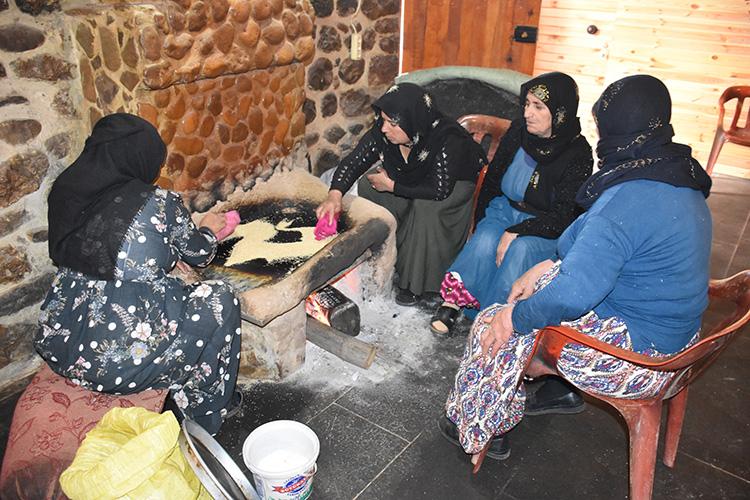
Roasting is carried out in specially constructed stone ovens within the geographical boundary. The sesame seeds are stirred continuously on stone slabs until they attain a golden, glossy hue, then ground in water-powered mills. The mill rotates at 250–300 revolutions per minute and has a grinding capacity of 10–15 kg of sesame per hour. The tahini is portioned into food-grade plastic or glass jars and can be stored at ambient temperature for approximately two years.
The production process of Şırnak Dergul Tahini is monitored under the coordination of the registering authority and the Şırnak University Laboratory. Inspections cover the use of sesame grown within the geographical boundary, the appropriateness of roasting and grinding methods, and compliance of product characteristics with established standards. Proper use of the geographical indication emblem and product labeling is strictly enforced. The monitoring authority may seek support from expert personnel when necessary and carries out legal procedures as required.
Anadolu Ajansı. “Şırnak’ta 154 Yıllık Değirmende Günde 400 Kilogram Tescilli Dergul Tahini Üretiliyor.” AA, July 1, 2023. Accessed August 16, 2025. https://www.aa.com.tr/tr/ekonomi/sirnakta-154-yillik-degirmende-gunde-400-kilogram-tescilli-dergul-tahini-uretiliyor/3136995
Turkish Patent and Trademark Office. "Şırnak Dergul Tahini Coğrafi İşaret Dosyası." PDF. Accessed August 16, 2025. https://ci.turkpatent.gov.tr/Files/GeographicalSigns/5322c58a-805d-4778-90f7-abb3416c4298.pdf
Turkish Patent and Trademark Office. "Şırnak Dergul Tahini – Coğrafi İşaret Detay." Accessed August 16, 2025. https://ci.turkpatent.gov.tr/cografi-isaretler/detay/7585

Product / Product Group(s) | Tahini / Other | ||||||||
|---|---|---|---|---|---|---|---|---|---|
Geographical Indication Type(s) | Mahreç mark | ||||||||
Applicant/Registrant(s) | Şırnak Provincial Directorate of Agriculture and Forestry | ||||||||
Geographical Boundary | Kumçatı Village Şırnak Province Central District | ||||||||
Production Characteristic | Grinding in a water-powered stone mill, roasting in a special stone quarry, no additives | ||||||||
Shelf Life | Approximately 2 years at room temperature | ||||||||
No Discussion Added Yet
Start discussion for "Şırnak Dergul Tahini" article
Product Description and Distinctive Characteristics
Chemical and Physical Properties
History and Geographical Link
Production Method
Monitoring and Quality Control