


This article was automatically translated from the original Turkish version.
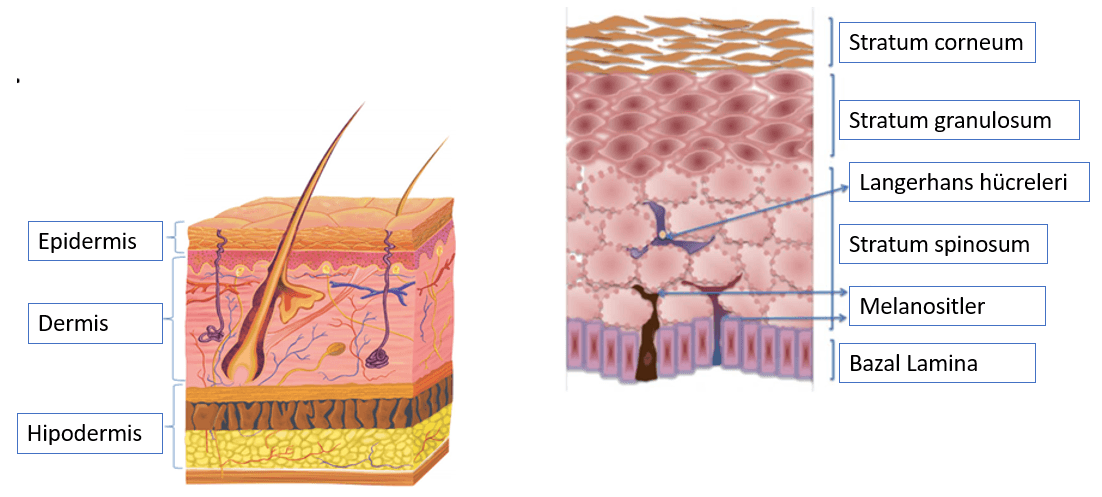
The skin, which completely covers our body and is the largest organ, is in constant interaction with the environment interaction. Its primary function is to act as a barrier against chemical and physical influences ultraviolet (UV) radiation and microorganisms. In addition row, the skin prevents excessive water loss and maintains hemostatic balance. Trauma it is capable of self-renewal.
It consists of three layers: the epidermis, dermis and hypodermis. The epidermis is the outermost layer composed of a multilayered squamous epithelium primarily made up of keratinocytes. The dermis is the middle layer formed of amorphous vine tissue containing collagen, nerve and vascular networks, epidermal extensions, fibroblasts, macrophages and mast cells. The hypodermis or subcutaneous tissue is an endocrine organ composed of collagen and blood vessels.
The epidermis is a multilayered squamous epithelial layer forming the outermost part of the skin. It consists of keratinocytes melanocytes and Langerhans cells. Keratinocytes perform mechanical functions melanocytes contribute to skin pigmentation and Langerhans cells are involved in immune responses. Keratinocytes are the dominant cells continuously produced in the basal lamina of the epidermis. As they differentiate they form the stratum corneum stratum granulosum and stratum spinosum layers above the basal lamina. The stratum corneum is the outermost layer of the epidermis and serves as the primary functional water barrier. The stratum spinosum is the inner layer and influences the power and elasticity of the skin. It also contains Langerhans cells which are dendritic cells.
The dermis is a connective tissue system containing numerous cell types including nerve and vascular networks epidermal extensions fibroblasts macrophages and mast cells such as. The dermis constitutes the major portion of the skin and affects its flexibility elasticity and tensile strength. It protects the body from mechanical injury retains water aids in thermal regulation and contains receptors for sensory stimuli.
The hypodermis composed of lipocytes is well vascularized. It plays a role in thermal insulation and also serves as a nutrient reservoir.
Anonim. "Science of skin." Accessed December 1, 2023. Science of the skin – Dermel Skin care (dermel-lb.com)
Gilaberte, Y., Prieto-Torres, L., Pastushenko, I., and Juarranz, Á. (2016). Anatomy and Function of the Skin. In Nanoscience in dermatology (pp. 1-14). Academic Press.
Güder, H., 2021, Derinin Yapısı ve Fonksiyonları, Deri ve Travma Kitabı
Honari, G., Skin Structure and Function, Sensitive Skin Seyndrome kitabı.
Kolarsick, P. A., Kolarsick, M. A., and Goodwin, C. (2011). Anatomy and physiology of the skin. Journal of the Dermatology Nurses' Association, 3(4), 203-213.

No Discussion Added Yet
Start discussion for "Skin Structure and Function" article
Epidermis
Dermis
Hypodermis