

This article was automatically translated from the original Turkish version.
Subject(s) | The Zong Massacre and the Power of Nature | ||||||||
|---|---|---|---|---|---|---|---|---|---|
Dimension(s) | 90.8 cm × 122.6 cm | ||||||||
Technique | Oil on canvas | ||||||||
Year of Production | 1840 | ||||||||
Artist | Joseph Mallord William Turner (1775–1851) | ||||||||
Location | Museum of Fine Arts Boston (MFA) | ||||||||
Slave Ship is a painting created in 1840 by the English artist Joseph Mallord William Turner. The work was executed in oil on canvas and measures 90.8 cm × 122.6 cm. The painting is currently part of the collection of the Museum of Fine Arts Boston, where it is on display.【1】
Turner, Slave Ship - Smarthistory
Joseph Mallord William Turner (1775–1851) is one of the most significant figures in British painting. He served for many years as Professor of Perspective at the Royal Academy.【2】 Turner is renowned for his paintings associated with seascapes, natural phenomena, and historical narratives. His emphasis on color and his ability to highlight atmospheric effects in depictions of nature are defining features of his work. Slave Ship is one of Turner’s works that unites a historical event with a natural landscape and is regarded as a masterpiece from his mature period.【3】
The historical background of the painting is linked to the Zong Massacre of 1781. The captain of the British slave ship Zong ordered that 133 enslaved people on board be thrown overboard.【5】 The act was justified by claims of a shortage of drinking water aboard the ship.【7】

Slave Ship - Flickr
At the time, commercial practices allowed insurance claims to be filed for enslaved people “lost at sea.” As a result, the throwing of enslaved people overboard was treated as an economic decision. After the incident, the ship’s owners filed a claim for compensation with the insurance company, and the matter proceeded to legal proceedings.【9】
The Zong Massacre had a significant impact on the abolitionist movement by bringing the brutal realities of the slave trade into public view.
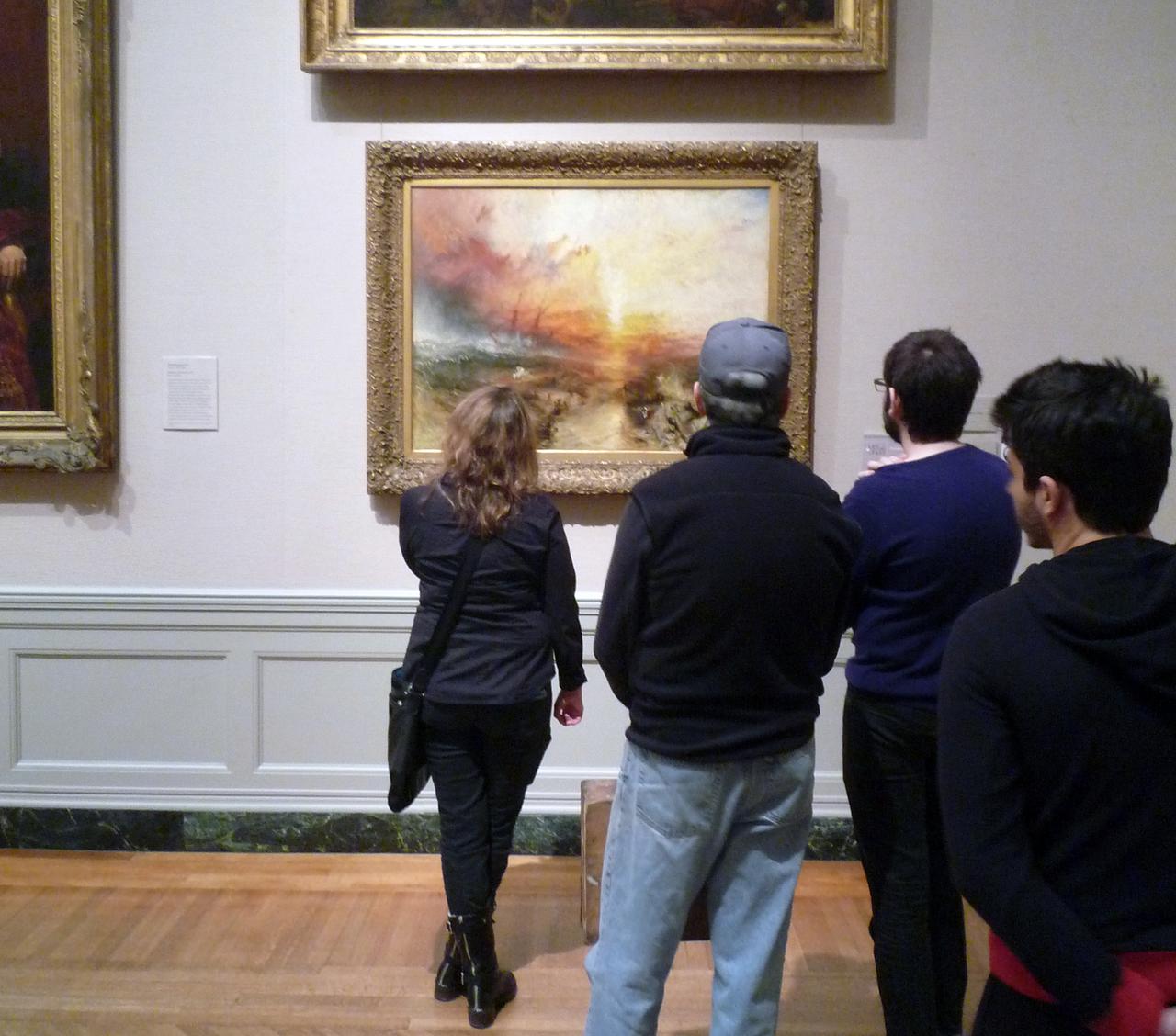
Slave Ship depicts a ship advancing through a stormy sea. The vessel appears in the background, near the horizon. The sea surface is turbulent, and the sky is filled with dark red, orange, purple, and yellow tones. The sunset dominates a large portion of the painting.

Detail of metal shackles and chains still attached to wrists, visible above the water. - Flickr

Bodies of enslaved people thrown into the sea, with shackled limbs and surrounding fish and birds. - Flickr
In the foreground, numerous human bodies are visible in the water. Chains bind arms, legs, and body parts, which appear either on the surface or just beneath it. The chains and dark skin tones clearly identify these figures as enslaved people. Marine life, particularly fish, is depicted converging toward these remains. Birds are also present in the sky and on the water’s surface.
There is a distinct spatial separation in the composition between the ship and the figures in the foreground. While the ship continues its course, the enslaved people thrown into the sea occupy the area closest to the viewer. This arrangement creates a visual structure with two separate planes.
The painting was executed in oil on canvas. Turner employed a form of modeling based on color transitions rather than distinct, sharp outlines. Waves, sky, sun, and figures are defined not by clear contours but by dense brushstrokes and areas of color. In contrast, the ship’s masts and chains are rendered with more defined lines.

View of the Ship - Flickr
These elements emerge as identifiable structural components within the composition. The color palette consists primarily of red, orange, purple, blue, and brown tones. Darker hues dominate the sea surface, while the sky features bright, intense colors.
Throughout the painting, horizontal and vertical divisions of color are striking. The light of the sunset visually segments the composition and directs the viewer’s gaze across different areas.
Slave Ship was first exhibited in 1840 at the Royal Academy in London.【11】 The exhibition date coincides with international abolitionist meetings held in London that same year.【12】
Turner presented the painting in tandem with these abolitionist gatherings. One of its earliest owners was the art critic John Ruskin.【13】 Later, through a collection associated with abolitionist circles in the United States, the painting was transferred to Boston. It is now part of the collection of the Museum of Fine Arts Boston.
Landay, Lori, and Beth Harris. "J. M. W. Turner, Slave Ship." Smarthistory. Accessed March 29, 2026. https://smarthistory.org/j-m-w-turner-slave-ship/
Museum of Fine Arts Boston. "Slave Ship (Slavers Throwing Overboard the Dead and Dying, Typhoon Coming On)." MFA Boston. Accessed March 29, 2026. https://collections.mfa.org/objects/31102/slave-ship-slavers-throwing-overboard-thedead-and-dying-t
Smarthistory. "Turner, Slave Ship." YouTube, 4:02. December 18, 2012. Accessed March 29, 2026. https://www.youtube.com/watch?v=NoCW80MEGXY
Temiz, Begüm. "Sıradışı Yaşamlar Serisi: Işığın Ressamı J. M. William Turner." *Söylenti Dergi.* Accessed March 29, 2026. https://www.soylentidergi.com/siradisi-yasamlar-serisi-isigin-ressami-j-m-william-turner/
Victorian Web. "Turner's Slave Ship and the Aesthetics of the Sublime." victorianweb.org. Accessed March 29, 2026. https://victorianweb.org/art/crisis/crisis4e.html
Zucker, Steven. "JMW Turner, Slave Ship, detail of ship." Flickr. Accessed March 29, 2026. https://flic.kr/p/dBZLG5
Zucker, Steven. "JMW Turner, Slave Ship, detail with chains." Flickr. Accessed March 29, 2026. https://flic.kr/p/dBUmRM
Zucker, Steven. "JMW Turner, Slave Ship, detail with chains." Flickr. Accessed March 29, 2026. https://flic.kr/p/dBUmnx
Zucker, Steven. "JMW Turner, Slave Ship, viewers." Flickr. Accessed March 29, 2026. https://flic.kr/p/dBZNgj
Zucker, Steven. "JMW Turner, Slave Ship." Flickr. Accessed March 29, 2026. https://flic.kr/p/dBZLry
[1]
Museum of Fine Arts Boston, "Slave Ship (Slavers Throwing Overboard the Dead and Dying, Typhoon Coming On)," MFA Boston, Access date: 29 March 2026, https://collections.mfa.org/objects/31102/slave-ship-slavers-throwing-overboard-thedead-and-dying-t
[2]
Begüm Temiz, "Sıradışı Yaşamlar Serisi: Işığın Ressamı J. M. William Turner," Söylenti Dergi, Access date: 29 March 2026, https://www.soylentidergi.com/siradisi-yasamlar-serisi-isigin-ressami-j-m-william-turner/
[3]
Lori Landay, Beth Harris, "J. M. W. Turner, Slave Ship," Smarthistory, Access date: 29 March 2026, https://smarthistory.org/j-m-w-turner-slave-ship/
[5]
Begüm Temiz, "Sıradışı Yaşamlar Serisi: Işığın Ressamı J. M. William Turner," Söylenti Dergi, Access date: 29 March 2026, https://www.soylentidergi.com/siradisi-yasamlar-serisi-isigin-ressami-j-m-william-turner/
[7]
Victorian Web, "Turner's Slave Ship and the Aesthetics of the Sublime," victorianweb.org, Access date: 29 March 2026, https://victorianweb.org/art/crisis/crisis4e.html
[9]
Lori Landay, Beth Harris, "J. M. W. Turner, Slave Ship,"
[11]
Museum of Fine Arts Boston, "Slave Ship (Slavers Throwing Overboard the Dead and Dying, Typhoon Coming On),"
[12]
Lori Landay, Beth Harris, "J. M. W. Turner, Slave Ship,"
[13]
Museum of Fine Arts Boston, "Slave Ship (Slavers Throwing Overboard the Dead and Dying, Typhoon Coming On),"

Subject(s) | The Zong Massacre and the Power of Nature | ||||||||
|---|---|---|---|---|---|---|---|---|---|
Dimension(s) | 90.8 cm × 122.6 cm | ||||||||
Technique | Oil on canvas | ||||||||
Year of Production | 1840 | ||||||||
Artist | Joseph Mallord William Turner (1775–1851) | ||||||||
Location | Museum of Fine Arts Boston (MFA) | ||||||||
No Discussion Added Yet
Start discussion for "Slave Ship (Painting)" article
The Artist
Historical Context
Subject and Description
Technical and Formal Characteristics
Exhibition and Collection History