


This article was automatically translated from the original Turkish version.
+1 More
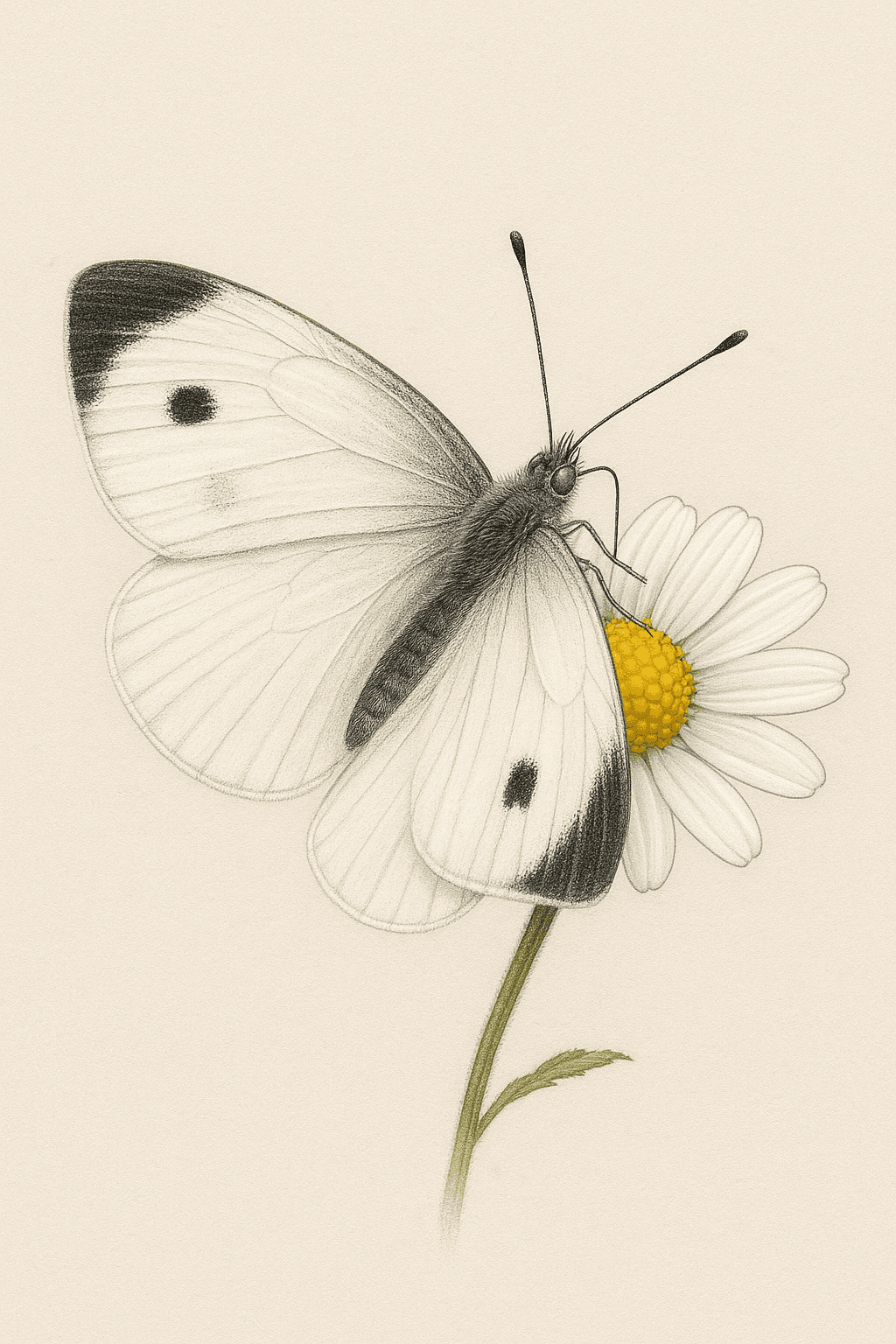
Small White Butterfly (Pieris rapae) (generated by artificial intelligence)
Taxon | Lepidoptera | ||||||||
|---|---|---|---|---|---|---|---|---|---|
Family | Pieridae | ||||||||
Genus | Pieris | ||||||||
Distribution(s) | Europe Australia and New Zealand North America Asia | ||||||||
Conservation Status | IUCN Least Concern (LC) category | ||||||||
The Small White (Pieris rapae) is a small butterfly species belonging to the Pieridae family and is widely distributed across the globe. Recognized by its delicate white wings and black markings, this species is considered a significant agricultural pest due to its larvae, which feed primarily on cabbage and other brassicas.
Adults have a wingspan ranging from 3 to 4.5 cm. The wings are typically white, with black markings on the tips of the forewings. Females have a greater number of these black spots, a feature used to distinguish sex. The hindwings may be white or pale yellow. The body is slender and gray-black, covered in scales. The antennae terminate in a club-shaped tip.
Larvae (caterpillars) are green with yellowish stripes along their sides. Their bodies are covered with fine hairs. The pupal stage is yellowish-green and is commonly found attached to plant stems or leaves.
Küçük Beyaz Melek is found on nearly all continents, including Europe, Asia, North America, Australia, and New Zealand. Human activities, particularly the transport of agricultural products, have facilitated its spread to various regions worldwide. It is also commonly observed in Türkiye.
This species prefers open areas, agricultural fields, gardens, road verges, and meadows. It is frequently observed in areas where nectar-producing flowers are abundant.
The life cycle consists of four stages: egg, larva (caterpillar), pupa, and adult.
This species can produce multiple generations per year. In temperate climates, it typically produces two to three generations; in tropical and subtropical regions, it may produce more.
Küçük Beyaz Melek plays both harmful and beneficial roles in ecosystems. While adult butterflies assist in the pollination of many plant species, their larvae are a major agricultural pest. They cause leaf loss and reduced yields in crops such as cabbage, cauliflower, broccoli, turnip, and mustard—all members of the Brassicaceae family. For this reason, it is commonly known as the “cabbage white” among agricultural pests.
Integrated Pest Management (IPM) strategies are employed for its control. In biological control, parasitoid wasps such as Cotesia glomerata and other natural predators play a significant role. Additionally, biopesticides based on Bacillus thuringiensis (Bt) are used to manage caterpillar populations.
Küçük Beyaz Melek (Pieris rapae) can be mistaken for several other white and yellowish butterfly species:
Due to its wide distribution and high reproductive capacity, the species is not under any threat. It is classified as “Least Concern (LC)” by the IUCN.
Kingsolver, JG. "Feeding, growth, and the thermal environment of cabbage white caterpillars, *Pieris rapae* L." *Physiol Biochem Zool*. (2000): 73(5): 621-628.
Root, R. B., and Kareiva, P. M. "The search for resources by cabbage butterflies (*Pieris rapae*): ecological consequences and adaptive significance of Markovian movements in a patchy environment." *Ecology* 65, no. 1 (1984): 147–165. https://doi.org/10.2307/1939467

Small White Butterfly (Pieris rapae) (generated by artificial intelligence)
Taxon | Lepidoptera | ||||||||
|---|---|---|---|---|---|---|---|---|---|
Family | Pieridae | ||||||||
Genus | Pieris | ||||||||
Distribution(s) | Europe Australia and New Zealand North America Asia | ||||||||
Conservation Status | IUCN Least Concern (LC) category | ||||||||
No Discussion Added Yet
Start discussion for "Small White Butterfly (Pieris rapae)" article
Morphological Characteristics
Distribution and Habitat
Life Cycle and Behavior
Ecological and Economic Importance
Confused Species
Conservation Status