


This article was automatically translated from the original Turkish version.
+1 More
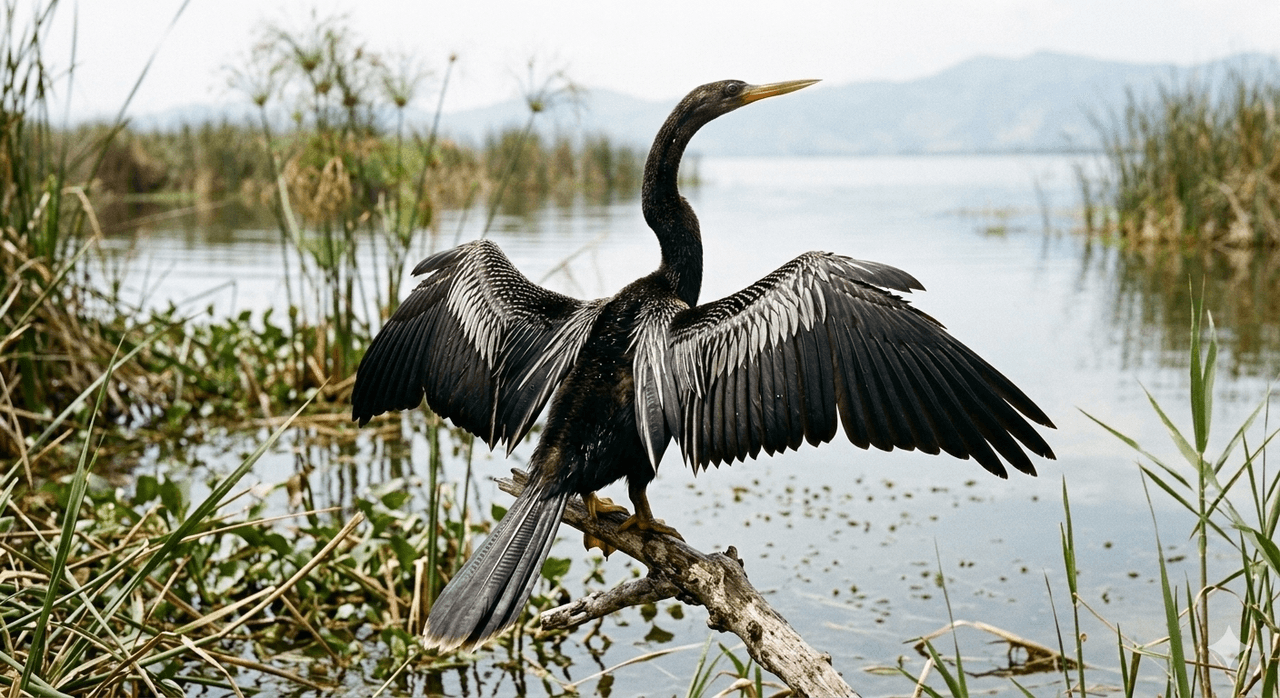
Yılanboyun Kuşu
(Yapay Zeka ile Oluşturulmuştur)
Anhinga (Anhinga rufa) is a specialized aquatic bird species of tropical and subtropical origin belonging to the family Anhingidae. It is characterized by its slender, elongated neck which, when hunting in water, gives it a snake-like appearance. The bird derives its name from the fact that while submerged in water to hunt, only its neck and head remain visible above the surface. Although morphologically related to cormorants, it is distinguished by its spear-like bill and unique hunting technique. This species, once distributed across sub-Saharan Africa, Mesopotamia (Iraq), and historically in Türkiye, is considered one of the most important indicator species for ecological balance in shallow water habitats. The only known resident and breeding population in Türkiye was found in Lake Amik in Hatay Province; however, with the draining of the lake, the species’ presence in Türkiye has been completely eradicated.

Anhinga (Anhinga rufa)
(Generated by Artificial Intelligence)
The anhinga is a large waterbird reaching lengths of 80 to 90 cm and a wingspan of up to 120 cm. Its body is covered in dark plumage; males display silvery wing patches and distinct coloration around the neck, while females and juveniles exhibit paler brown tones. Its most distinctive feature is its highly specialized, sharply pointed, and straight bill, evolved for spearing fish underwater. The cervical vertebrae possess a unique S-shaped joint structure that enables the bird to thrust its bill forward with great speed.
Taxonomically, the populations found in the Middle East and Türkiye are classified as the subspecies Anhinga rufa chantrei. This subspecies is geographically isolated from the main African population and has developed regional adaptations. The isolated group that once inhabited Lake Amik was regarded as one of the most unique bird populations in the world from a biological diversity perspective.
Anhingas prefer stagnant or slow-moving shallow freshwater habitats, including marshes surrounded by reeds and river deltas. These environments provide the necessary shallowness and cover for the bird’s hunting strategy.
The species is a highly specialized fish hunter. It glides silently underwater and impales its prey using its bill like a spear. It then surfaces to toss the fish into the air and swallows it headfirst. As a top predator in the food chain, its presence provides direct insight into the health of fish populations and water quality in its habitat.
The anhinga’s feathers are less oily than those of other waterbirds, making them more water-permeable to enhance diving efficiency. While this reduces drag underwater, it causes the feathers to become waterlogged after surfacing, necessitating drying. A typical behavior following a dive is for the bird to perch on a high branch, spread its wings wide, and face the sun to dry its plumage and regulate body temperature.
The history of the anhinga in Türkiye is inseparable from Lake Amik in Hatay Province. Until the 1950s, Lake Amik was one of the largest wetlands in the Middle East, hosting over 250 bird species, numerous endemic fish, and diverse aquatic life.
For the subspecies Anhinga rufa chantrei, this lake represented the northernmost breeding limit in the world. The birds nested in colonies within the lake’s extensive reed beds and submerged trees. Although population levels were recorded as healthy in early 20th-century surveys, rapid changes occurred due to agricultural interventions.
The extinction of the anhinga in Türkiye is one of the most concrete examples of how a species can be eliminated through the complete destruction of its habitat.
In 1954, the State Hydraulic Works (DSİ) launched the “Lake Amik Rehabilitation Project,” aiming to drain the lake and convert it into agricultural land. Massive drainage channels, constructed under the pretext of combating malaria and creating new cotton cultivation areas, connected to the Asi River, rapidly lowered the lake’s water level. By the mid-1970s, Lake Amik had completely dried up and was replaced by farmland.

Anhinga (Anhinga rufa)
(Generated by Artificial Intelligence)
With the drying of the lake, the fish stocks necessary for the anhinga’s survival and the reed beds required for nesting disappeared. Although breeding records still existed in the 1950s, the population declined rapidly during the 1960s, with the last confirmed breeding observation recorded between 1968 and 1970. No live anhinga has been observed within Türkiye’s borders since 1974. The species has been classified as “Extinct” (EX) at the national level.
The draining of Lake Amik did not only eliminate the anhinga population; it disrupted the entire regional biodiversity balance. With the collapse of the lake’s ecosystem, top predators and aquatic vertebrates were forced to abandon the area, leading to permanent shifts in local faunal composition. From a genetic diversity standpoint, the loss of locally adapted subspecies such as Anhinga rufa chantrei represents a narrowing of the species’ global gene pool and a reduction in its resilience to environmental change.
Today, the former bed of Lake Amik hosts Hatay Airport and intensive agricultural fields. Periodic major floods in the region demonstrate that the ecosystem’s hydrological memory remains intact and that water still tends to return to its former course.
Within the scientific community and nature conservation circles, proposals are being discussed to restore certain areas—such as Gölbasi Lake—using ecological restoration techniques and to reintroduce lost species like the anhinga. However, existing infrastructure investments and agricultural priorities continue to pose serious obstacles to the potential return of the anhinga to Türkiye.
The intensification of cotton and wheat farming on the former lakebed has led to massive inputs of pesticides and synthetic fertilizers into the region. The few aquatic bird and aquatic species that survived the lake’s drainage now face chemical pollution pressure. Agricultural runoff entering the aquatic ecosystem through drainage channels has caused bioaccumulation in the upper trophic levels, reducing reproductive success and further limiting any potential for the recovery of sensitive species like the anhinga.
The loss of the anhinga carries significant lessons for modern Türkiye’s environmental education and nature conservation literature. In academic studies and environmental panels, this species is symbolized as a victim of misguided drainage policies. Researchers who have followed the anhinga’s decline from the 1920s to the 2020s emphasize that this extinction was not merely the disappearance of a bird species, but also the loss of a region’s cultural and economic future—including traditional fishing and reed-weaving practices.
Adil Baktıaya. “Yılanboyun Kuşunun Peşinde: Kısa Ortadoğu Tarihi.” Kuşlar ve İnsanlar. Accessed March 10, 2026. https://www.academia.edu/108051081/Ku%C5%9Flar_ve_%C4%B0nsanlar_Y%C4%B1lanboyun_Ku%C5%9Funun_Pe%C5%9Finde_K%C4%B1sa_Ortado%C4%9Fu_Tarihi
Atilla Durmuş. Yaban Hayatı ve Biyolojik Çeşitlilik Kaybı. Ankara: Türkiye Bilimler Akademisi Yayınları. Accessed March 10, 2026. https://www.tuba.gov.tr/files/yayinlar/raporlar/TUBA-978-625-6110-01-4_ch08.pdf
Eken, Güven, Murat Bozdoğan, Süreyya İsfendiyaroğlu, Dicle Tuba Kılıç, and Yıldıray Lise, eds. Türkiye’nin Önemli Doğa Alanları. Production coordinator Gökmen Yalçın. Istanbul: Doğa Derneği, 2006. Accessed March 10, 2026. https://dogadernegi.org/wp-content/uploads/2015/09/01_ONYAZI_CILT_1.pdf
Hevra Kızılcokak, Dilan. "Ganos Dağı (Tekirdağ) Kuş Faunasının Araştırılması." Master's thesis, Namık Kemal University, Institute of Natural Sciences, 2017. Accessed March 10, 2026. https://acikerisim.nku.edu.tr/server/api/core/bitstreams/abc353c7-7a76-4cac-89ef-3bdad86d7c4c/content
Karataş, Avni. “Yılanboyun (Anhinga rufa) Anısına.” National Geographic Türkiye, March 2016, p. 16. Accessed March 10, 2026. https://www.academia.edu/23248914/Y%C4%B1lanboyun_Anhinga_rufa_An%C4%B1s%C4%B1na
T.C. Ministry of Agriculture and Forestry. General Directorate of Nature Conservation and National Parks Official Statistics and Publications. Publication No: 81. Ankara: DKMP, n.d. Accessed March 10, 2026. https://www.tarimorman.gov.tr/DKMP/Belgeler/dkmp%20resmi%20istatistik/kutuphane/81.pdf
Taşçı, Ahmet. "Anhinga rufa (Afrika Yılanboyunlusu)." Türkiye Yaban Hayatı Bilgi Sistemi. Accessed March 10, 2026. https://turkiyeyabanhayati.org/species/detail/anhinga-rufa-yilan-boyun

Yılanboyun Kuşu
(Yapay Zeka ile Oluşturulmuştur)
No Discussion Added Yet
Start discussion for "Snakebird (Anhinga rufa)" article
Physical Characteristics and Taxonomic Classification
Ecology and Behavioral Patterns
Hunting and Feeding
Thermoregulation
Lake Amik Ecosystem and the Türkiye Population
Habitat Loss and the Process of Extinction
Drainage Projects
Population Collapse
Regional Impacts of Biodiversity Loss
Current Risks and Restoration Discussions
Agricultural Chemical Use and Pollution Pressure
Symbolic Value in Education and Awareness Campaigns