


This article was automatically translated from the original Turkish version.
+1 More

Snow Crystal
Name(s) | Snow Crystal | ||||||||
|---|---|---|---|---|---|---|---|---|---|
Classification(s) | Hexagonal Ice Crystal (Hexagonal Ice – Ih phase) | ||||||||
Formation | Direct deposition of water vapor into solid state via sublimation | ||||||||
Basic Structure | Six-armed star-shaped structure | ||||||||
Nucleation | Heterogeneous nucleation around aerosol particles | ||||||||
Morphological Types | Column and needle shapes Dendritic stars Layered structure Hexagonal prism | ||||||||
Formation Conditions | Relative humidity: 70–100% Temperature range: -2°C to -22°C | ||||||||
Physical Properties | Low thermal conductivity High insulation Low density | ||||||||
Modern Applications | Water resources and ecosystem modeling Ice accretion analysis in aviation Radar meteorology Remote sensing | ||||||||
Snow crystals are structures formed by the delicate balance of atmospheric conditions. These crystals develop when water vapor directly transitions into a solid state through deposition. Microscopically characterized by their hexagonal symmetry, snow crystals are influenced not only by atmospheric temperature and humidity conditions but also by microscale environmental factors.
Studying these crystals is not merely an aesthetic curiosity; it holds critical importance in numerous fields such as atmospheric science, climate research, and even flight safety. Understanding the morphology of snow crystals contributes to more accurate modeling of climatic processes and improved forecasting of future weather events. Additionally, because snow crystals contain microscopic air bubbles, they serve as climate archives. For this reason, they play a significant role in ice core and paleoclimatology research.

Snow Crystal with Hexagonal Symmetry and Complex Branches (Generated by Artificial Intelligence.)
The fundamental structure of snow crystals is based on hexagonal symmetry. This structure arises from the polar nature of water molecules and their hydrogen bonding. Under specific temperature and pressure conditions, water molecules crystallize to form the basic skeleton of a snowflake. The primary reason for the hexagonal shape is that hydrogen bonds between water molecules adopt their most stable configuration during freezing. As a result, snow crystals typically exhibit a six-armed star shape.
However, the uniqueness of each crystal does not contradict this hexagonal symmetry. On the contrary, while each arm of the crystal begins under identical initial conditions, microscale fluctuations in temperature and humidity cause subtle differences to develop along the arms. These microvariations produce the distinctive uniqueness described as “no two snowflakes are alike.” Ultimately, each snowflake possesses both a universal geometry and an individual detail. The physical origin of this structure and its evolution under environmental influences remain important subjects of meteorological study.
The nucleation phase during crystal formation is of great importance. A snowflake begins to form around microscopic nuclei such as dust or salt particles suspended in the atmosphere. These nucleation sites influence the growth rate and direction of the crystal. Nucleation conditions explain the variations in size and shape among snow crystals. Thus, the growth process of a crystal is the cumulative result of microscale physical interactions. In this process, temperature, relative humidity, and air currents determine the symmetry and complexity of the crystal.
The hexagonal symmetry of crystals is a direct consequence of the internal structure of ice. Ice’s hexagonal (Ih) phase is the crystal structure water adopts when freezing under normal atmospheric conditions. This structure also determines the optical and mechanical properties of snow crystals. Phenomena such as light refraction and reflection are related to the crystal’s regular hexagonal prism arrangement. Therefore, snow crystals fall within the scope of interest not only for atmospheric sciences but also for optical engineering.
The diversity of snow crystals is a significant indicator of the complexity of atmospheric conditions. Research has shown that snow crystals can be classified into more than 80 distinct morphological types based on temperature and humidity conditions. This morphological variety enables more precise interpretation of meteorological data. Crystals generally appear in different forms such as hexagonal prisms, hexagonal plates, star-shaped dendrites, and columnar crystals. The formation of these types is tightly linked to the temperature and relative humidity during crystal growth.
Under low temperature and low relative humidity conditions, snow crystals typically form as simple prisms or columns. These crystals are common in drier and colder regions of the atmosphere. In contrast, when temperature rises slightly and relative humidity increases, more complex star-shaped dendrites develop. Dendritic structures rapidly grow by branching their hexagonal arms in response to the saturation level of water vapor in the air. Thus, the most visually studied types of snow crystals emerge.
Understanding snow crystal diversity provides valuable clues for analyzing climate conditions. For example, a high abundance of dendritic crystals indicates intense snowfall and high humidity. Conversely, snowflakes dominated by columnar or needle-shaped crystals signal drier and colder air masses. Therefore, microscopic examinations of snow crystals provide valuable information for weather forecasting and climate analysis. Modern meteorological stations are equipped with automated instruments capable of detecting this morphological diversity.
In the formation of morphological structures, the growth rate of the crystal is also a decisive factor. Differences in growth rate affect the final shape of snow crystals. For instance, rapidly growing crystals develop more branched and complex arms, while slowly growing crystals exhibit simpler and smoother structures. This growth rate is closely related to microscale air currents and temperature gradients in the atmosphere. Thus, even at the same temperature, different growth rates can produce distinctly different snow crystals.
The classification of snow crystals has been a field developed by scientists over many years. The famous Nakaya Diagram systematically categorizes crystal types according to temperature and relative humidity values. Developed by Japanese physicist Ukichiro Nakaya, this diagram has become a foundational reference in the study of snow crystal morphology. Thanks to this diagram, field-collected data can be easily compared with laboratory experiments.
The formation of snow crystals occurs through the direct transition of water vapor into a solid state, known as deposition. The most critical step in this process is nucleation. Microscopic particles in the atmosphere—such as dust, sea salt, or pollen aerosols—provide a surface for water vapor molecules to condense. These particles are called “nuclei” or “nucleation centers,” and crystal growth begins around them. Consequently, the concentration of particles in the atmosphere directly influences the number and size of snow crystals.
Nucleation can occur through two mechanisms: homogeneous and heterogeneous nucleation. Homogeneous nucleation involves the spontaneous clustering of pure water vapor molecules without any foreign surface. However, this occurs rarely under atmospheric conditions. Instead, heterogeneous nucleation is common, where atmospheric particles facilitate the condensation of water vapor. In this process, an ice crystal forms on the particle surface and grows by absorbing surrounding water vapor.
During crystal growth, temperature and relative humidity play the most critical roles. Temperature, in particular, determines the morphology of the growing crystal. For example, plate-like crystals typically form between -2°C and -10°C, while star-shaped dendritic structures appear between -10°C and -22°C. These temperature ranges determine which arms of the hexagonal crystal grow rapidly and which grow more slowly. Thus, the final shape of the crystal emerges from the combined effect of temperature and relative humidity.
Additionally, the chemical and physical properties of the nucleation center are important. Particles with hydrophilic surfaces facilitate water vapor condensation. Therefore, particles such as sea salt or clay minerals can initiate snow crystal formation more efficiently. The diversity of nucleation centers in the atmosphere leads to the formation of numerous distinct morphological types of snow crystals. This variety is directly linked to atmospheric chemistry and geophysical processes.
Once crystal growth is complete, the arms of the crystal develop highly complex structures at the microscopic level. Each arm is sensitive to small temperature fluctuations in the atmosphere, making every crystal unique. This uniqueness forms the scientific basis for the expression “no two snowflakes are alike.” In fact, this phrase reveals how sensitive and dynamic the crystal growth process truly is.
Snow crystals are not merely an aesthetic natural wonder; they are also a vital component of the complex puzzle of atmospheric and climatic dynamics. Snow crystals directly affect the Earth’s energy balance. As they fall to the surface, they create an albedo effect by reflecting sunlight, thereby reducing surface warming. Especially in polar regions and high latitudes, the presence of snow cover ensures that a significant portion of incoming solar energy is reflected back into space. This has a cooling effect on regional and global climates.
Suspended snow crystals in the atmosphere also influence cloud dynamics. Snow crystals formed within clouds interact with cloud droplets, helping to balance the cloud’s water content. In particular, in cold clouds, the nucleation and growth processes of snow crystals initiate precipitation formation. Therefore, snow crystals play a key role in regulating the atmospheric water cycle. Cloud microphysics studies focus on understanding how snow crystals contribute to this process and use this knowledge to improve weather forecasting models.
The contribution of snow crystals to the atmosphere is not limited to physical processes. Crystals also affect atmospheric chemistry. Chemical reactions occurring on the surface of ice crystals facilitate the transformation of certain atmospheric compounds. For instance, chemical reactions on ice crystals in the stratosphere play a significant role in ozone layer depletion. Such phenomena demonstrate that snow crystals are critical components not only for climate but also for atmospheric chemistry.
Even after reaching the Earth’s surface, snow crystals continue to influence climatic processes. Snow cover regulates soil temperature and evaporation. Particularly in spring and summer, the melting of snowpack has a decisive impact on local and regional water cycles. Meltwater from snow feeds river flows and holds economic importance for agriculture and hydropower production. Therefore, snow crystals and snow cover are considered important parameters in climate models.
The impact of snow crystals on climate change is also substantial. Due to global warming, the duration of snow cover is extending, and the atmospheric reflection effect (albedo) of snow crystals is weakening. This creates a feedback mechanism that accelerates temperature increases in polar regions. Climate scientists use modern technologies such as radar and satellite observations to understand the role of snow crystals in this feedback loop.
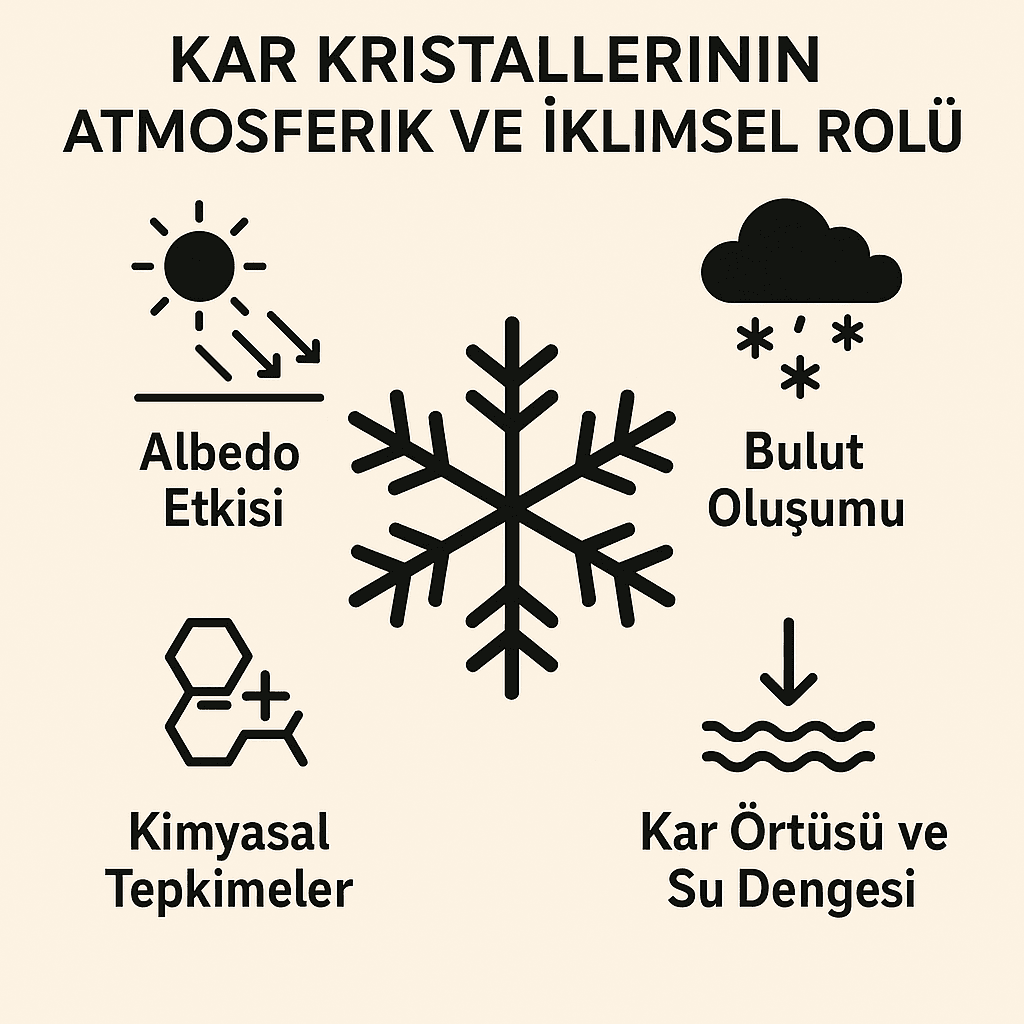
Atmospheric and Climatic Role of Snow Crystals (Generated by Artificial Intelligence.)
Snow crystals exert unique effects on the journey of light through the atmosphere and therefore play a significant role in understanding optical phenomena. The hexagonal symmetry of crystals determines optical events such as refraction and reflection. Particularly, atmospheric optical phenomena such as parhelia (sun dogs) and halos, which arise when sunlight interacts with snow crystals, are direct results of the physical properties of these crystals. These light displays occur because the prism-like structure of the crystal refracts light at specific angles. Thus, the optical properties of snow crystals are not only aesthetically significant but also scientifically important in atmospheric physics.
Laboratory experiments examining the optical properties of snow crystals demonstrate how light is refracted at different wavelengths. These experiments hold a fundamental place in optical meteorology research. Microscopic imperfections during crystal growth also affect the amount of light reflection and scattering. For example, tiny surface irregularities on crystal arms can cause irregular light scattering, resulting in a matte appearance of the snow crystal. Such optical characteristics also shape the albedo effect of snow on the Earth’s surface.
From a physical standpoint, the density and hardness of snow crystals vary depending on the temperature and relative humidity conditions under which they form. Snow crystals formed in colder and drier conditions are typically thinner and more fragile. In contrast, crystals growing at slightly higher temperatures are thicker and more durable. These properties are the main factors determining the density and persistence of snow cover. Snow thickness and hardness have critical implications for erosion processes, avalanche risk, and the role of snow in the water cycle.
The physical properties of snow crystals also influence environmental factors such as sound insulation. Sound waves falling on snow are absorbed within the air pockets between crystals, reducing echoes. As a result, snow cover creates an acoustically soft environment during winter months. Additionally, snow crystals have low thermal conductivity. This property reduces heat loss from the Earth’s surface, protecting subterranean life. Thus, snow crystals also serve as a protective insulating layer for ecosystems.
Snow crystals are also studied in the field of ice optics. The hexagonal symmetry and growth processes of crystals provide models for understanding the optical and physical behavior of ice. In particular, the internal structure of glaciers in polar regions forms as snow crystals compress over time into ice. This process contributes to the analysis of long-term climate records in geophysics and climate science. For example, ancient ice cores from Antarctic ice sheets are examined as records of how snow crystals have transformed over time.
Snow crystal physics holds an important place not only in fundamental atmospheric and climate sciences but also in various applied research fields. Modeling the formation and evolution of snow crystals is considered essential for improving the accuracy of weather forecasts. In particular, radar meteorology and satellite-based imaging technologies provide real-time data on the distribution, density, and morphology of snow crystals in the atmosphere, contributing to the development of short-term predictions. These advancements are critically important for anticipating disasters such as avalanches, floods, and transportation disruptions caused by sudden snowfall.
The optical and physical properties of snow crystals are also valuable in the context of remote sensing technologies. Surface properties of snow cover, such as albedo, can be monitored via satellites, and these data are integrated into climate change models. Such optical measurements are used not only to understand global climate systems but also for agricultural water management and hydrological cycle calculations. In this context, snow crystals have become a key research subject integrated into global warming and climate change studies beyond atmospheric science.
Experimental studies conducted in laboratory settings are also bringing new insights to the field of snow crystal physics. High-speed imaging systems and microscopic analysis techniques allow researchers to track crystal growth and melting stages with millisecond resolution, enabling quantitative analysis of how crystal morphology changes under physical conditions. These experimental data are converted into mathematical models, allowing numerical evaluations of how factors such as energy transfer, moisture content, and thermal balance influence crystal development. In climate-focused studies, these models are used particularly in the context of energy budgets during snow crystal formation and melting.
Research on snow crystals is also applied in engineering fields such as aviation and transportation. Models describing how crystals form under different temperature and humidity conditions provide critical technical data regarding ice accumulation on aircraft wings and associated aerodynamic performance losses. Therefore, physical models of snow crystal morphology are widely used in flight safety studies and are considered in industry regulations.
Finally, the impact of snow crystal dynamics on ecosystems is significant for environmental planning and natural resource management. The timing of snowmelt and the water input it provides to soil play a decisive role in vegetation renewal cycles and ecosystem water budgets. Therefore, data from snow crystal physics are used to develop predictive models in agriculture and integrated water resource management. Thus, snow crystals are not merely a meteorological phenomenon but are also regarded as a strategic research area in sustainable environmental and resource management.
Bailey, Matthew, and John Hallett. “Growth Rates and Habits of Ice Crystals between −20° and −70°C.” *Journal of the Atmospheric Sciences* 69, no. 12 (2012): 4601–4615. Accessed June 12, 2025. https://doi.org/10.1175/1520-0469(2004)061
Libbrecht, Kenneth G. “The Physics of Snow Crystals.” *Reports on Progress in Physics* 68, no. 4 (2005): 855–895. Accessed June 12, 2025. https://www.researchgate.net/publication/30759481_The_physics_of_snow_crystals
Libbrecht, Kenneth, Patricia Rasmussen, and Philippe M. Binder. "The Snowflake: Winter’s Secret Beauty." *American Journal of Physics* 72, no. 8 (2004): 1134–1143. Accessed June 12, 2025. https://pubs.aip.org/aapt/ajp/article-abstract/72/8/1134/529125/The-Snowflake-Winter-s-Secret-Beauty.
Nakaya, Ukichiro. *Snow Crystals: Natural and Artificial*. Cambridge, MA: Harvard University Press, 1954. Accessed June 12, 2025. https://doi.org/10.4159/harvard.9780674182769.c3.
Nelson, Jon. “Growth Mechanisms to Explain the Primary and Secondary Habits of Snow Crystals.” *Philosophical Magazine A* 81, no. 10 (2001): 2337–2373. Accessed June 12, 2025. https://doi.org/10.1080/01418610108217152.
Sturm, Matthew, Jon Holmgren, and Glen E. Liston. "A Seasonal Snow Cover Classification System for Local to Global Applications." *Journal of Climate* 8, no. 6 (1995): 1261–1283. Accessed June 12, 2025. https://journals.ametsoc.org/view/journals/clim/8/5/1520-0442_1995_008_1261_assccs_2_0_co_2.xml.


Snow Crystal
Name(s) | Snow Crystal | ||||||||
|---|---|---|---|---|---|---|---|---|---|
Classification(s) | Hexagonal Ice Crystal (Hexagonal Ice – Ih phase) | ||||||||
Formation | Direct deposition of water vapor into solid state via sublimation | ||||||||
Basic Structure | Six-armed star-shaped structure | ||||||||
Nucleation | Heterogeneous nucleation around aerosol particles | ||||||||
Morphological Types | Column and needle shapes Dendritic stars Layered structure Hexagonal prism | ||||||||
Formation Conditions | Relative humidity: 70–100% Temperature range: -2°C to -22°C | ||||||||
Physical Properties | Low thermal conductivity High insulation Low density | ||||||||
Modern Applications | Water resources and ecosystem modeling Ice accretion analysis in aviation Radar meteorology Remote sensing | ||||||||
Basic Features of Snow Crystal Structure
Types and Morphological Features of Snow Crystals
Formation Process and Nucleation Mechanisms of Snow Crystals
Atmospheric and Climatic Role of Snow Crystals
Optical and Physical Properties of Snow Crystals
Modern Research Areas and Applications of Snow Crystals