


This article was automatically translated from the original Turkish version.
+2 More
Chemical Solution
Definition(s) | A homogeneous mixture formed by two or more substances | ||||||||
|---|---|---|---|---|---|---|---|---|---|
Component(s) | Solvent and solute | ||||||||
Type(s) | Solid gas liquid | ||||||||
Example | Saltwater (dissolution of a solid in a liquid) | ||||||||
Fundamental Principle | Like dissolves like (polar-polar, nonpolar-nonpolar) | ||||||||
A solution is a homogeneous mixture formed when two or more pure substances are uniformly distributed within each other. Homogeneous mixtures are systems in which the components exhibit identical properties at every point and consist of a single phase. A solution fundamentally consists of two components: the substance present in greater quantity and responsible for the dissolving process is called the solvent (or dissolving medium), while the substance present in smaller quantity and dispersed within the solvent is called the solute. Dissolution is the process by which a substance is uniformly distributed in another substance as ions or molecules. Solutions are not limited to the liquid state; they can exist in solid, liquid, or gaseous phases. For example, the dissolution of salt in water forms a liquid solution, alloys formed by the combination of metals constitute a solid solution, and the mixture of gases in air is a gaseous solution.
In analytical chemistry, liquid solutions are the most commonly encountered type. These solutions are formed when a solid dissolves in a liquid, a liquid dissolves in another liquid, or a gas dissolves in a liquid. One fundamental principle of dissolution is the “like dissolves like” rule. According to this principle, polar substances dissolve better in polar solvents, while nonpolar substances dissolve better in nonpolar solvents. For instance, alcohol, a polar molecule, dissolves readily in water, another polar solvent, whereas benzene, a nonpolar molecule, does not dissolve in water. Water is regarded as a universal solvent for polar compounds.
Dissolution is the process by which particles of the solute (molecules or ions) are surrounded by solvent particles and dispersed uniformly throughout the mixture. This process depends on molecular interactions between solute and solvent molecules. Forces such as electrostatic interactions, hydrogen bonds, and van der Waals forces form the basis of these interactions. From a thermodynamic perspective, whether a dissolution process occurs spontaneously is determined by the change in Gibbs free energy (ΔG). If ΔG has a negative value, the dissolution process is thermodynamically spontaneous and occurs naturally.
Solubility refers to the maximum amount of a substance that can dissolve in a specific quantity of solvent at a given temperature and pressure. The solubility of a substance is not a fixed value; it varies depending on factors such as temperature, pressure, and the chemical nature of the substances involved. Generally, the solubility of solids in liquids increases with rising temperature, while the solubility of gases in liquids decreases with increasing temperature and increases with increasing pressure. This phenomenon can be observed in carbonated beverages, which contain more carbon dioxide gas when cold and release gas when opened due to the drop in pressure.
Solutions can be classified into various categories based on their chemical composition, physical properties, and electrical behavior. These classifications are made according to the physical state of the solvent, the amount of solute, and the solution’s ability to conduct electric current. Each classification provides an important framework for understanding the nature of solutions and analyzing different chemical systems.
The physical state of the solvent is one of the fundamental factors determining the overall character of a solution. Accordingly, solutions can exist in solid, liquid, or gaseous states.
In this type of solution, the solvent is in the solid phase. These typically include alloys formed by the combination of metallic elements. For example, steel, formed by iron and carbon, and brass, formed by copper and zinc, are examples of solid solutions. These structures are of significant importance in materials science and industrial applications.
This is the most commonly encountered type of solution in daily life. In systems where the solvent is liquid, the solute can be solid (e.g., saltwater), liquid (e.g., alcoholic water), or gas (e.g., carbon dioxide in soda). These solutions are widely used in both biological and industrial processes.
These are systems in which both the solvent and the solute are in the gaseous state. The atmosphere is a natural example of such a solution. The air we breathe is a homogeneous mixture of nitrogen, oxygen, carbon dioxide, and other gases, forming a gaseous solution.
Based on the amount of solute, solutions are classified into three categories: unsaturated, saturated, and supersaturated. This classification indicates the saturation state of the solution and the solvent’s dissolving capacity.
In these solutions, the amount of solute is less than the maximum amount the solvent can dissolve under specific temperature and pressure conditions. Therefore, additional solute can be added and will continue to dissolve.
A solution becomes saturated when the solvent contains the maximum amount of solute it can dissolve. At this point, a dynamic equilibrium is established between dissolution and precipitation; the rate at which solute dissolves equals the rate at which it precipitates.
Under certain special conditions, a solvent can hold more solute than it normally could. Such solutions are unstable and sensitive to external influences. A sudden change in temperature or physical disturbance can cause the excess solute to precipitate, returning the solution to a saturated state. Additionally, solutions can be classified as dilute or concentrated based on the amount of solute. Dilute solutions contain a small amount of solute per unit volume, while concentrated solutions contain a large amount. These terms are relative and are typically used when comparing two solutions.
The ability of solutions to conduct electric current depends on whether the dissolved substances dissociate into ions. In this context, solutions are divided into two main categories: electrolytic and nonelectrolytic solutions.
These solutions contain substances that dissociate into ions when dissolved in water. Acids, bases, and salts belong to this group. For example, sodium chloride (NaCl) dissociates into Na⁺ and Cl⁻ ions when added to water, enabling the solution to conduct electric current. Electrolytic solutions have important applications in fields such as electrochemistry, biology, and energy technologies.
These solutions contain substances that do not ionize upon dissolution and retain their molecular structure. Covalent compounds such as sugar and alcohol do not produce free ions when dissolved in water. Consequently, they do not exhibit electrical conductivity. Nonelectrolytic solutions are commonly used in the food and pharmaceutical industries as stable solution systems.

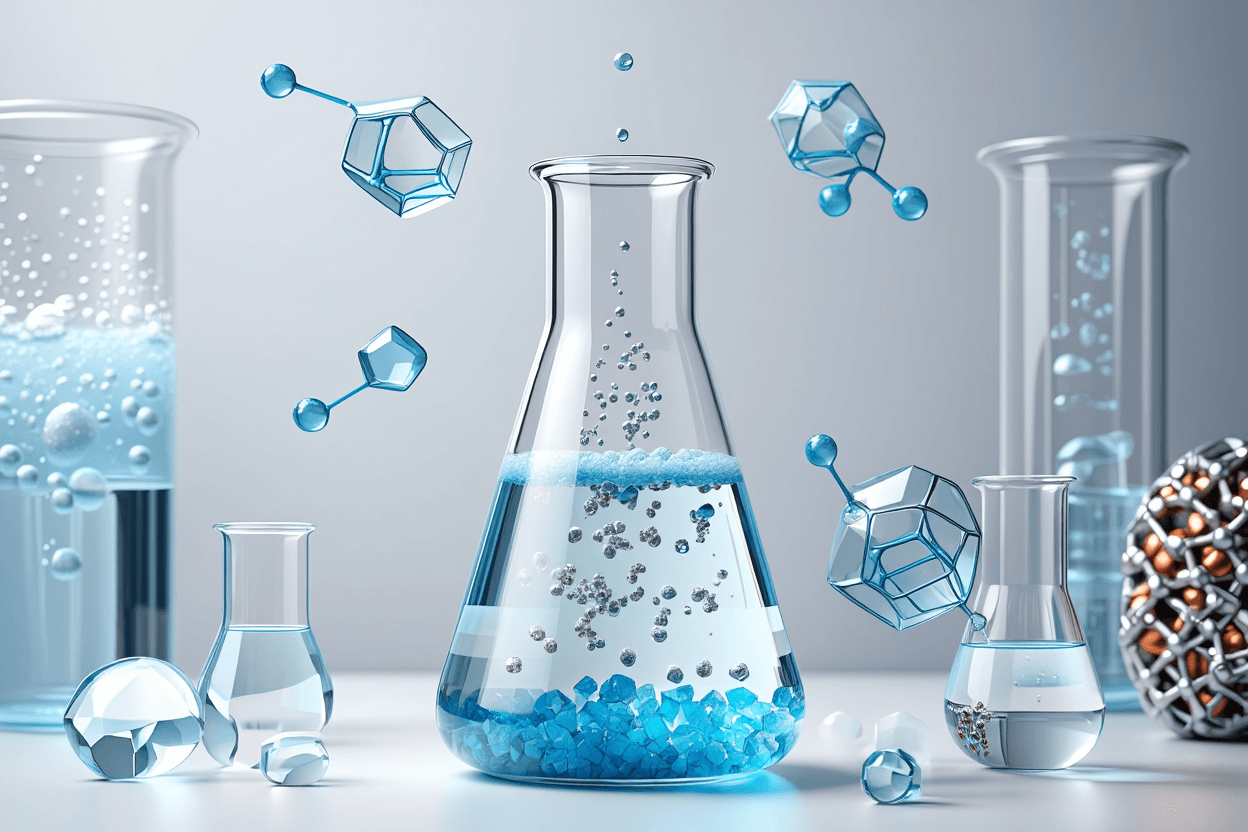
Solutions (Generated by Artificial Intelligence.)
Solid solutions are structural systems formed when atoms of two or more elements combine homogeneously in the solid phase. The key characteristic of such solutions is that the system remains a single phase when the solute element is added to the solvent, without disrupting the solvent’s crystal structure. In other words, solute atoms occupy positions within the crystal lattice while preserving the orderly structure of the solvent; in this respect, solid solutions differ from chemical compounds. Solid solutions are divided into two main subtypes based on how solute atoms are positioned within the crystal structure:
In this type of solution, atoms of the solute element replace atoms of the solvent in its crystal lattice. In other words, solute and solvent atoms occupy the same lattice sites. For such an arrangement to occur, certain fundamental conditions must be met:
When these conditions are satisfied, solute atoms can readily integrate into the crystal lattice, forming a homogeneous solution. An alloy formed between copper (Cu) and nickel (Ni) is a classic example of a substitutional solid solution. Both metals have FCC structures and very similar atomic properties, allowing them to mix completely.
In interstitial solid solutions, atoms of the solute element occupy the interstitial spaces—gaps between atoms—in the solvent’s crystal lattice. For such a solution to form, the solute atoms must be significantly smaller than the solvent atoms. These solutions are typically formed with nonmetallic elements of small atomic radius.
Elements such as carbon (C), hydrogen (H), nitrogen (N), and oxygen (O) can form interstitial solid solutions with transition metals such as iron (Fe). These interactions are particularly important in metallurgy and materials science. For example, carbon in steel occupies interstitial sites within the iron crystal lattice, significantly altering the mechanical properties of the material. Depending on the amount of carbon, the hardness, ductility, and strength of steel can be greatly affected.
Some physical properties of solutions change solely based on the number of solute particles, or their concentration, in the solution. These properties depend only on the quantity of particles present, regardless of the chemical nature of the solute. Therefore, these properties are termed “colligative” (from Latin coligare: to bind). Colligative properties are based on thermodynamic principles that apply primarily to dilute ideal solutions and play a crucial role in understanding solution behavior. The main colligative properties are: vapor pressure lowering, boiling point elevation, freezing point depression, and osmotic pressure.
When a nonvolatile substance dissolves in a liquid solvent, the vapor pressure of the solution is lower than that of the pure solvent. This occurs because solute particles occupy surface positions, reducing the number of solvent molecules available to evaporate. As a result, fewer molecules escape into the gas phase, leading to a decrease in vapor pressure.
Raoult’s Law quantitatively describes this phenomenon. According to the law, the vapor pressure of a solution is directly proportional to the mole fraction of the solvent. This principle applies particularly to ideal solutions and is widely considered in chemical processes where control of liquid volatility is required.
Because the vapor pressure of a solution is lower than that of the pure solvent, the solution must reach a higher temperature to boil. Boiling occurs when the vapor pressure of the liquid equals the external atmospheric pressure. Due to the presence of solute particles, a solution requires more thermal energy and thus a higher temperature to achieve this equilibrium and begin boiling.
This phenomenon is applied in practical uses such as antifreeze solutions. When substances like ethylene glycol are added to water, the boiling point of the mixture increases, allowing car engines to operate at higher temperatures without boiling over.
Solute particles affect not only evaporation but also solidification. Freezing occurs when molecules in the liquid state arrange into an orderly crystalline structure to form a solid. However, solute particles interfere with this process by hindering solvent molecules from approaching each other in a regular pattern. Consequently, the freezing point of a solution is lower than that of the pure solvent.
The decrease in freezing point is typically measured as a specific drop per mole of solute added to the solvent. This principle is applied practically during winter months when salt is spread on roads to prevent icing. Salt lowers the freezing point of water below 0 °C, delaying or preventing ice formation.
The concentration of a solution is a measure of the amount of solute present in a given quantity of solution or solvent. Some commonly used concentration units in chemistry include:
Chemical solutions play a fundamental role in many disciplines of modern science and in nearly every stage of industrial production. These systems, obtained by uniformly dispersing solutes in appropriate solvents, enhance the efficiency of chemical processes and enable the attainment of desired physical and biological properties. Below are the primary application areas of chemical solutions in detail:
Solutions are widely used in the formulation of pharmaceutical products. Many active drug ingredients are dissolved in suitable solvents to deliver them in liquid form, enhancing bioavailability. This allows the active substance to disperse more rapidly and effectively in body fluids. For example, injectable solutions, eye drops, and oral syrups are solution systems that ensure accurate and homogeneous dosing.
In food technology, solutions are used to optimize taste, texture, and stability. Liquid mixtures formed by dissolving sugar, salt, or organic acids in water serve as functional components in beverages, sauces, canned goods, and fermented products. For instance, vinegar or sugar solutions can act as both flavoring agents and preservatives. Additionally, the homogeneous dispersion of food additives in solution is essential for maintaining consistent product quality.
In analytical and experimental chemistry, solutions are indispensable for preparing reagents, performing titrations, and conducting standardized analyses. Solutions prepared at specific concentrations ensure that reactions proceed under controlled conditions. Moreover, information about a substance’s composition, purity, or chemical structure can be obtained by studying its physical and chemical behavior in solution.
Solutions are actively used in water and wastewater treatment technologies. Chemicals employed in processes such as precipitation, neutralization, and disinfection are typically in aqueous solution form. For example, ammonia, aluminum sulfate, or polyelectrolytes, when applied in solution, react with contaminants in water to cause unwanted substances to precipitate or separate. Furthermore, many spectroscopic methods used in environmental analysis rely on evaluating samples in solution.
The concept of solid solutions is particularly important in metallurgy and materials engineering. Alloys formed by the atomic-scale homogeneous dispersion of specific elements into metals enable the attainment of desired mechanical and chemical properties. For example, the incorporation of carbon into the iron crystal lattice during steel production directly affects the material’s hardness and elasticity. Similarly, alloys such as brass and bronze acquire properties such as corrosion resistance, workability, and durability through their solid solution structures.
Atkins, Peter, and Julio de Paula. Physical Chemistry. 11th edition. Oxford: Oxford University Press, 2018.
Chabib, Chahd Maher, Jisha Kuttiani Ali, Maguy Abi Jaoude, Emad Alhseinat, Idowu A. Adeyemi, and Inas M. Al Nashef. "Application of Deep Eutectic Solvents in Water Treatment Processes: A Review." *Journal of Water Process Engineering* 47 (2022): 102663. Accessed August 2, 2025. https://doi.org/10.1016/j.jwpe.2022.102663
Harris, Daniel C. Quantitative Chemical Analysis. 10th edition. New York: W. H. Freeman, 2020.
Sharma, Ramesh. *Foods and Food Products: Significance and Applications of Colligative Properties*. 2024. Accessed August 2, 2025. https://doi.org/10.1007/978-981-99-6831-2_2
Tshilande, Neani, Liliana Mammino, and Mireille K. Bilonda. "The Study of Molecules and Processes in Solution: An Overview of Questions, Approaches and Applications." *Computation* 12, no. 4 (2024): 78. Accessed August 2, 2025. https://doi.org/10.3390/computation12040078
Zumdahl, Steven S., and Susan A. Zumdahl. Chemistry: An Atoms First Approach. 3rd edition. Boston: Cengage Learning, 2019.

Chemical Solution
Definition(s) | A homogeneous mixture formed by two or more substances | ||||||||
|---|---|---|---|---|---|---|---|---|---|
Component(s) | Solvent and solute | ||||||||
Type(s) | Solid gas liquid | ||||||||
Example | Saltwater (dissolution of a solid in a liquid) | ||||||||
Fundamental Principle | Like dissolves like (polar-polar, nonpolar-nonpolar) | ||||||||
Dissolution Process and Solubility
Types of Solutions
Solutions According to Physical State
Solid Solutions
Liquid Solutions
Gaseous Solutions
Solutions According to Amount of Solute
Unsaturated Solutions
Saturated Solutions
Supersaturated Solutions
Solutions According to Electrical Conductivity
Electrolytic Solutions
Nonelectrolytic Solutions
Solid Solutions
Substitutional Solid Solution
Interstitial Solid Solution
Colligative Properties of Solutions
Vapor Pressure Lowering
Boiling Point Elevation
Freezing Point Depression
Concentration Units
Applications
Pharmaceutical Industry
Food Industry
Chemistry Laboratories
Environmental Engineering
Materials Science