


This article was automatically translated from the original Turkish version.
+1 More
Location | Near the source of Damsa Çayı at the locality of Örencik | ||||||||
|---|---|---|---|---|---|---|---|---|---|
Period(s) | 4th century AD – Middle Byzantine Period (in use until the 10th century) | ||||||||
Structure(s) | Residences cemetery areas chapel bathhouse | ||||||||
Historical Significance | Episcopal center during the reign of Leo VI (886–912) | ||||||||
Notable Structure | Church of the Forty Martyrs (9th–13th centuries) | ||||||||
The Ancient City of Sobesos is located in the South-Eastern part of Şahinefendi Village, within the district of Ürgüp in Nevşehir Province, in Türkiye’s Central Anatolia Region, near the sources of the Damsa Creek, at a site known locally as “Örencik.” The settlement was uncovered through excavation campaigns conducted by the Nevşehir Archaeology Museum between 2002 and 2005, and again between 2010 and 2011. The findings reveal that Sobesos possessed significant architectural and cultural features dating to the Late Antiquity and Byzantine periods.
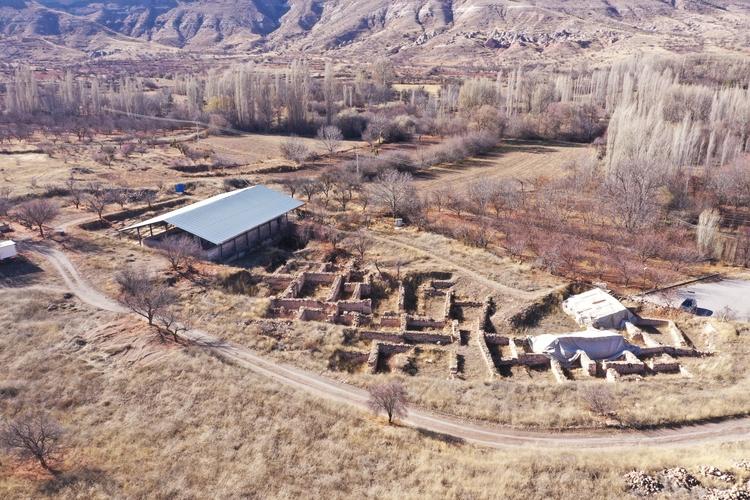
The Ancient City of Sobesos (Anadolu Agency)
The name Sobesos appears only in episcopal lists from the reign of Byzantine Emperor Leo VI (886–912). These records indicate the presence of an Orthodox community in the region during the 10th century. During this period, the number of bishoprics in Cappadocia was expanded, and Sobesos was established as one of these bishopric centers. However, its absence from later lists suggests that its episcopal status was not permanent.
Excavations at the Ancient City of Sobesos have revealed various types of structures including dwellings, a bathhouse, religious buildings, and tombs. Some structures in the settlement show changes in function over time. For example, a rectangular dwelling dating to the 4th century AD was later converted into a church; during this transformation, its vestibule, mosaic-decorated room, and courtyard acquired new functions. The courtyard was reconfigured into a single-nave chapel.
Another dwelling, featuring a peristyle courtyard, was constructed in the 4th century AD alongside a bathhouse. Certain parts of this building continued to be used and modified in subsequent periods.

The Ancient City of Sobesos (Anadolu Agency)
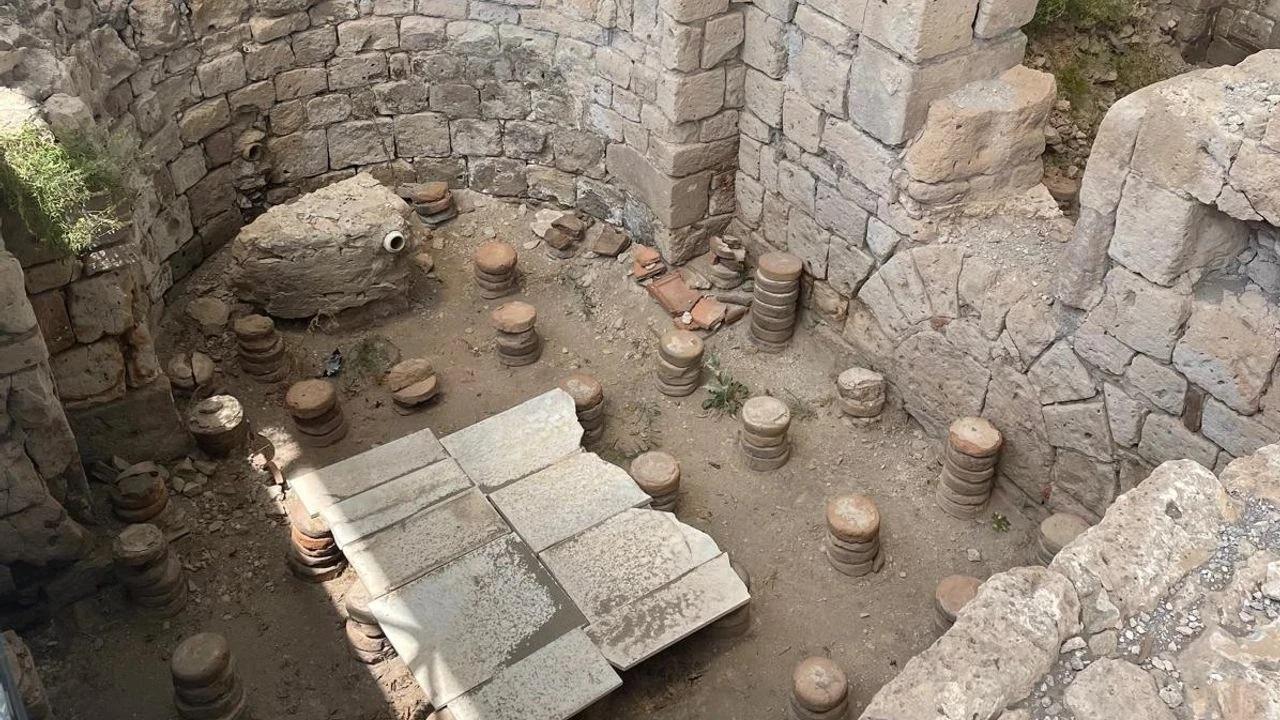
The bathhouse at Sobesos is situated at the northern edge of the settlement. It was built according to a variant of the Roman-style sequential plan, shaped in an “L” configuration. The structure comprises an apodyterium (changing room), frigidarium I–II (cold room), tepidarium (warm room), caldarium (hot room), and sudatorium/laconicum (steam room). Heating was provided by the hypocaust system, which circulated hot air beneath the floor.
The mosaic panels on the floor of the apodyterium were executed in opus tessellatum technique and feature geometric, vegetal, and figural decorations. Notable motifs include stars, rhombuses, crosses, partridges, and flowers. A sandal motif at the entrance to frigidarium II is particularly distinctive. From the 7th century onward, following Arab raids, the bathhouse underwent functional changes, with some sections repurposed as dwellings and workshops.
Among the religious structures at the site is a building originally constructed as a dwelling and later converted into a church. Multiple burials have been identified within and around this structure. Inscriptions on the tombs mention deacons Karterios and Antiochos, as well as Eugenios. The tomb chapel has a single-nave, narthex, and courtyard plan. The structure stands out for its finely cut stone masonry and high-quality craftsmanship.
Settlement at Sobesos began in the 4th century AD, though the exact date of its abandonment remains uncertain. The episcopal record from the reign of Leo VI confirms that the settlement was still active in the 10th century. The rock-cut spaces in the north-western area, including the Church of the Forty Martyrs and surrounding structures, demonstrate that from the 9th century onward, the region functioned as a rural center. This area contains churches, tomb chapels, stables, wine cellars, storage facilities, and agricultural production spaces. The construction phases of the Church of the Forty Martyrs have been dated to the 9th–10th centuries, the 11th century, and 1216/1217.
Alkan, Behçet. “Definecilerin Ortaya Çıkardığı Mozaikler Kapadokya'nın Sanat Tarihine Işık Tutuyor.” Anadolu Ajansı. Accessed June 11, 2025. https://www.aa.com.tr/tr/anadolu-mozaigi/definecilerin-ortaya-cikardigi-mozaikler-kapadokyanin-sanat-tarihine-isik-tutuyor/2799904.
Erpek, Can. “Sobesos Antik Kenti.” Türkiye Turizm Ansiklopedisi. Accessed June 11, 2025. https://turkiyeturizmansiklopedisi.com/sobesos-antik-kenti.
Erpek, Can. “Şahinefendi (Sobesos) Geç Antik Çağ Hamamı.” *Nevşehir Hacı Bektaş Veli Üniversitesi Sosyal Bilimler Enstitüsü Dergisi* 12, no. 3 (2022): 1621–1637. Accessed June 11, 2025. https://dergipark.org.tr/tr/download/article-file/2301520.
Gündoğmuş, Yıldız Nevin. “Türkiye'de Yıl Sonuna Kadar 750 Arkeolojik Kazı ve Araştırma Yapılacak.” Anadolu Ajansı. Accessed June 11, 2025.

Location | Near the source of Damsa Çayı at the locality of Örencik | ||||||||
|---|---|---|---|---|---|---|---|---|---|
Period(s) | 4th century AD – Middle Byzantine Period (in use until the 10th century) | ||||||||
Structure(s) | Residences cemetery areas chapel bathhouse | ||||||||
Historical Significance | Episcopal center during the reign of Leo VI (886–912) | ||||||||
Notable Structure | Church of the Forty Martyrs (9th–13th centuries) | ||||||||
No Discussion Added Yet
Start discussion for "Sobesos Ancient City" article
History
Architectural Structures
Bathhouse
Religious Structures and Tombs
Continuity of Settlement