


This article was automatically translated from the original Turkish version.
+2 More
Soil horizons are distinct layers observed in a vertical cross-section of soil (soil profile), lying approximately parallel to the surface and exhibiting clear differences from one another. These layers, known as soil horizons, differ from adjacent horizons in at least several fundamental characteristics that can be identified in the field.
These layers, which serve as a source of data on the morphological, physical, chemical, and mineralogical properties of soil, are used by soil scientists to identify horizon boundaries under field conditions.
Soils are composed of fragmented parent material known as "regolith". Horizonation is a result of soil-forming processes. The main factors contributing to the development of a soil profile are parent material, climate, organisms, topography, and time.
Under the influence of these factors, particularly the movement of water within the profile, horizons become differentiated. Water entering the soil transports dissolved salts and colloidal materials (such as clay minerals, organic colloids, iron and aluminum oxides) from upper horizons to lower layers. The accumulation of these materials in lower layers (illuviation) forms layers such as the B horizon. The removal of materials from upper layers through leaching (eluviation) creates lighter-colored horizons such as A2.
For example, in humid and temperate regions, soils are heavily leached, causing the lower parts of the A horizon to become bleached. In drier climates, humus accumulates to considerable depth, giving the A horizon a dark color.
The identification of soil horizons and the profile as a whole cannot be done in a laboratory; this work requires in situ examination of the soil in the field. The smallest soil body used as the basis for soil classification and survey is called a "pedon". A pedon is a three-dimensional soil body with sufficient width (typically 1 to 10 m2) to allow examination of the shapes and relationships of horizons within the profile. Adjacent pedons with similar properties within defined limits form a "polipedon" or soil association.
In the field, the identification of horizons relies on morphological characteristics such as color, texture, structure, consistency, and boundaries between layers. Soil color serves as an indicator for determining horizon boundaries. Traditionally, the Munsell Color Scale has been used, but in recent studies, colorimetric methods that measure numerical color parameters such as CIELab (L, a, b) are increasingly preferred.
Soil horizons are named using a symbolic system that indicates their genetic origin and position within the profile. This system consists of letters and numbers that denote major horizons, their subdivisions, and specific characteristics.
Represented by capital letters such as O, A, B, C, and R. These letters indicate the dominant deviation from the parent material.
Subdivisions of main horizons are indicated by a number immediately following the capital letter (e.g., O1, O2, A1, A2, B1, B2, B3).
Each of these numbers has a specific genetic meaning. For example, A3 and B1 denote transition horizons, while B2 indicates the main part of the B horizon without transitional characteristics.
More detailed vertical variations within a horizon are indicated by a second number (e.g., B21, B22). Numbers such as C1 and C2 used in the C horizon have no genetic meaning and simply denote vertical sequence.
Lowercase suffixes are used to indicate secondary deviations from the parent material or specific characteristics of horizons. These suffixes follow letters or numbers (e.g., B3ca — calcium carbonate accumulation; A2g — gleying; Bt — clay accumulation). An exceptional usage is the letter 'p' (plowing), which is used only immediately after the letter A (Ap).
To indicate that soil formation has occurred on more than one parent material (a geological distinction), Roman numerals (II, III, IV, etc.) are added as prefixes to the main horizon symbols. The numeral I is not used for the uppermost material (e.g., A2, B1,
When a soil profile (A and B horizons) develops over another soil profile, an accent mark is placed above the letters to indicate the underlying secondary series (e.g., , ).
A soil profile consists essentially of organic (O) and mineral (A, B, C, R) horizons.
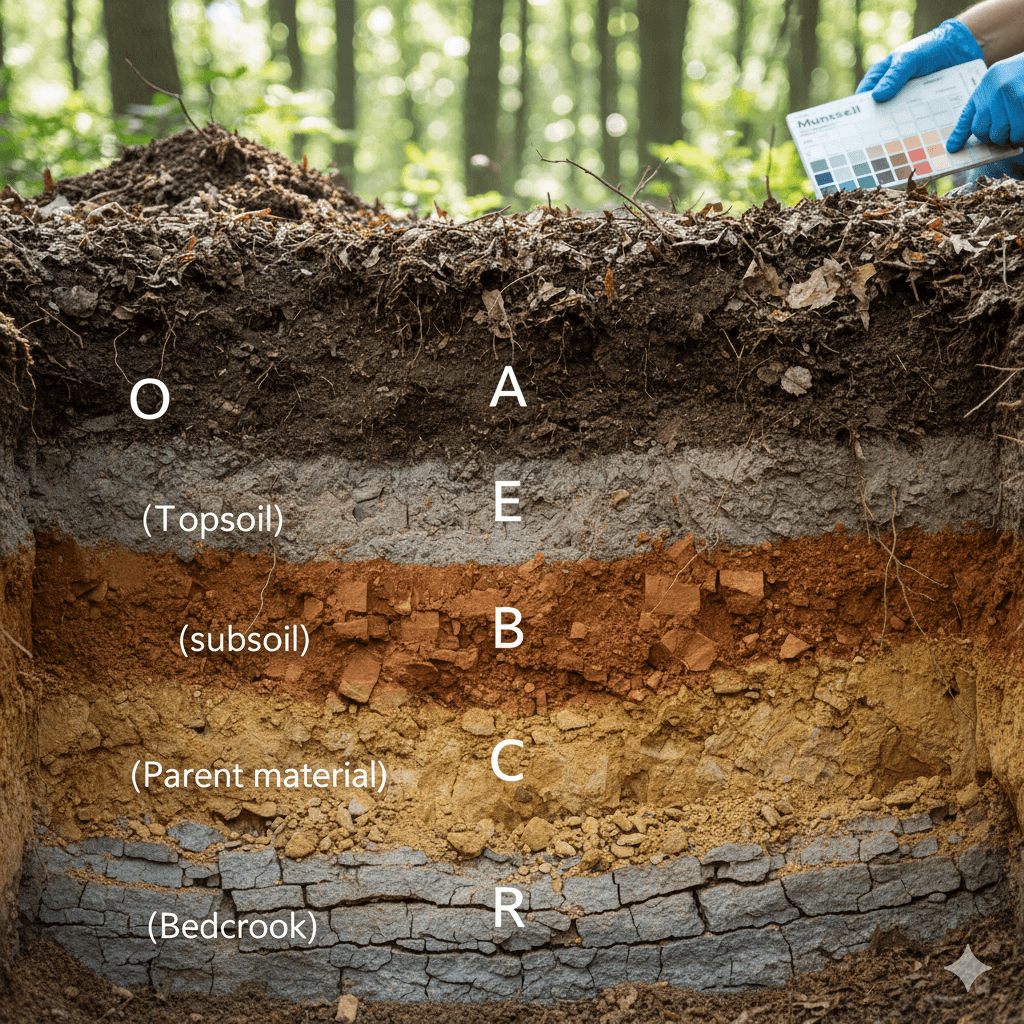
Soil Horizons (Generated by Artificial Intelligence)
An organic horizon found at the surface of mineral soils. It consists of fresh or partially decomposed organic material and contains a significant proportion of organic matter (e.g., at least 30% organic matter if the mineral fraction contains more than 50% clay, or at least 20% if it contains no clay).
A layer in which the original plant material (e.g., leaves) is still recognizable to the naked eye. It corresponds to the L (litter) and partially F (fermentation) layers of the older system.
A layer in which plant or animal residues have lost their original form and are highly decomposed. It corresponds to the H (humus) layer of the older system.
A mineral horizon typically formed at or near the surface. It is characterized by two main processes: (1) Accumulation of humified organic matter mixed with mineral fractions, or (2) Leaching (eluviation) of clay, iron, and aluminum, leaving behind resistant minerals such as quartz.
The surface horizon, usually dark in color, where humified organic matter is mixed with mineral material.
The horizon of maximum eluviation (leaching). It is typically lighter in color than the underlying B horizon or the overlying A1 horizon due to loss of clay, iron, and aluminum.
A transition horizon between A and B; its properties are closer to those of A1 or A2, but it also exhibits some characteristics of the underlying B horizon.
A transition horizon displaying characteristics of both A and B, with its upper part resembling A and its lower part resembling B.
A transition horizon between A and C in profiles lacking a B horizon.
A horizon typically located beneath the A horizon, defined as a zone of illuviation (accumulation). Typical characteristics include:
A transition horizon between A (usually A2) and B2; it exhibits characteristics of B2 but also retains some features of A2.
The main accumulation layer that most clearly displays the characteristic features of the B horizon and shows no transitional properties to A or C. Its definition is made according to the specific conditions of the profile and has no absolute quantitative measure.
Constitutes a transition between the B horizon and the C (parent material) or R (bedrock) horizon. It clearly exhibits features of both B2 and C or R.
A mineral layer beneath the solum (A and B horizons) that has been only slightly affected by pedogenic processes that define A or B horizons (excluding bedrock layers). It is generally assumed to resemble the parent material from which the solum originated, although this is not always certain. The C horizon may include weathered material below the zone of biological activity, or layers with accumulations such as gleying (Cg), calcium carbonate (Cca), gypsum (Ccs), or other salts (Csa).
The consolidated bedrock, such as granite, sandstone, or limestone, underlying the soil profile.
In addition to horizon definitions, some general terms are used in soil profile descriptions:
Topsoil: A general term used to refer to the surface layer typically tilled (Ap), the existing A horizon, or the organic-rich, fertile surface layer.
Surface soil: Refers to the soil layer cultivated for agricultural purposes, or the surface layer between 12.5 cm and 20 cm depth in uncultivated areas.
Subsoil: In well-developed soils, it refers to the B horizon; in poorly developed soils, it refers to the layer beneath the surface soil where plant roots develop.
The identification of soil horizons and profiles forms the foundation of soil survey and mapping. The characteristics of horizons (diagnostic surface horizons and subsurface diagnostic horizons) are used in international classification systems such as Soil Taxonomy to classify soils into orders (e.g., Entisol, Inceptisol), suborders, and great groups. For example, soils with no significant pedogenetic development and only A and C horizons may be classified in the Entisol order, while more developed soils may be included in the Inceptisol order.
Gözükara, Gafur, Bayram Çağdaş Demirel, and Sevda Altunbaş. “Sayısal Renk Parametreleri ile Toprak Özellikleri Arasındaki İlişkiye Toprak Horizonlarının Etkisi.” *Mediterranean Agricultural Sciences* 34, no. 1 (April 2021): 125–133. Accessed October 24, 2025. https://doi.org/10.29136/mediterranean.746628
Yalçın, Emel, and Abdullah Baran. “Kösrelik Göleti Çevresi Topraklarının Temel Toprak Özellikleri ve Toprak Sınıflamasının Yapılması.” *ADYUTAYAM Dergisi* 10, no. 1 (2022): 25–45. Accessed October 24, 2025. https://dergipark.org.tr/en/pub/adyutayam/issue/71011/1049035
Çelebi, Hayati. “Toprak Oluşumu ve Morfolojik Özellikleri.” *Atatürk Üniversitesi Ziraat Fakültesi Dergisi* 6, no. 4 (1975). Accessed October 24, 2025. https://dergipark.org.tr/en/download/article-file/34746
Şimşek, Gülağa. “Bir Toprak Ünitesinin Profil ve Horizontlarının Tanımı ve Sembollendirilmesi.” *Atatürk Üniversitesi Ziraat Fakültesi Dergisi* 4, no. 2 (2010). Accessed October 24, 2025. https://dergipark.org.tr/en/download/article-file/34625

Formation (Horizonation)
Definition and Survey Methods
Horizon Symbolism
Main Horizons
First-Order Subdivisions
Second-Order Subdivisions
Lowercase Suffixes
Lithological Discontinuities
Secondary Series (Sequum)
Definitions of Main Horizons
O Horizon
O1
O2
A Horizon
A1
A2
A3
AB
AC
B Horizon
B1
B2
B3
C Horizon
R Horizon
Related Terminology
Use and Classification