

This article was automatically translated from the original Turkish version.

Solidity is a high-level, object-oriented programming language designed for writing smart contracts that run on the Ethereum Virtual Machine (EVM). It was created to meet the needs of the Ethereum blockchain platform by enabling the development of secure and efficient smart contracts. In addition to Ethereum, Solidity has become a fundamental tool for developing decentralized applications (dApps) and digital assets on other blockchain networks. Solidity is regarded not merely as a programming language but as one of the foundational building pillars of the Web3 ecosystem.
The history of Solidity begins as part of the ideas developed by Gavin Wood, one of Ethereum’s original creators, in 2014. Ethereum’s goal was not merely to be a digital money unit but to serve as a platform capable of running decentralized applications. To achieve this, a specialized programming language was needed to write and securely execute smart contracts. Solidity emerged from this need and was developed as a suitable language for the Ethereum platform. Its design took into account Ethereum’s functionality and security requirements.
Although Solidity’s initial versions were developed to meet Ethereum’s specific needs, its features have since expanded and it has been adopted by other blockchain platforms. It is an open-source project continuously evolving and supported by community. The Ethereum Foundation provides the necessary resources for Solidity’s development, but its evolution is driven by contributions from important, developers, and other community members.
Solidity’s core features can be summarized as follows:
Solidity requires the type of every variable to be defined at compile time. This increases code correctness, reduces potential errors, and enables the compiler to detect issues earlier. Variables must be declared with specific types, and type mismatches are reported as compilation errors.
Solidity has a syntax similar to popular programming languages such as JavaScript, Python, and C++. This makes it easier for developers to learn and use. Its human-readable nature improves accessibility for writing, reviewing, and debugging code.
Solidity is an object-oriented language in which contracts behave like objects. These contracts contain functions, variables, and structures (structs). Each contract can operate independently and interact with other contracts.
Code written in Solidity is compiled into bytecode that runs on the Ethereum Virtual Machine (EVM). The EVM is a virtual machine that executes all smart contracts on the Ethereum network. Solidity’s purpose is to translate written code into bytecode understandable by the EVM, ensuring execution on the Ethereum blockchain.
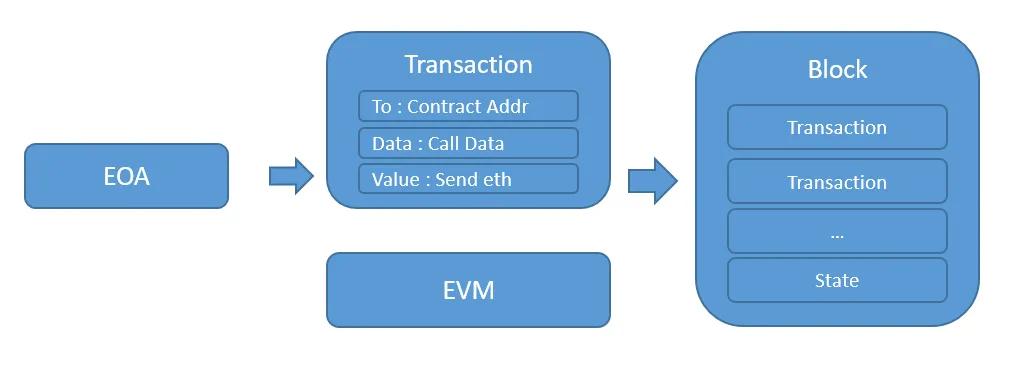
Smart contract invocation process (Credit: Engin Ünal)
Solidity supports inheritance, allowing one contract to inherit functionality from another. This enables developers to write reusable and modular code. This feature facilitates efficient organization of code.
Executing operations on the Ethereum network requires payment of a fee called gas, which varies based on computation time and complexity. Solidity provides developers with opportunities to write more efficient code, enabling transactions to be processed at lower costs on the network.
The main areas where Solidity is used include:
DeFi refers to applications that provide financial services in a decentralized manner. Solidity is the foundational language for such applications. Platforms such as Uniswap, Aave, and Compound operate on smart contracts written in Solidity. Users can transact directly with each other without banks or financial intermediaries.
NFTs are tokens that represent the uniqueness and ownership of digital assets. Solidity defines NFT standards such as ERC-721 and ERC-1155 and enables their purchase and sale. NFTs are used in many areas including digital art, collection products, and game assets.
DAOs are organizations that operate and are governed by their members in a decentralized manner. Solidity plays a crucial role in creating DAOs. DAOs enable members to make common decisions and conduct governance through voting mechanisms.
Solidity is also used in the gaming industry. Blockchain-based games allow players to convert their digital assets into tradable real value assets and freely buy and sell them. Games such as Axie Infinity and Gods Unchained operate on smart contracts written in Solidity.
Blockchain is also used in digital identity verification and transparent certification systems. Solidity plays a key active role in building such systems. Decentralized identity verification provides a secure environment by keeping control of personal data in the hands of users.
In Solidity, every thing is defined as a contract. Contracts can contain constructors, events, public or private functions, structs, mappings, and arrays. Standards such as ERC-20, ERC-721, and ERC-1155 are also templates defined using Solidity.
In this example, a contract named MerhabaDunya is defined. Inside the contract, there is a public variable named mesaj, and the guncelle function allows this message to be updated from outside the contract.
The security of smart contracts written in Solidity is of paramount importance because once deployed on the Ethereum network, a contract cannot be reversed. Therefore, security vulnerabilities in deployed contracts can lead to severe financial losses. The most common security risks include:
If a contract contains external function calls, attackers can exploit them to recursively invoke functions, potentially draining funds. This situation led to significant damage in incidents such as the DAO hack.
Variables unexpectedly reaching excessively large or small values can cause contracts to behave incorrectly. Solidity version 0.8.0 automatically mitigates such errors.
Smart contracts sometimes rely on timestamps for logic. Attackers can manipulate blockchain time timestamps to alter contract behavior.
Executing smart contracts requires gas. If a contract consumes excessive gas or gets stuck in an infinite loop, it fails to execute. This can lead to denial-of-service (DoS) attacks.
Various tools and frameworks are available for Solidity development:
Remix is a web-based development environment used to write, test, and debug Solidity smart contracts. It allows users to quickly create prototypes.
Truffle is a comprehensive development framework for Solidity projects. It simplifies contract deployment on test networks, integration testing, and database management.
Hardhat provides a powerful environment for developing Solidity smart contracts. It offers tools for testing and deploying contracts on local networks.
Ganache is a local blockchain simulator used by developers to test their code. It is helpful for controlling transaction speeds and identifying potential errors.
OpenZeppelin provides secure, audited Solidity libraries. It offers pre-vetted code to help enhance the security of smart contracts.

No Discussion Added Yet
Start discussion for "Solidity Programming Language" article
History
Key Features
Static Typing
High-Level and Human-Readable
Object-Oriented Structure
EVM Compatibility
Inheritance and Modularity
High Performance and Gas Efficiency
Use Cases
Decentralized Finance (DeFi)
Non-Fungible Tokens (NFTs)
Decentralized Autonomous Organizations (DAOs)
Blockchain-Based Games
Identity Verification and Certification
Programming Structure and Language Features
Security and Risks
Reentrancy (Re-entrancy Attacks)
Integer Overflow and Underflow
Timestamp Manipulation
Gas Limit and DoS Attacks
Development Tools and Ecosystem
Remix IDE
Truffle Framework
Hardhat
Ganache
OpenZeppelin