

This article was automatically translated from the original Turkish version.
+2 More
Name(s) | Space Launch Site Spaceport Spaceport Space Base | ||||||||
|---|---|---|---|---|---|---|---|---|---|
Type(s) | Launch-landing site Space transportation infrastructure | ||||||||
Application Area(s) | High-altitude balloon launches Planned landing/recovery Horizontal operation (runway takeoff/landing) Launch (vertical rocket) | ||||||||
Basic Components | Runway-apron-hangar Fuel/hazardous material storage-processing areas Telemetry/monitoring-communication infrastructure Integration-processing facilities Launch complex | ||||||||
Safety Elements | Quantitative risk threshold Debris/scatter area No-fly zone Flight corridor | ||||||||
Site Selection | Disaster/geological risks Infrastructure-logistical access and cost Ocean/downrange drop capability Weather conditions and annual operational window Population density and safety zones Proximity to equator/orbital targets | ||||||||
Spaceport is an infrastructure area requiring high security where spaceflight activities are conducted; it serves launch and reentry operations. Such facilities are structured not merely as a “launch point” but as a system in which interrelated functions—such as vehicle preparation and integration, ground support services, flight monitoring and control capabilities, and access management—are coordinated under one umbrella. Therefore, a spaceport is a multi-component facility that integrates engineering infrastructure with operational planning.
The establishment and operation of spaceports necessitate not only technical competence but also safety and regulatory dimensions. Site selection is evaluated alongside geographical conditions, flight corridors, and environmental impacts, while during operations, risk management, authorization processes, and liability regimes become decisive. Within this framework, the concept of “spaceport” encompasses not only the physical infrastructure enabling access to space but also the institutional and legal frameworks ensuring its safe and sustainable operation.
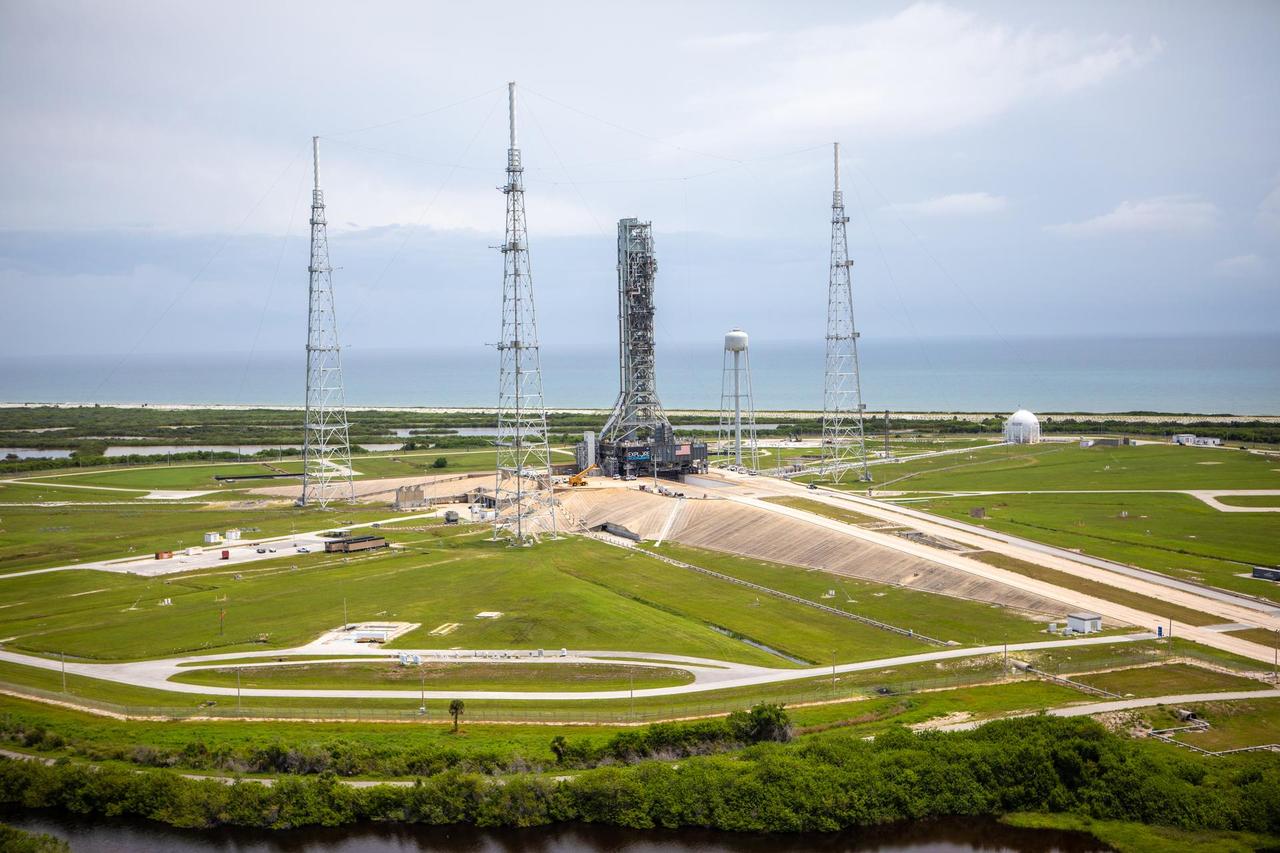
Kennedy Spaceport (NASA)
A spaceport is not merely a single launch ramp or narrowly defined “launch site”; rather, it is understood as a multi-layered operational area that brings together diverse functional clusters on a single site. This approach defines a spaceport as a “nexus” or “connection node” and emphasizes that planning must begin by integrating the requirements of a jet-capable regional airport with the specialized needs imposed by spaceflight technologies.【1】
In regulatory texts, the definition is more activity-oriented. A spaceport is defined as a “site” encompassing uses such as vertical rocket launches, horizontal launches using runways (via carrier aircraft that release spacecraft or space vehicles), high-altitude balloon launches for space experiments or rocket testing, and planned landings of space vehicles. This framework explicitly demonstrates that the concept of spaceport includes not only launch but also, in some models, planned return or landing components.
From a conceptual standpoint, three main activity clusters emerge around the spaceport. First is the launch activity: significant differences exist in infrastructure and site management between vertical and horizontal launches; in horizontal launch models, processes similar to airport operations—such as airspace regulation, taxi and parking areas, and aircraft integration—become critical. Second is the reentry/landing activity; this element transforms the spaceport from a “one-way” launch point into a facility requiring a more comprehensive operational model encompassing flight safety, site access control, and emergency preparedness.

A Spaceport Built by NASA (NASA)
The third cluster is associated ground operations: elements such as vehicle preparation, integration, ground support services, and the communication and monitoring infrastructure required for mission execution form the backbone of the approach that defines a spaceport as a “facility complex.” Therefore, when defining a spaceport, it is not only “which vehicle launches from where” but also “which ground operations are conducted under which safety regime” that become integral parts of the concept.
Terminology usage varies among countries and institutions. For instance, some compilation lists use the term “space launch site(s)” as a classification category providing names and locations to encompass both commercial and government launch areas.【2】
In contrast, the term “spaceport” particularly in licensing and operational contexts, treats the site not merely as a geographical point but as a regulatory entity that authorizes specific types of launch or landing activities and imposes operator responsibilities.【3】
Thus, in practice, “space launch site” serves primarily as a designation answering the question “where is the launch taking place?” whereas “spaceport” offers a broader framework that also addresses the question “which activities are permitted under what operational and safety conditions?” This distinction forms the conceptual basis for discussions on safety, licensing, and site selection.
The primary function of a spaceport is to institutionalize the transition between preparing a spacecraft for flight and executing the launch or landing operation. Within this framework, operational logic can be read similarly to the “terminal-to-outside” organization of a conventional airport: acceptance, direction, and—in suborbital flight models—training and medical checks conducted on-site; parallel to this, management of processes such as fueling, inspection and maintenance, flight crew preparation, baggage/equipment control, and transfer are emphasized.
Decisions regarding gate arrangements, safe and rapid establishment of taxi and parking flows, and particularly how the spacecraft is transported from assembly and processing facilities to the launch site, represent critical junctures where operations are translated into engineering design within a spaceport.
The sustainable operation of spaceports relies on integration and qualification infrastructure beyond the launch day. A spaceport must house not only the launch moment but also the necessary sites and facilities for validating subsystems, testing critical components—including solid rocket motors—and conducting pre-mission preparations.

A Launch from a Spaceport (NASA)
This function is explicitly defined at the institutional level in some cases: certain centers simultaneously support launch vehicle programs and provide testing and qualification infrastructure for various subsystems and solid rocket motors. From this perspective, a spaceport performs a central role by linking ground support activities—assembly, integration, testing, and processing—required throughout the spacecraft’s “pre-flight lifecycle” with the launch and landing infrastructure under a unified operational regime.
Operational logic at spaceports varies according to the launch or landing concept employed. In vertical launch systems, platforms, support infrastructure, and site-specific safety zones are prominent; in horizontal operations conducted via runways, requirements similar to airport operations—such as runway usage, taxi and parking arrangements, and airspace coordination—become more pronounced. Activities such as high-altitude balloon launches add a different type of site preparation and safety organization.
This diversity structures operations not only at the infrastructure level but also at the management model level, based on “roles and responsibilities”: the separation of functions such as accountable manager, safety officer, and security officer; and the institutionalization of continuous tasks such as record keeping, procedure updates, and site inspections. Moreover, in commercial examples with a tenant structure, multiple actors conducting different operations on the same site place shared safety frameworks and coordination mechanisms at the core of operations.
One of the core components of a spaceport is the launch complex and the technical and operational structures clustered around it. At vertical launch sites, infrastructure surrounding the ramp is shaped by service and access roads, pre-launch preparation areas, and safety zones accompanying the launch moment. The scale of development at such sites is not limited to a single platform; for example, the Startovıy Kompleks (стартовый комплекс) planned for the Angara rocket at Vostochny is reported to cover an area of 109 hectares with over 100 buildings and facilities anticipated.
The same source notes that the facility was designed with a target capacity of 10 launches per year, involved 1,320 personnel and 140 equipment units during construction, and could see workforce levels rise to 5,000 during certain phases. At the operational Startovıy Kompleks (стартовый комплекс) for Soyuz-2, unique solutions such as a mobile service tower stand out: this 1,600-ton, 52-meter-high mobile tower enables mission preparation procedures to continue under harsh climatic conditions and is also presented as a critical element for worker safety.【4】
The site-specific “pre-flight” functions of a launch site are often realized through integration and processing capabilities, as well as testing and qualification infrastructure. The key issue here is determining which facilities and workflows prepare the spacecraft and its subsystems before they reach the launch area. In the Vostochny example, the “unified technical complex” approach integrates storage and logistics units, assembly and test (montajno-ispıtatelnıe, монтажно-испытательные) structures, transition systems to reduce risks during transport, and fueling stations under a single complex logic; such integration shortens on-site transport steps, benefiting both time and safety management.【5】

A Landing Runway at a Spaceport (NASA)
Similarly, the mission definition for the Satish Dhawan Space Centre (SDSC SHAR) in Sriharikota clearly shows how the infrastructure complex supports multiple functions: the center concurrently manages solid propellant production for ISRO’s launch vehicles, testing infrastructure for qualifying subsystems and solid rocket motors, and “launch base” facilities for satellite and launch vehicle preparation. Additionally, the presence of a separate launch pad for sounding rockets provides a practical example of how different mission types can be supported by distinct infrastructure within the same site.【6】
In models requiring horizontal launch or runway-based landing and takeoff, the physical layout of a spaceport approaches that of an aerodrome: runways, aprons, taxiways, parking areas, ground services, and site access control become more visible. In master planning approaches, it is emphasized that the runway must support not only daily operations but also large-scale logistics: since spacecraft components cannot reach the launch site autonomously, the runway must be designed to accommodate heavy or specialized cargo aircraft such as the Airbus Beluga or Boeing SuperGuppy. Such a requirement highlights that “cargo and logistics” at a spaceport are as decisive as engineering processes.
The commercial example of Spaceport America illustrates numerically how runways and environmental conditions are integrated into infrastructure design: the facility is located on an 18,000-acre site, features a runway measuring 12,000 by 200 feet (3,658 by 61 meters), and aims for a vertical launch complex alongside an extensive restricted airspace regime. Such dimensions demonstrate that in spaceport physical design, the runway is not merely a matter of “length”; it is evaluated alongside safety zones, airspace coordination, and logistics capacity.【7】
One of the most critical layers of physical infrastructure is the storage, transportation, and handling of propellants and other hazardous materials. Licensing guidelines treat this area in direct conjunction with “site safety”: the inventory of all propellant types and other hazardous materials to be stored or used on-site must be identified, and facility layout and safety measures must be defined accordingly.
Similarly, equipment for fire suppression and chemical spill response must be readily available on-site, and organizational structures for rescue and firefighting personnel, facilities, and equipment must be established to enable rapid transition from normal operations to emergency response. In runway-based (horizontal) models, integration of existing aerodrome fire and rescue capacity is treated as a direct factor influencing infrastructure planning.
Safety management at spaceports is not based on a “zero risk” assumption; the goal is to establish a risk framework ensuring that activity-related adverse outcomes are rare and manageable. Within this framework, risk is not viewed solely as hazards at the moment of launch but includes all procedures conducted during the preparation phase—particularly those involving hazardous materials and high-energy systems.
In practice, maintaining risk at an acceptable level proceeds along two main lines: (I) systematic identification of hazards and evaluation of their probability-impact relationships, and (II) implementation of additional safeguards wherever risk can be reasonably reduced (ALARP principle). This approach unifies “design safety” and “operational safety”; that is, safety is generated not only through procedures but also through on-site layout decisions (zoning, separation distances, access restrictions).
The backbone of flight safety discussions is the flight corridor approach, which translates the spacecraft’s route and fall zones into definable safety areas on the ground. The key concepts in this architecture are:
This schema demonstrates that safety is not established through a single safety perimeter but through a layered restriction that varies according to flight phases and may expand incrementally as needed.
The flight corridor approach is not completed merely by drawing a corridor on a map; sub-areas within the corridor are defined using numerical methods. For suborbital flights, particularly around the nominal fall point of stages or the final phase, “impact dispersion areas” are defined using a “three standard deviations” (3σ) dispersion model. These areas answer not only “where could it fall?” but also “how much deviation is expected?”, enabling safety zones to be established based on models rather than arbitrary decisions.

Close-up Launch Moment from a Spaceport (NASA)
Risk assessment then considers population density, presence of public areas, site access dynamics, and operational timing. Thus, safety management rests on one hand on physical/probabilistic modeling (dispersion and potential debris zones) and on the other on socio-spatial realities (human presence and accessibility).
Risk reduction in practice is not limited to the “define corridor—ban access” duality; different hazard types (blast pressure, fragments/debris, thermal effects, toxic release, etc.) require distinct safety packages. One prominent method is the safety clear zone application: specific areas are defined, marked, and enforced to physically exclude the public during critical operational phases where major accident risks exist. In addition, access control (specifying who may enter which area and when), temporary restrictions during operations (closures of land, air, and sea use), and coordination of on-site operational units form the “implementation” dimension of safety.
Emergency capacity constitutes the second pillar of safety: pre-definition of response arrangements (firefighting, chemical spill response, evacuation, medical intervention, coordination chain); clarification of responsibilities with public agencies and emergency services; and maintaining readiness of response equipment, personnel, and communication channels are integral parts of safety planning. Thus, risk management encompasses not only “prevention” but also “preparedness and recovery” phases.
The institutional output of safety management is the safety case framework, which demonstrates how risks were identified, measured under which assumptions, and reduced through which measures. Safety case functions not as a mere file but as a framework that makes an operator’s decision-making logic regarding risks visible and auditable.
The critical point is that risk assessment must be treated not as a static process but as an evolving one that is updated as operations change: a new mission profile, a new propellant type, or a different flight profile may require re-evaluation of many elements—from corridor definition to access control, from emergency plans to on-site zoning. Therefore, safety is not a one-time arrangement but a continuous governance practice throughout the operational lifespan.
Legal liability for space activities is largely established through states’ international obligations. The 1967 Outer Space Treaty and the 1972 Convention on International Liability for Damage Caused by Space Objects (Liability Convention) center responsibility on the “launching state” when a space object causes damage to another state.【8】
This framework implies that spaceport operation is not merely a technical and administrative matter; licensing, oversight, and inspection mechanisms function as tools for states to manage their international liability risks. In practice, states use financial liability, insurance, and indemnity mechanisms to transfer this risk to private operators.
In national regulations, spaceports are generally addressed within a licensing architecture that distinguishes between “permission to operate” and “permission to use the site.” In the United States, the regulatory framework for commercial space transportation operates through the Department of Transportation (DOT) and its implementing agency, the Office of Commercial Space Transportation (AST) within the Federal Aviation Administration (FAA).
The licensing evaluation framework highlights five main axes: public health and safety (safety review), national security and foreign policy dimensions (policy review), payload assessment, financial liability, and environmental review. Additionally, the FAA’s obligation to coordinate with its air traffic units regarding impacts on the national airspace is part of the institutional framework. This structure demonstrates that licensing is not merely a technical qualification certificate but an administrative process that integrates multiple public domains—safety, foreign policy, and environment—into a single decision.
In U.S. regulations, “spaceport operation” has become a distinct regulatory subject. Under 14 CFR Part 420 – License to Operate a Launch Site, the scope, application requirements, and licensing conditions for operating a launch site are detailed.
Under Part 420’s “launch site location review” approach, the site’s compliance with safety criteria is assessed; among the licensee’s responsibilities are controlling public access and scheduling site operations.【9】 Such provisions demonstrate that the legal framework does not rest solely on a binary “grant or deny” model but defines continuous administrative obligations throughout the operational period.
In commercial space activities, the financial liability regime is a critical component of the regulatory framework, particularly regarding compensation for damage to third parties. In the U.S. example, licensed operators are expected to demonstrate financial liability up to a level determined by the Maximum Probable Loss (MPL) methodology; this liability covers claims for death, injury, or property damage to third parties as well as damage or loss to U.S. government property.

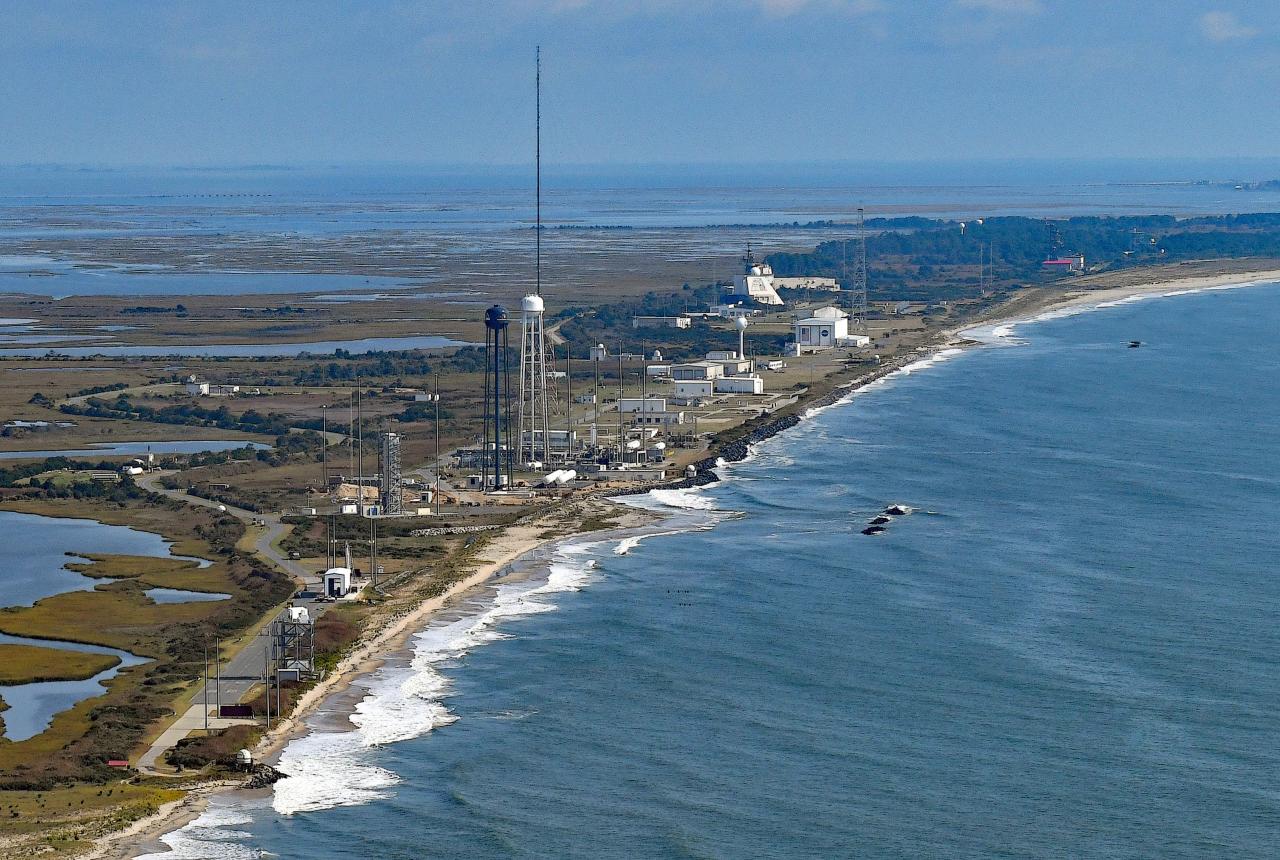
Wallops Spaceport Complex (NASA)
This area is a focal point of public-private risk-sharing debates: how MPL is calculated, insurance costs, and the limits of state “indemnification” are periodically re-examined through oversight reports and advisory mechanisms. Thus, financial liability provisions are not merely “additional conditions” of licensing but key elements of the state’s strategy to balance international liability and domestic legal risks.
Spaceport activities are subject to separate evaluation processes in most regulatory regimes due to environmental impacts. In the United States, environmental review is formally integrated into the licensing evaluation chain. In the United Kingdom, applicants for a spaceport license are required to prepare an “assessment of environmental effects”; this study must be conducted by qualified experts, be publishable in nature, and be open to public consultation. This approach designs environmental considerations not as an external add-on but as a layer of “transparency and participation” that strengthens the legitimacy of decisions.
In the regulatory framework, the responsibilities of a spaceport operator are typically structured as a triad of “organizational role definition + documentation + continuous oversight.” In the UK model, licensed spaceports are expected to have designated roles such as an accountable manager, safety manager, and security manager. The accountable manager is responsible for implementing and maintaining the safety management system (SMS), while the safety manager assumes the functional role during daily operations.
Additionally, the preparation of a spaceport manual is mandated as a regulatory requirement, covering topics such as management structure and roles, SMS details, site information-sharing procedures, and rapid response arrangements. The manual must be made accessible to personnel, kept current, have change records tracked, and be reported to regulatory authorities. On the emergency side, the license holder must develop an emergency response plan consistent with the safety case and establish the necessary equipment, training, and organizational capacity.
In the security dimension, a “site security programme” is required to prevent unauthorized access; protection of carrier aircraft, launch vehicles, and payloads before and after integration; and zoning of areas where range control services are conducted using concepts such as “security restricted area” and, under certain conditions, “controlled area.” Detailed obligations are defined for these zones, including access control, signage, identification requirements, and prohibition of restricted items; appropriate qualifications and required security investigations or clearances are also part of the system for the security manager.
Environmental impact is not treated as a secondary concern but as an integral component of licensing decisions. Environmental assessment aims to identify the direct and indirect effects of activities on-site (launch, planned landing, propellant handling, testing, and ground support operations); to outline how mitigation measures should be designed; and to define under what conditions operational boundaries may be updated. This approach does not limit environmental licensing to report generation; it structures it as a “process management” system involving monitoring of environmental impacts, updating reports, and integrating public transparency and consultation.
Environmental impact areas vary by activity type but cluster around certain categories. Launch activities highlight noise and vibration, air emissions and particulate release, temporary access restrictions in nearby areas, and risks of debris or fall zones during operations. Storage and use of hazardous materials (propellants and other chemicals) on-site place leakage/spill scenarios and fire risks at the center of environmental planning.
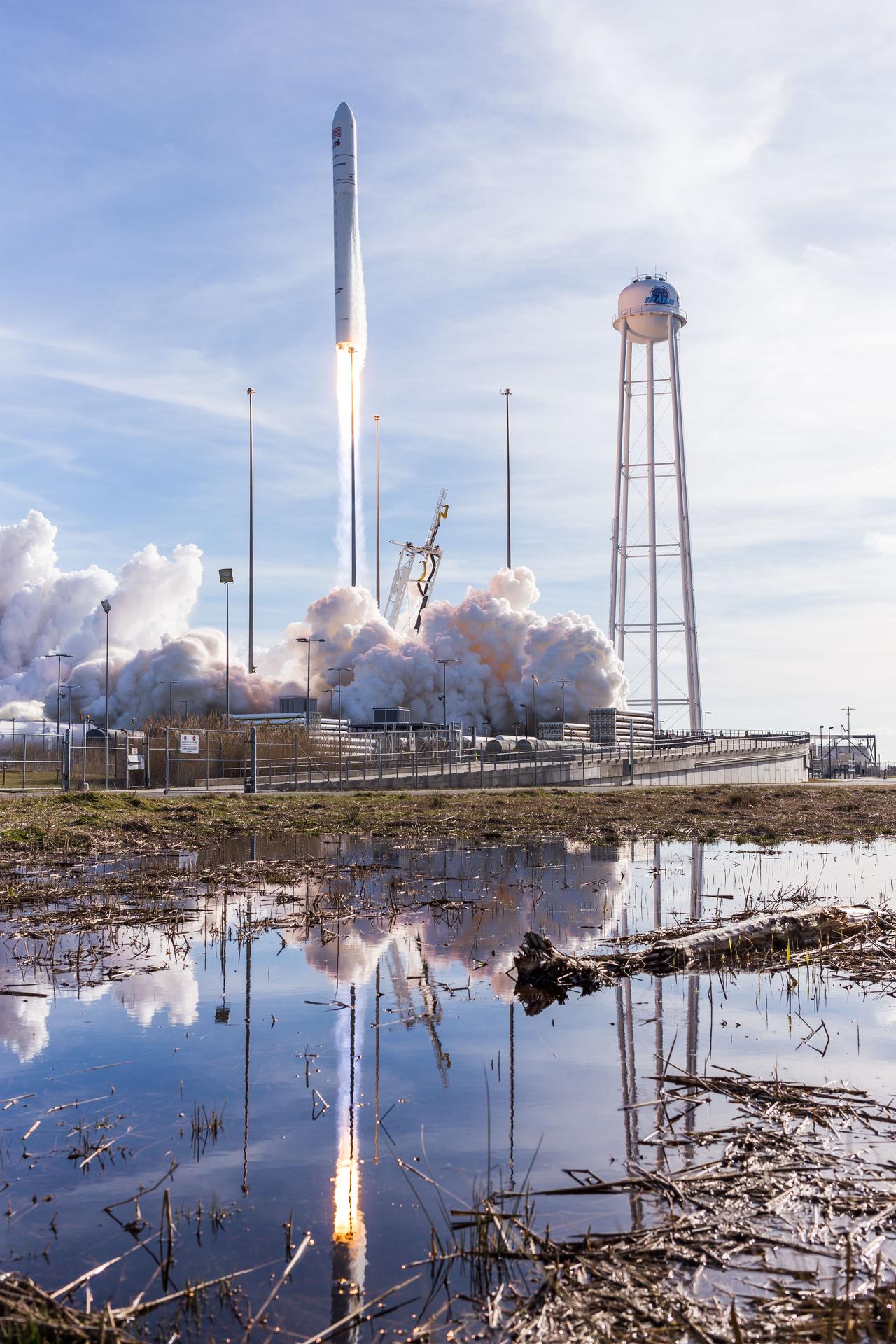
A Launch at Wallops Spaceport (NASA)
Accordingly, emergency response capacity (firefighting, chemical spill control, evacuation, and communication chain) must be considered alongside environmental risk management. At facilities conducting horizontal operations, runway and apron operations, vehicle traffic, logistics flights, and airspace regulations also contribute to environmental pressure; thus, the environmental framework is shaped not by a single event but by operational intensity and activity diversity throughout the year.
Environmental impact assessments are expected to be conducted with technical expertise; the assessment document must be publishable and open to public consultation by the relevant authority when necessary, strengthening the transparency dimension of licensing processes. In this context, environmental studies are not merely lists of potential impacts but technical documents that clarify the assumptions used, data sources relied upon, methods of impact mitigation, and indicators for monitoring.
Furthermore, a significant change in the operator’s activity profile (a new operation type, different propellant use, new flight profile, or increased capacity) may require re-evaluation of the environmental file; thus, environmental assessment is managed as a “living document” that can be updated throughout the operational life.
The environmental dimension is not independent of safety and security arrangements at a spaceport. Hazardous material management, fire and spill response, access control, and definition of restricted areas serve both to reduce environmental risk and ensure public safety. Therefore, licensing processes embed environmental safeguards not as separate add-ons but as embedded components of the site’s management system (roles, procedures, training, and drills). Ultimately, the environmental dimension becomes a fundamental component of the regulatory process, determining not merely the technical capacity of the spaceport but its sustainability and social acceptance.
Spaceport site selection is not a matter of finding “a suitable empty plot of land”; it is a decision that integrates flight profiles with terrestrial risk areas (flight corridors, fall/dispersion zones, and access restrictions) through a unified engineering and planning framework. Therefore, location is evaluated alongside target orbit types (e.g., profiles benefiting from the velocity advantage near the equator), flight azimuths, and potential fall trajectories.
Areas with low population density, wide safety zones, and an environment conducive to managing land, air, and sea use during operations directly affect the public safety dimension of the decision. Climate and meteorology are also practical determinants: the frequency of favorable weather windows, wind patterns, and visibility conditions determine the operational calendar and the costs of cancellations or delays. This framework ties the technical rationale for site selection not to the “launch moment” but to the operational capacity sustained throughout the year.
The second layer in site selection decisions involves the infrastructure and cost components that make the site “operable.” Logistics accessibility (road, port, and suitable airport connections), energy and communication infrastructure, skilled labor, and supply chains determine not only the initial construction cost but also the long-term operational cost of a spaceport. Some master planning approaches emphasize that the runway must serve not only operational flights but also the transport of heavy and bulky components (e.g., capacity to accommodate large cargo aircraft such as the Beluga or SuperGuppy).

Voyager-2 Launching from a Spaceport (NASA)
Such a requirement shifts site selection from purely terrain and climate conditions to the level of a “regional logistics ecosystem.” Similarly, the ability to establish a wide restricted airspace, manage temporary closures during operations, and ensure access to emergency response capacity (firefighting, rescue, chemical spill response) become components of “operability.” Therefore, site selection requires simultaneous optimization of technical suitability, cost, and operational continuity.
In practice, site selection does not produce a single “correct location”; most often, alternatives with different advantages must be ranked under conditions of uncertainty. At this point, multi-criteria decision-making approaches come into play: expert opinion refines the criterion set (Delphi method); interactions between criteria are analyzed for direction and intensity (DEMATEL); uncertain and linguistic evaluations are quantified (fuzzy logic/fuzzy numbers); and alternatives are ranked according to proximity to a consensus solution (VIKOR); these methods enable the decision to answer the “why this location?” question with an auditable logic.
The key contribution of such models is not merely weighting criteria individually but making visible how criteria trigger one another: for example, relationships established between airspace restrictions and population density, emergency capacity and hazardous material infrastructure, or logistics accessibility and cost determine the decision’s critical points. Numerical examples in site selection further concretize its multidimensionality: long-term governance elements such as leasing Baykonur until 2050 and its annual rental fee; physical parameters such as land area, runway dimensions, and restricted airspace at Spaceport America; these are typical variables demonstrating that site selection is not merely geographical but also institutional and economic—a problem of “continuity.”
Spaceport America, located in southern New Mexico adjacent to the White Sands Missile Range, is an example framed as an FAA-licensed launch complex. Data on the site demonstrate that site selection is directly linked to the “operational window” and “airspace management”: the facility is situated on an 18,000-acre (approximately 73 km²) area, targets a 6,000-square-mile restricted airspace for operations, features a runway measuring 12,000 by 200 feet (3,658 by 61 meters), and emphasizes approximately 340 sunny/dry days per year. This numerical framework concretely illustrates that in a commercially oriented spaceport, runway capacity, extensive airspace regulation, and meteorological stability are integral components of physical design.【10】
The Vostochny Cosmodrome is located within the boundaries of Amur Oblast in the Russian Federation, with its first launch occurring in 2016. The distinctive feature of this example is that the spaceport is conceived not as a single platform but as a complex integrating numerous structures and functions. The Startovıy Kompleks (стартовый комплекс) planned for the Angara program is reported to cover an area of 109 hectares with over 100 buildings and facilities anticipated; the design target is a capacity of 10 launches per year. Numbers related to the construction process support this scale: at certain stages, 1,320 personnel and 140 equipment units were employed, and workforce levels reached up to 5,000 during some periods.【11】

A Component of the Mir Space Station Launching from Baikonur Spaceport (NASA)
An operational infrastructure highlight is the mobile service tower at the Soyuz-2 Startovıy Kompleks (стартовый комплекс): reported to weigh 1,600 tons and stand 52 meters tall, this tower enables mission preparation to proceed despite climatic conditions and enhances the safety of site personnel. This example demonstrates that a spaceport design aiming for continuity under high climatic and logistical challenges simultaneously expands both infrastructure investment and safety-operational requirements.
SDSC SHAR (Satish Dhawan Space Centre, Sriharikota) is an example defined by ISRO as a “launch base” for its launch vehicle programs. In this structure, the spaceport distinguishes itself by integrating, within the same organizational framework, not only launch activities but also the production of solid propellant boosters, testing infrastructure for qualifying subsystems and solid rocket motors, and satellite and launch vehicle preparation.
Additionally, the presence of a separate launch pad for sounding rockets provides a practical detail demonstrating that different mission types can be supported by distinct infrastructure within the same site. Thus, SDSC SHAR presents a model where the “production-testing-preparation-operation” chain supporting the national program is centralized in a single location.【12】
In Türkiye, the agenda for access to space is shaped by the strategic distinction between “direct ownership of launch services” and “purchasing services externally.” A spaceport is the infrastructure counterpart of this distinction: it requires institutional capacity to plan launch activities, manage integration and ground support processes on-site, operate safety and security regimes, and manage international liabilities. Therefore, the spaceport agenda emerges not merely as an infrastructure investment but as a “space access regime” encompassing long-term operational models, regulatory frameworks, and state responsibilities as a single package.

Orion Launching from a Spaceport (NASA)
The approach of establishing a spaceport abroad shifts site selection criteria beyond Türkiye’s geographical boundaries to pursue technical advantages. In this context, proximity to the equatorial zone offers performance and operational efficiency benefits for certain mission profiles, primarily through increased orbital velocity. In particular, the seas surrounding Türkiye and its mainland lack the wide, uninhabited areas required for post-launch fall scenarios, whereas equatorial and oceanic regions are viewed as “ideal spaceport locations.”
According to a 30 December 2025 report by Anadolu Agency, feasibility and design studies for Türkiye’s planned spaceport in Somalia have been completed, initial construction activities have begun, and the project is being carried out on land allocated to Türkiye under a Türkiye-Somalia cooperation agreement.【13】
Table Showing Technical Advantages of Equatorial Zone Launches
In the same context, the technical advantages held by countries in the equatorial zone for space access are emphasized, and feasibility studies conclude that Somalia emerges as an advantageous investment option. This example illustrates that “site selection” is not merely a matter of geographical suitability but a multi-layered process involving land allocation, bilateral agreements, and long-term operational guarantees.
Establishing a spaceport abroad occurs within the sovereign territory of the host country; therefore, issues of authority sharing and liability limitation must be addressed alongside technical design. In this context, three issues become decisive.
First, Judicial and Administrative Authority: Access control, security restrictions, emergency management, and operational decision-making mechanisms require a functional administrative framework for the “operator” to function effectively.
Second, International Liability and Financial Risk: Risks associated with launch activities intersect with state liability regimes; therefore, insurance, financial liability, and indemnity arrangements must be explicitly structured within the agreement design.
Third, Safety and Security Architecture: Adapting the flight corridor approach to the site, defining restricted areas, preventing unauthorized access, and maintaining emergency response capacity on-site continuously require that operations be conducted within a corporate framework that does not require reinvention for every mission. Therefore, an overseas spaceport is not merely a technical advantage but a complex setup requiring high levels of detail in agreement design, governance, and risk-sharing.
Adams, Constance M., and Georgi Petrov. “Spaceport Master Planning: Principles and Precedents.” Paper presented at the Space 2006 Conference, San Jose, CA, September 19–21, 2006. Accessed December 31, 2025. https://spacearchitect.org/pubs/AIAA-2006-7325.pdf.
Aslanhan, Uğur. “Somali'ye kurulacak uzay limanının ayrıntıları belli oldu.” Anadolu Ajansı, December 30, 2025. Accessed December 31, 2025. https://www.aa.com.tr/tr/bilim-teknoloji/somaliye-kurulacak-uzay-limaninin-ayrintilari-belli-oldu/3785334.
Atakul, Duygu. “Somali'nin Türkiye İçin Jeostratejik Önemi.” Sakarya İktisat Dergisi 13, no. 3 (2024): 324–48. Accessed December 31, 2025. https://dergipark.org.tr/tr/download/article-file/4062432.
Central Intelligence Agency. “Space launch site(s).” The World Factbook. Accessed December 31, 2025. https://www.cia.gov/the-world-factbook/about/archives/2023/field/space-launch-sites/
Centre National d'Études Spatiales (CNES). “A French Ambition That Became European.” Accessed December 31, 2025. https://centrespatialguyanais.cnes.fr/en/ambition-nationale-devenue-europeenne
Civil Aviation Authority (CAA). "Guidance for spaceport licence applicants and spaceport licensees." CAP 2212. 2. bs. Crawley: Civil Aviation Authority, 2024. Accessed December 31, 2025. https://www.caa.co.uk/publication/download/18913.
Department for Business and Trade, Department for Transport, UK Space Agency, Ofcom, Civil Aviation Authority, and Department for Science, Innovation and Technology. “Operating a spaceport: rules and regulations.” December 17, 2025. Accessed December 31, 2025. https://www.gov.uk/guidance/operating-a-spaceport-rules-and-regulations.
European Space Agency (ESA). “Europe's Spaceport.” Accessed December 31, 2025. https://www.esa.int/Enabling_Support/Space_Transportation/Europe_s_Spaceport/Europe_s_Spaceport2
Federal Aviation Administration (FAA). “Getting Started with Licensing.” Accessed December 31, 2025. https://www.faa.gov/space/licenses/licensing_process
Finger, G. Wayne, and Carey M. McCleskey. "Spaceport Performance Measures." Paper presented at the SpaceOps 2010 Conference, Huntsville, AL, April 25–30, 2010. Accessed December 31, 2025. https://ntrs.nasa.gov/api/citations/20100039456/downloads/20100039456.pdf.
Indian Space Research Organisation (ISRO). "Satish Dhawan Space Centre (SDSC) SHAR." Accessed December 31, 2025. https://www.isro.gov.in/SDSC.html.
Japan Aerospace Exploration Agency (JAXA). “Tanegashima Space Center.” Accessed December 31, 2025. https://global.jaxa.jp/about/centers/tnsc/index.html.
Lindbergh, Rachel. Commercial Space Launch and Reentry Regulations: Overview and Select Issues. CRS Report R48582. Washington, DC: Congressional Research Service, June 23, 2025. Accessed December 31, 2025. https://www.congress.gov/crs-product/R48582.
National Aeronautics and Space Administration (NASA). “35 Years Ago: Launch of Mir Space Station’s First Module.” February 22, 2021. Accessed December 31, 2025. https://www.nasa.gov/history/35-years-ago-launch-of-mir-space-stations-first-module/
National Aeronautics and Space Administration (NASA). “35 Years Ago: Voyager 2 Explores Uranus.” January 2021. Accessed December 31, 2025. https://www.nasa.gov/history/35-years-ago-voyager-2-explores-uranus/
National Aeronautics and Space Administration (NASA). “Cabana Announces New Initiatives for Multi-User Spaceport.” May 30, 2014. Accessed December 31, 2025. https://www.nasa.gov/missions/station/cabana-announces-new-initiatives-for-multi-user-spaceport/
National Aeronautics and Space Administration (NASA). “Falcon Heavy: A Multi-User Spaceport Success Story.” February 7, 2018. Accessed December 31, 2025. https://www.nasa.gov/humans-in-space/commercial-space/falcon-heavy-a-multi-user-spaceport-success-story/
National Aeronautics and Space Administration (NASA). “Kennedy Space Center.” Accessed December 31, 2025. https://www.nasa.gov/kennedy/
National Aeronautics and Space Administration (NASA). “Launch Complex 39B.” Accessed December 31, 2025. https://www.nasa.gov/reference/launch-complex-39b/
National Aeronautics and Space Administration (NASA). “Launch Pad 39B.” Accessed December 31, 2025. https://www.nasa.gov/humans-in-space/exploration-ground-systems/launch-pad-39b/
National Aeronautics and Space Administration (NASA). “Launch Services Program Overview.” Accessed December 31, 2025. https://www.nasa.gov/kennedy/launch-services-program/launch-services-program-overview/
National Aeronautics and Space Administration (NASA). “Media Invited to See Progress Toward Space Station Launches from Virginia.” December 7, 2015. Accessed December 31, 2025. https://www.nasa.gov/news-release/media-invited-to-see-progress-toward-space-station-launches-from-virginia/
National Aeronautics and Space Administration (NASA). “NASA Partnerships Launch Multi-User Spaceport.” May 1, 2014. Accessed December 31, 2025. https://www.nasa.gov/humans-in-space/commercial-space/nasa-partnerships-launch-multi-user-spaceport/
National Aeronautics and Space Administration (NASA). “NASA Wallops to Support October Sounding Rocket Launch.” October 22, 2024. Accessed December 31, 2025. https://www.nasa.gov/centers-and-facilities/wallops/nasa-wallops-to-support-october-sounding-rocket-launch/
National Aeronautics and Space Administration (NASA). “NG-13 Remote Launch Images.” February 2020. Accessed December 31, 2025. https://www.nasa.gov/image-article/ng-13-remote-launch-images/
National Archives. “Federal Site Providing Ground Safety Services and Oversight for Launch or Reentry Activities Conducted From a Commercial Site Located on Land Owned by a Federal Site.” Federal Register 90, no. 89 (May 9, 2025). Accessed December 31, 2025. https://www.federalregister.gov/documents/2025/05/09/2025-08097/federal-site-providing-ground-safety-services-and-oversight-for-launch-or-reentry-activities
National Archives. “Part 420—License to Operate a Launch Site.” Electronic Code of Federal Regulations (eCFR), Title 14. Accessed December 31, 2025. https://www.ecfr.gov/current/title-14/chapter-III/subchapter-C/part-420.
Spaceport America. "The Gateway to Space." Accessed December 31, 2025. https://www.spaceportamerica.com/about/
TsENKI. “КЦ «Восточный».” Accessed December 31, 2025. https://www.russian.space/o-predpriyatii/filialy/kts-vostochnyy.html.
TsENKI. “Космодром Восточный.” Accessed December 31, 2025. https://www.russian.space/kosmodromy/kosmodrom-vostochnyy/
United Kingdom. "Space Industry Act 2018." 2018 c. 5. Status: Point in time view as at 7 February 2023. Accessed December 31, 2025. https://www.legislation.gov.uk/ukpga/2018/5/2023-02-07/data.pdf.
United Nations Office for Outer Space Affairs (UNOOSA). "Guidance on Space Object Registration and Frequency Management for Small and Very Small Satellites." Vienna, 2015. Accessed December 31, 2025. https://www.unoosa.org/documents/pdf/psa/bsti/2015_Handout-on-Small-SatellitesE.pdf.
United Nations Office for Outer Space Affairs (UNOOSA). "United Nations Register of Objects Launched into Outer Space: Global Launch Locations." Accessed December 31, 2025. https://www.unoosa.org/oosa/de/spaceobjectregister/resources/index.html.
Wong, Ken. “Regulating and Licensing Commercial Space Transportation.” Presentation presented at the Interagency Satellite Workshop, Federal Aviation Administration Office of Commercial Space Transportation (AST), October 17, 2018. Accessed December 31, 2025. https://www.space.commerce.gov/wp-content/uploads/FAA_COMMERCIAL_TRANSPORTATION.pdf
Çakır, Tuğrul. "Türkiye’nin Yurt Dışında Uzay Limanı Kurması." SETA Perspektif, no. 327. Ankara: Siyaset, Ekonomi ve Toplum Araştırmaları Vakfı (SETA), February 2022. Accessed December 31, 2025. https://media.setav.org/tr/dosya/2022/02/perspektif-turkiyenin-yurt-disinda-uzay-limani-kurmasi.pdf.
İlhan, Melike. “Bulanık ortamda yeni bir karar verme yöntemiyle uzay limanı değerlendirmesi.” Master's thesis, National Defense University, Atatürk Strategic Research and Graduate Education Institute, 2022. Accessed December 31, 2025. https://tez.yok.gov.tr/UlusalTezMerkezi/TezGoster?key=qVqOZFj2DwNmvdf1oGFYiFL1q8K99PhLYHLbYBFfw4BJtZX3yumeHcSGi66xsmPP
[1]
Constance M. Adams and Georgi Petrov, “Spaceport Master Planning: Principles and Precedents” (Paper presented at the Space 2006 Conference, San Jose, CA, 19–21 September 2006), p. 1.
[2]
Central Intelligence Agency, “Space launch site(s),” The World Factbook, accessed 31 December 2025, https://www.cia.gov/the-world-factbook/about/archives/2023/field/space-launch-sites/.
[3]
Civil Aviation Authority (CAA), Guidance for spaceport licence applicants and spaceport licensees, CAP 2212, 2nd ed. (Crawley: Civil Aviation Authority, 2024), p. 30.
[4]
TsENKI, “Космодром Восточный,” accessed 31 December 2025, https://www.russian.space/kosmodromy/kosmodrom-vostochnyy/.
[5]
TsENKI, “Космодром Восточный,” accessed 31 December 2025, https://www.russian.space/kosmodromy/kosmodrom-vostochnyy/.
[6]
Indian Space Research Organisation (ISRO), “Satish Dhawan Space Centre (SDSC) SHAR,” accessed 31 December 2025, https://www.isro.gov.in/SDSC.html.
[7]
Spaceport America, “The Gateway to Space,” accessed 31 December 2025, https://www.spaceportamerica.com/about/.
[8]
Rachel Lindbergh, Commercial Space Launch and Reentry Regulations: Overview and Select Issues, CRS Report R48582 (Washington, DC: Congressional Research Service, 23 June 2025), p. 9.
[9]
National Archives, “Part 420—License to Operate a Launch Site,” Electronic Code of Federal Regulations (eCFR), Title 14, pp. 1, 63, 70.
[10]
Spaceport America, “The Gateway to Space,” accessed 31 December 2025, https://www.spaceportamerica.com/about/.
[11]
TsENKI, “Космодром Восточный,” accessed 31 December 2025, https://www.russian.space/kosmodromy/kosmodrom-vostochnyy/. Also see TsENKI, “КЦ «Восточный»,” accessed 31 December 2025, https://www.russian.space/o-predpriyatii/filialy/kts-vostochnyy.html.
[12]
Indian Space Research Organisation (ISRO), “Satish Dhawan Space Centre (SDSC) SHAR,” accessed 31 December 2025, https://www.isro.gov.in/SDSC.html.
[13]
Uğur Aslanhan, “Somali'ye kurulacak uzay limanının ayrıntıları belli oldu,” Anadolu Ajansı, 30 December 2025, https://www.aa.com.tr/tr/bilim-teknoloji/somaliye-kurulacak-uzay-limaninin-ayrintilari-belli-oldu/3785334.


Name(s) | Space Launch Site Spaceport Spaceport Space Base | ||||||||
|---|---|---|---|---|---|---|---|---|---|
Type(s) | Launch-landing site Space transportation infrastructure | ||||||||
Application Area(s) | High-altitude balloon launches Planned landing/recovery Horizontal operation (runway takeoff/landing) Launch (vertical rocket) | ||||||||
Basic Components | Runway-apron-hangar Fuel/hazardous material storage-processing areas Telemetry/monitoring-communication infrastructure Integration-processing facilities Launch complex | ||||||||
Safety Elements | Quantitative risk threshold Debris/scatter area No-fly zone Flight corridor | ||||||||
Site Selection | Disaster/geological risks Infrastructure-logistical access and cost Ocean/downrange drop capability Weather conditions and annual operational window Population density and safety zones Proximity to equator/orbital targets | ||||||||
Conceptual Framework and Definitions
The Concept and Scope of Spaceport
Activity Clusters: Launch, Reentry, and Associated Operations
Terminology and Usage Distinctions: “Spaceport” versus “Space Launch Site”
Functions and Operational Logic of a Spaceport
Launch and Planned Landing Operations
Integration, Testing, and Ground Support Activities
Multi-Modal Use and Operational Organization
Physical Infrastructure and Facility Components
Launch Complexes, Ramps, and On-Site Development
Integration–Processing Facilities and Ground Support Infrastructure
Runway, Apron, and “Horizontal Operation” Components
Propellant and Hazardous Material Infrastructure and Emergency Capacity
Safety, Risk Management, and Flight Corridor
Public Safety Objective and the “Acceptable Risk” Approach
Flight Corridor Architecture
Quantitative Risking: Fall Dispersion, “3 Sigma” Areas, and Population Criteria
Primary Mitigation Measures
The Institutional Document of Safety: Safety Case and Continuity
Legal and Regulatory Framework
International Liability Regime and the “Launching State” Principle
National Licensing Procedure
Financial Liability, Insurance, and Indemnity Sharing
Environmental Assessment and Public Transparency
Operator Responsibilities
Environmental Dimension and Licensing Processes
Role of Environmental Impact in Decision-Making
Key Impact Areas and Typical Risk Categories
Reporting, Expertise, and Public Consultation
Interrelationship of Environment, Safety, and Security
Site Selection Problem: Criteria, Constraints, Decision Models
Geographical and Technical Rationale
Multi-Criteria Evaluation: Infrastructure, Cost, and Operability
Decision Models: Ranking and Justification Under Uncertainty
Case Studies of Spaceports
Spaceport America (USA)
Vostochny (Russia)
SDSC SHAR (India)
Türkiye Context: Somali Spaceport
The Spaceport Dimension of Türkiye’s Access to Space Agenda
Rationale for Establishing a Spaceport Abroad and the Somali Example
Legal Nature and Agreement Design Agenda