


This article was automatically translated from the original Turkish version.
+1 More
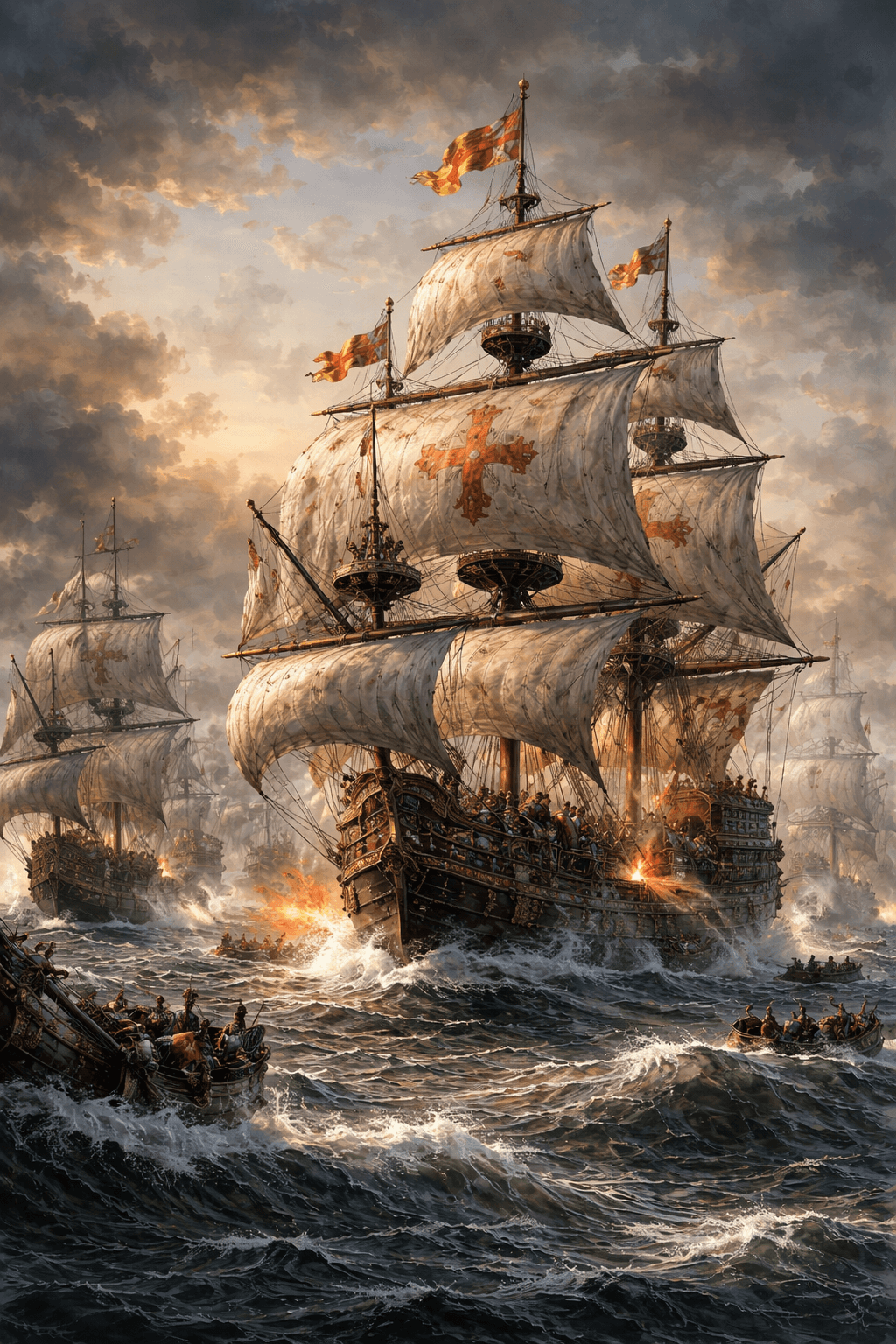
İspanyol Armadası (Yapay zeka ile oluşturulmuştur)
The Spanish Armada was a large naval force assembled in 1588 by King Philip II of Spain with the aim of invading England and restoring Catholicism. This campaign, conducted during the reign of Queen Elizabeth I of England, ended in failure due to battles in the English Channel and significant losses during the return journey.
In the second half of the sixteenth century, Europe was deeply divided along religious and political lines due to the impact of the Reformation. The establishment of Protestantism as the state religion in England and its continuation under Elizabeth I’s rule led to deteriorating relations with Catholic Spain. The English government’s support for Protestant elements and its tolerance of anti-Spanish activities further heightened tensions between the two states.【1】
King Philip II of Spain adopted the restoration of Catholicism in England and the end of the Protestant regime as both a political and religious objective. Within this framework, the Armada campaign was viewed not merely as a military intervention but as an extension of the broader Catholic-Protestant struggle in Europe.【2】
English attacks on Spanish ships and conflicts over interests in the Atlantic also contributed to the deterioration of relations. English privateers’ raids against Spanish trade were perceived by Spain as hostile acts and accelerated its military preparations.【3】
It is noted that Pope Pius V supported the initiative and framed the expedition as a defense of Catholicism. This reinforced the religious dimension of the campaign in the eyes of European public opinion.【4】
The preparation of the Armada involved a planning and organizational process lasting approximately twenty months. The fleet was assembled from warships and armed merchant vessels stationed in Spanish and Portuguese ports, with additional ships requisitioned by the state. Ships of varying tonnages and types were combined to form a large-scale fleet.【5】
The fleet was divided into several squadrons, each organized under a specific command structure. Numerous cannons were mounted on the ships, and stocks of ammunition, gunpowder, and weapons were significantly increased. Thousands of soldiers were embarked to enable transport and coordination with the Spanish army.
Extensive logistical preparations were made for the campaign. Food, drinking water, and essential supplies were stored, with durable materials selected in anticipation of a long sea voyage. Nevertheless, delays in the supply chain and shortages of materials caused various difficulties during the preparation phase.
Following the death of the original commander, Santa Cruz, command was given to Medina Sidonia. It is noted that Medina Sidonia had limited naval experience and accepted the assignment reluctantly. Nevertheless, the fleet assembled in Lisbon and set sail after completing final preparations.
The Spanish Armada departed from Lisbon in May 1588; however, adverse weather conditions caused delays during the initial phase of the campaign. Upon reaching the English Channel, the fleet encountered the English navy and aimed to join forces with the Duke of Parma’s troops stationed in Flanders. This union was intended to facilitate an invasion of England.【6】
The English fleet adopted a tactic of long-range artillery fire using smaller, more maneuverable ships. In contrast, the Spanish fleet planned to rely on traditional close-quarters combat and boarding actions. The English fleet’s mobile tactics and long-range firepower disrupted the Spanish formation and slowed its advance.
Various engagements occurred along the Channel in late July and early August. While the Spanish fleet was anchored off Calais, the English launched fire ships that broke the Spanish formation and forced the fleet to cut its anchors and disperse. This development shattered the Spanish defensive order.
During the Battle of Gravelines on 8 August 1588, English artillery proved highly effective, inflicting heavy damage on Spanish ships. As a result of these battles, the Armada failed to link up with Parma’s forces and was compelled to retreat from the English Channel. This phase is regarded as the military turning point of the campaign.

Spanish Armada on a Map (Generated by AI)
Under pressure from the English fleet, the Spanish Armada turned northward and decided to return to Spain by sailing around the northern tip of the British Isles. However, this retreat process significantly weakened the fleet due to both military losses and adverse weather conditions.
After the Battle of Gravelines, the Spanish Armada realized it could not regain control of the English Channel. With the plan to unite with Parma’s forces unfulfilled, the fleet sailed into the North Sea to escape English pressure and decided to return to Spain by circumnavigating the northern British Isles.
The retreat was conducted along an unplanned route. The fleet passed north of Scotland and entered the Atlantic, where it encountered violent storms and unfavorable sea conditions. Numerous ships ran aground or sank after striking rocks along the Irish coast. This resulted in additional losses beyond those suffered during the campaign itself.
During the long and arduous return voyage, ships experienced shortages of food, outbreaks of disease, and discipline problems. A significant portion of the fleet reached Spanish ports in damaged condition, while some ships never returned. It is reported that the Armada emerged from the campaign with a substantially reduced strength compared to its initial size.
The failure of the campaign created a political and military morale advantage for England and is regarded as a turning point in the development of English naval power. Although Spain’s military presence in Europe was not entirely extinguished, its absolute dominance at sea was called into question. The event significantly influenced the reshaping of religious and political balances in late sixteenth-century Europe.【7】
[1]
“Spanish Armada: Facts and Timeline.” History Extra. Erişim 19 Şubat 2026. https://www.historyextra.com/period/elizabethan/spanish-armada-facts-elizabeth-i-medina-sidonia-catholic-philip-ii/
[2]
“Armada, Spanish.” Encyclopedia.com. Erişim 19 Şubat 2026. https://www.encyclopedia.com/religion/encyclopedias-almanacs-transcripts-and-maps/armada-spanish
[3]
“Spanish Armada.” Historic UK. Erişim 19 Şubat 2026. https://www.historicuk.com/HistoryUK/HistoryofEngland/Spanish-Armada/
[4]
“Armada, Spanish.” Encyclopedia.com. Erişim 19 Şubat 2026. https://www.encyclopedia.com/religion/encyclopedias-almanacs-transcripts-and-maps/armada-spanish
[5]
“Armada, Spanish.” Encyclopedia.com. Erişim 19 Şubat 2026. https://www.encyclopedia.com/religion/encyclopedias-almanacs-transcripts-and-maps/armada-spanish
[6]
“When Did the Spanish Armada Set Sail? A Timeline.” History Hit. Erişim 19 Şubat 2026. https://www.historyhit.com/when-did-the-spanish-armada-set-sail-a-timeline/
[7]
“The Spanish Armada.” British Battles. Erişim 19 Şubat 2026. https://www.britishbattles.com/the-spanish-war/the-spanish-armada


İspanyol Armadası (Yapay zeka ile oluşturulmuştur)
Political and Religious Background
Preparation Process
Campaign and Battles
Retreat and Consequences