

This article was automatically translated from the original Turkish version.
Team(s) | Carnivora | ||||||||
|---|---|---|---|---|---|---|---|---|---|
Family | Ursidae | ||||||||
Conservation Status | IUCN status: Vulnerable | ||||||||
Specie(s) | Tremarctos ornatus | ||||||||
Geographic Distribution | northern Argentina Bolivia Peru Ecuador Colombia Venezuela | ||||||||
Fur Color | Black | ||||||||
General Definitions | It is the only bear species native to South America and the last surviving member of the short-faced bears | ||||||||
Genus | Tremarctos | ||||||||
Subfamily | Tremarctinae | ||||||||
Class | Mammalia | ||||||||
Spectacled bear is classified within the subfamily Tremarctinae of the family Ursidae and is the only bear species native to South America. This mammal, the last surviving member of the short-faced bear lineage, is taxonomically recognized as a monotypic species.
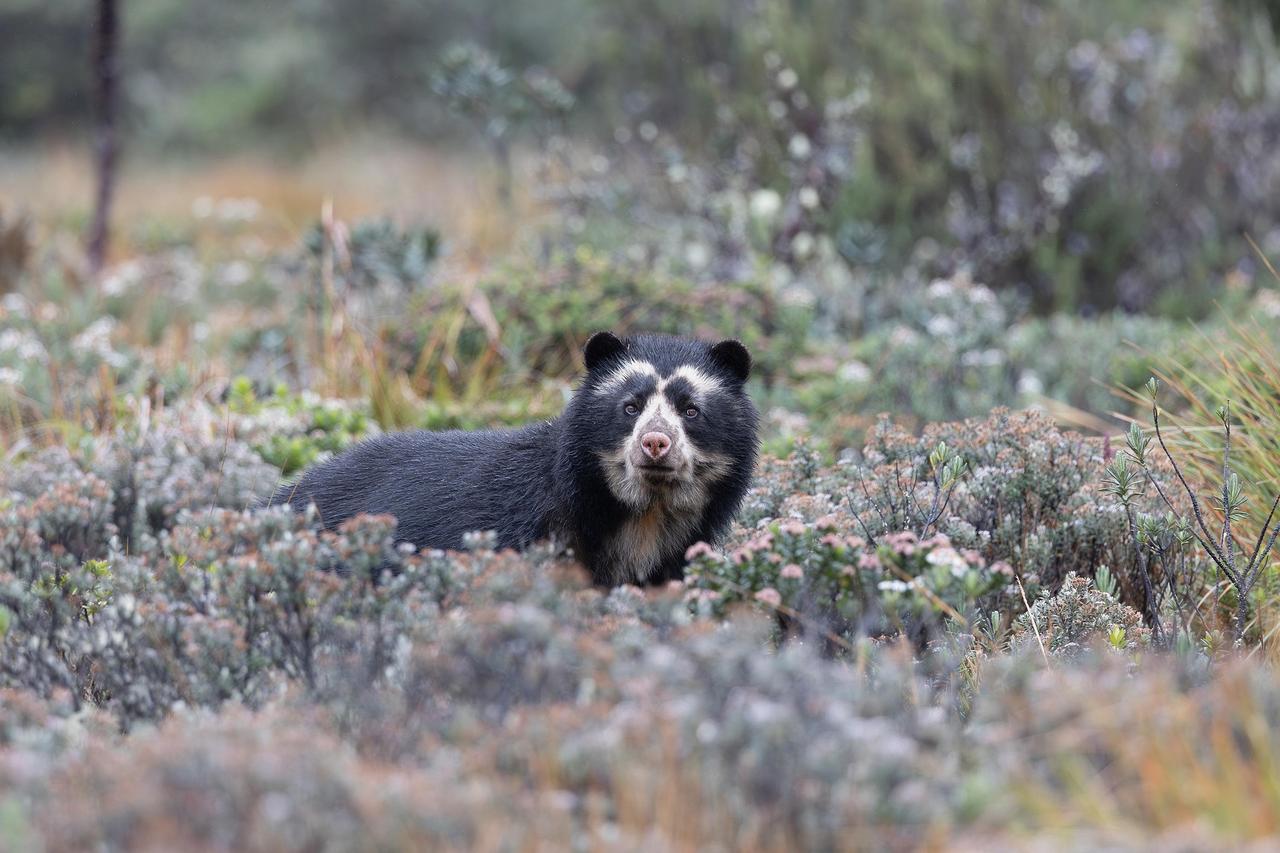
The species has a medium-sized body structure with fur color typically black, though individuals with reddish-brown pelage are also observed. Its most distinctive feature is the presence of white or cream-colored markings around the eyes that often extend to the neck and chest, forming unique patterns for each individual; these markings may be entirely absent in some individuals. A pronounced sexual dimorphism is evident, with adult males being approximately 30 to 50 percent larger than females.【1】
Its physiological structure is characterized by a plantigrade stance, elongated forelimbs that enhance climbing ability, and a short tail completely concealed by fur. The skull exhibits a broad chewing muscle area, indicative of adaptation to an herbivorous diet, along with a unique depression known as the premasseteric fossa, not found in other bear species. Additionally, a foramen in the humerus and a pseudothumb, also observed in giant pandas, are characteristic anatomical features of this species.

Spectacled Bear (Pixabay)
Tremarctos ornatus has a narrow distribution spanning approximately 4,600 kilometers along the tropical Andes, from Venezuela and Colombia through Ecuador, Peru, and Bolivia to northern Argentina. The species can inhabit elevations ranging from 200 meters to 4,250 meters above sea level. Its most common habitats are dense cloud forests between 1,900 and 2,350 meters, although it also occurs in páramo, shrublands, tropical dry forests, and steppes.【2】 Habitat use varies according to seasonal food availability. Studies in Bolivia and Peru have shown that bears actively prefer high-elevation elfin forests and moist montane forests while avoiding dry montane regions. Although the species is generally described as diurnal and crepuscular, its activity patterns may shift to nocturnal behavior or different time windows in response to environmental factors such as human pressure or the presence of feral dogs.

Geographic Distribution of the Spectacled Bear (Image Generated by Artificial Intelligence)
The spectacled bear is the most herbivorous bear species after the giant panda and is an opportunistic omnivore. Its diet primarily consists of plants from the Bromeliaceae family, favored for their high-nutrient meristem tissues. During periods when fruits are not ripe, bromeliad hearts become the main food source. Other plant materials consumed include cacti, bamboo shoots, orchid bulbs, palm trunks, and tree bark. Animal protein sources such as insects, small rodents, and birds are also consumed, and occasional reports note the ingestion of carrion or domestic animals. Spectacled bears possess a unique ability to construct feeding platforms or nests by breaking branches to reach fruits in tree canopies or for resting. This strategic behavior enables them to spend extended periods in the forest canopy, particularly during seasons of abundant fruit availability.
Spectacled bears are generally solitary, although temporary groups have been observed in areas with abundant food resources. The reproductive cycle is linked to seasonal fruit availability, with mating activity peaking between March and October. Females exhibit a polyoestrous reproductive structure and possess the ability for embryonic diapause, resulting in gestation periods ranging from 120 to 255 days. Births typically occur a few months before the onset of peak food availability, with litters of one to four cubs. Cubs weigh approximately 300 to 500 grams at birth, are born blind, and are entirely dependent on their mother. Males play no role in cub rearing, and infanticide by males has been documented. Olfactory marking is the primary method of communication between individuals; at least five distinct vocalizations have been identified between mothers and cubs. Genetically, the species possesses 52 diploid chromosomes, differing from other ursids.【3】

Social Structure of the Spectacled Bear (Pixabay)
Tremarctos ornatus is listed as Vulnerable on the International Union for Conservation of Nature Red List. Its population trend is declining due to habitat loss and fragmentation. Agricultural expansion, road construction, mining, and illegal coca cultivation are isolating bear populations into small, fragmented subpopulations. Additionally, retaliatory killings by local communities, justified by crop damage or rare attacks on livestock, constitute a serious threat. Illegal trade in bear parts for traditional medicine or ritual purposes further increases pressure on the species. Climate change is expected to further jeopardize the species’ long-term survival by altering high-altitude ecosystems. Conservation strategies focus on establishing habitat corridors, managing human-bear conflict, and enhancing the effectiveness of existing national parks in the Andes.
Fenner, K. "Tremarctos ornatus." Animal Diversity Web. 2012. Accessed April 2, 2026. https://animaldiversity.org/accounts/Tremarctos_ornatus/
Kattan, Gustavo, Olga Lucía Hernández, Isaac Goldstein, Vladimir Rojas, Oscar Murillo, Carolina Gómez, Héctor Restrepo, and Francisco Cuesta. "Range Fragmentation in the Spectacled Bear Tremarctos ornatus in the Northern Andes." Oryx 38, no. 2 (2004): 155–63. Accessed April 2, 2026. https://doi.org/10.1017/S0030605304000298
Peyton, Bernard. "Ecology, Distribution, and Food Habits of Spectacled Bears, *Tremarctos ornatus*, in Peru." *Journal of Mammalogy* 61, no. 4 (1980): 639–52. Accessed April 2, 2026. https://doi.org/10.2307/1380309
Pilfold, N. W., D. Mateo-Chero, W. Farfan-Rios, M. Watsa, M. A. Owen, and R. C. Van Horn. "Andean bears (Tremarctos ornatus) display selective behaviors while foraging bromeliads (Puya spp.) in high elevation puna grasslands." PLoS ONE 19, no. 12 (2024): e0314547. Accessed April 2, 2026. https://doi.org/10.1371/journal.pone.0314547
Pixabay. "gözlüklü ayı and ayı." Pixabay. Accessed April 2, 2026. https://pixabay.com/tr/photos/g%c3%b6zl%c3%bckl%c3%bc-ay%c4%b1-and-ay%c4%b1-279936/
Pixabay. "gözlüklü ayı dayanmak." Accessed April 2, 2026. https://pixabay.com/tr/photos/g%c3%b6zl%c3%bckl%c3%bc-ay%c4%b1-dayanmak-9091162/
Pixabay. "gözlüklü ayı dayanmak." Accessed April 2, 2026. https://pixabay.com/tr/photos/g%c3%b6zl%c3%bckl%c3%bc-ay%c4%b1-dayanmak-9091163/
Pixabay. "gözlüklü ayı dayanmak." Accessed April 2, 2026. https://pixabay.com/tr/photos/g%c3%b6zl%c3%bckl%c3%bc-ay%c4%b1-dayanmak-9091781/
Ríos-Uzeda, B., H. Gómez, and R. B. Wallace. "Habitat Preferences of the Andean Bear (Tremarctos ornatus) in the Bolivian Andes." Journal of Zoology 268, no. 3 (2006): 271–78. Accessed April 2, 2026. https://doi.org/10.1111/j.1469-7998.2005.00013.x
Vela-Vargas, I. Mauricio, Jeffrey P. Jorgenson, José F. González-Maya, and John L. Koprowski. "Tremarctos ornatus (Carnivora: Ursidae)." Mammalian Species 53, no. 1006 (2021): 78–94. Accessed April 2, 2026. https://www.jstor.org/stable/48642484
[1]
Vela-Vargas, I. Mauricio, Jeffrey P. Jorgenson, José F. González-Maya ve John L. Koprowski. "Tremarctos ornatus (Carnivora: Ursidae)." Mammalian Species 53, no. 1006 (2021): 78–94. Erişim tarihi: 2 Nisan 2026. https://www.jstor.org/stable/48642484
[2]
K. Fenner, "Tremarctos ornatus," Animal Diversity Web, 2012, erişim tarihi: 2 Nisan 2026, https://animaldiversity.org/accounts/Tremarctos_ornatus/
[3]
K. Fenner, "Tremarctos ornatus," Animal Diversity Web, 2012, erişim tarihi: 2 Nisan 2026, https://animaldiversity.org/accounts/Tremarctos_ornatus/


Team(s) | Carnivora | ||||||||
|---|---|---|---|---|---|---|---|---|---|
Family | Ursidae | ||||||||
Conservation Status | IUCN status: Vulnerable | ||||||||
Specie(s) | Tremarctos ornatus | ||||||||
Geographic Distribution | northern Argentina Bolivia Peru Ecuador Colombia Venezuela | ||||||||
Fur Color | Black | ||||||||
General Definitions | It is the only bear species native to South America and the last surviving member of the short-faced bears | ||||||||
Genus | Tremarctos | ||||||||
Subfamily | Tremarctinae | ||||||||
Class | Mammalia | ||||||||
No Discussion Added Yet
Start discussion for "Spectacled Bear (Tremarctos ornatus)" article
Morphological and Anatomical Characteristics
Habitat Preferences and Geographic Distribution Dynamics
Feeding Ecology and Foraging Strategies
Reproductive Biology, Social Structure, and Communication
Conservation Status and Threats