

This article was automatically translated from the original Turkish version.
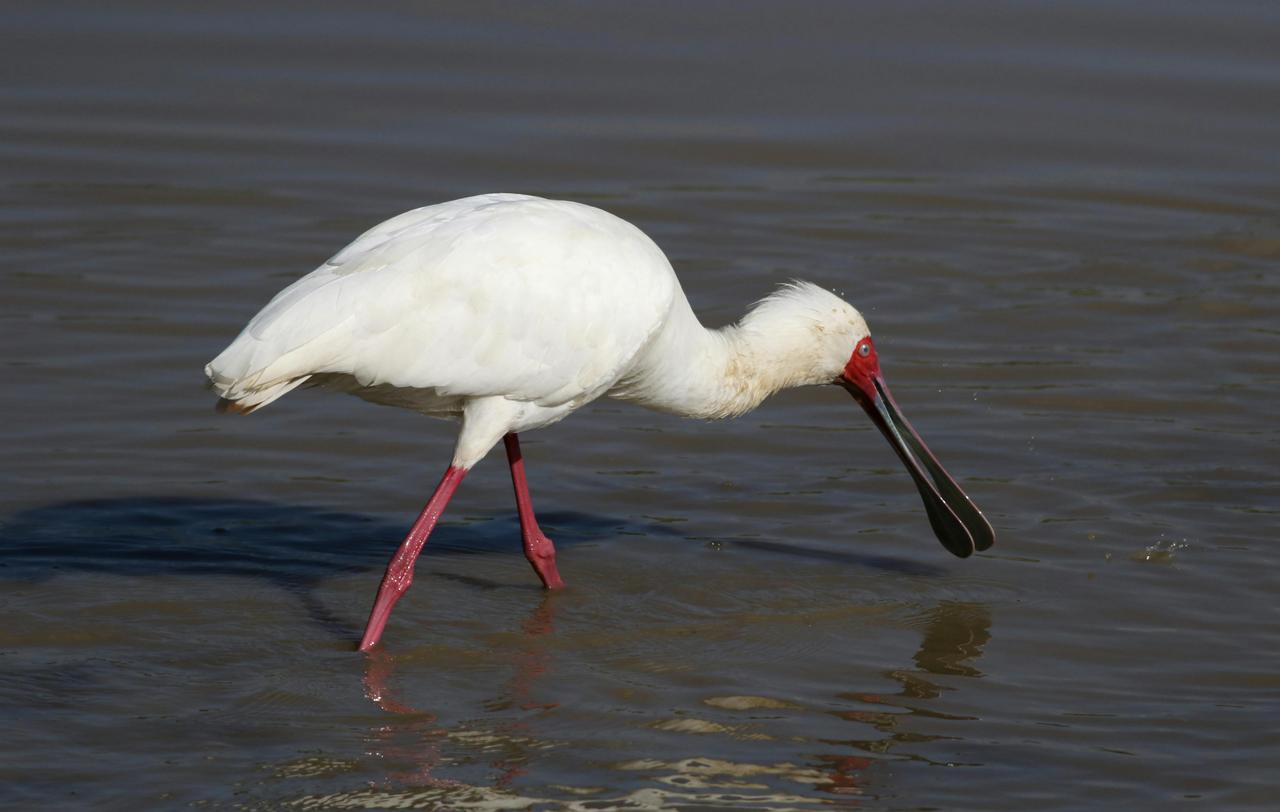
Spoonbill (Platalea leucorodia) is a large waterbird species belonging to the order Pelecaniformes and the family Threskiornithidae, which inhabits wetland areas. Its body length measures between 80 and 93 cm, its wingspan ranges from 115 to 135 cm, and its weight is between 1200 and 1700 grams. This species, roughly the size of a typical heron, is characterized by its ivory-white plumage and a distinctive black, spoon-shaped bill that gives it its name.
The bill of adult individuals is black with a prominent yellow tip at the end. Their legs are black, distinguishing them from the African spoonbill. During the breeding season, adults develop long crest feathers on the nape and a yellowish neck band, which disappear in winter. In juveniles, the bill and legs are pale pinkish, and the tips of the flight feathers appear black. Juveniles lack a neck band. When observing flight dynamics, it is noted that the bird extends its neck forward in a straight line, flaps its wings rapidly in a vertical plane with minimal movement, and occasionally enters brief gliding phases. The species tends to fly in small flocks, usually in a single-file formation.
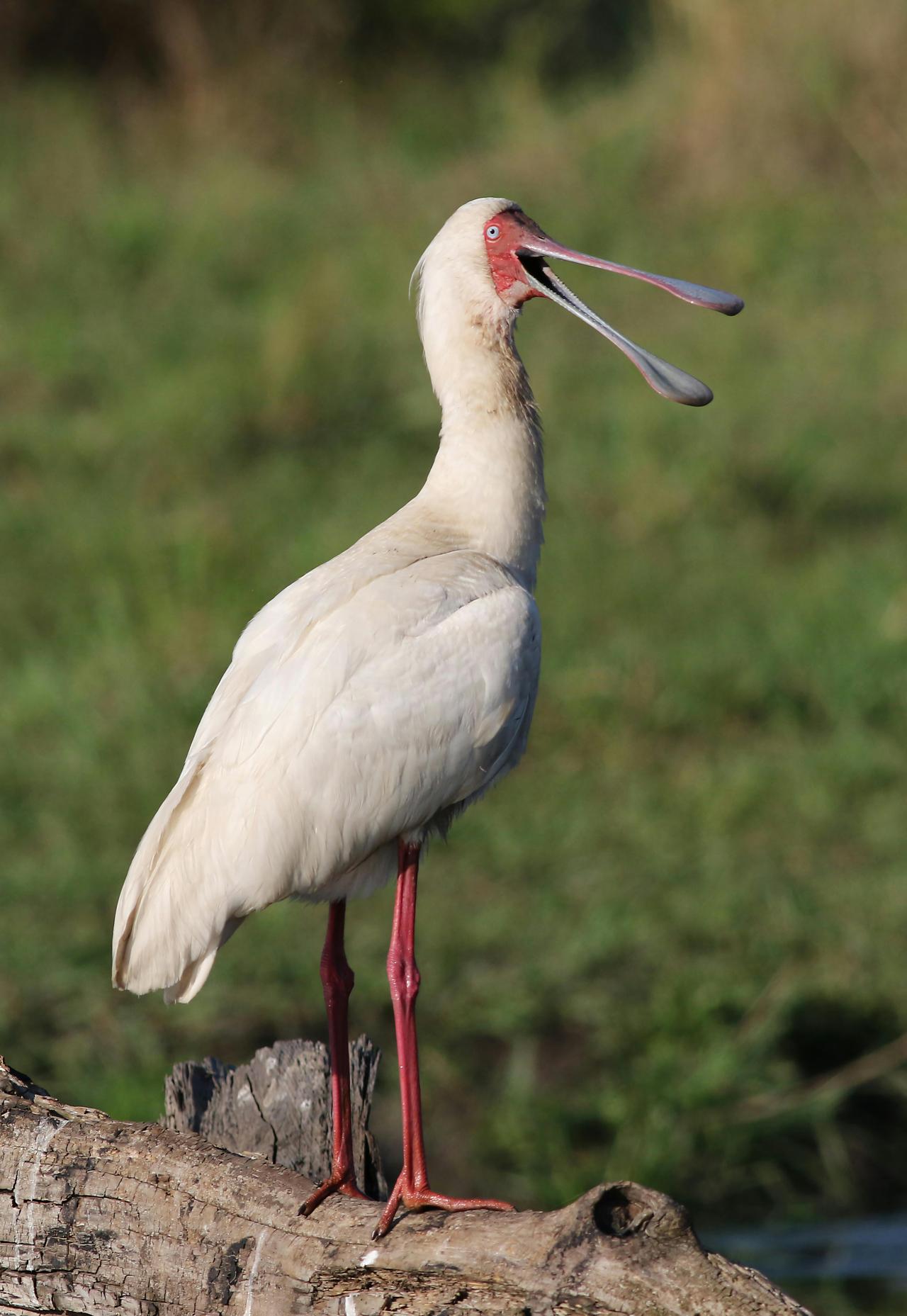
Spoonbill (Platalea leucorodia) (pexels)
This species primarily utilizes shallow open waters, flooded lands, rivers, marshes, streams, estuaries where rivers meet deltas, coastal lagoons, and mudflats as its main habitats. Partially migratory populations spend the winter across a broad geographic range extending from the southern coasts of Türkiye to southern Iran. In Türkiye, the species is more commonly observed as a summer visitor and passage migrant in the Marmara, Aegean, Mediterranean, Western Black Sea, and Central Anatolia regions, while it is found in smaller numbers and more locally in Eastern and Southeastern Anatolia. Globally, three distinct subspecies are recognized: P. l. leucorodia, which ranges from southern Spain and the Netherlands to Asia and India; P. l. balsaci, localized along the coast of Mauritania; and P. l. archeri, found near the Red Sea and Somalia.
During feeding, the bird walks through shallow water with its bill partially open, sweeping it side to side through the water or mud. The tip of the bill contains sensory receptors known as "papillae" that detect vibrations. These allow the bird to locate prey by touch rather than sight, granting it a physiological advantage that enables active foraging at night or in turbid waters. Its primary food sources include aquatic insects, insect larvae, worms, small fish, tadpoles, amphibians, crustaceans, and mollusks; seaweed is occasionally consumed. Due to its anatomical structure, it cannot swallow prey directly; instead, it tosses the prey into the air and catches it again before swallowing. Individuals often feed in close proximity to one another and, during the day, typically rest with their heads turned backward and bills tucked away. In breeding colonies, they produce low, growling calls for communication and are known to engage in mutual preening, cleaning each other’s feathers.
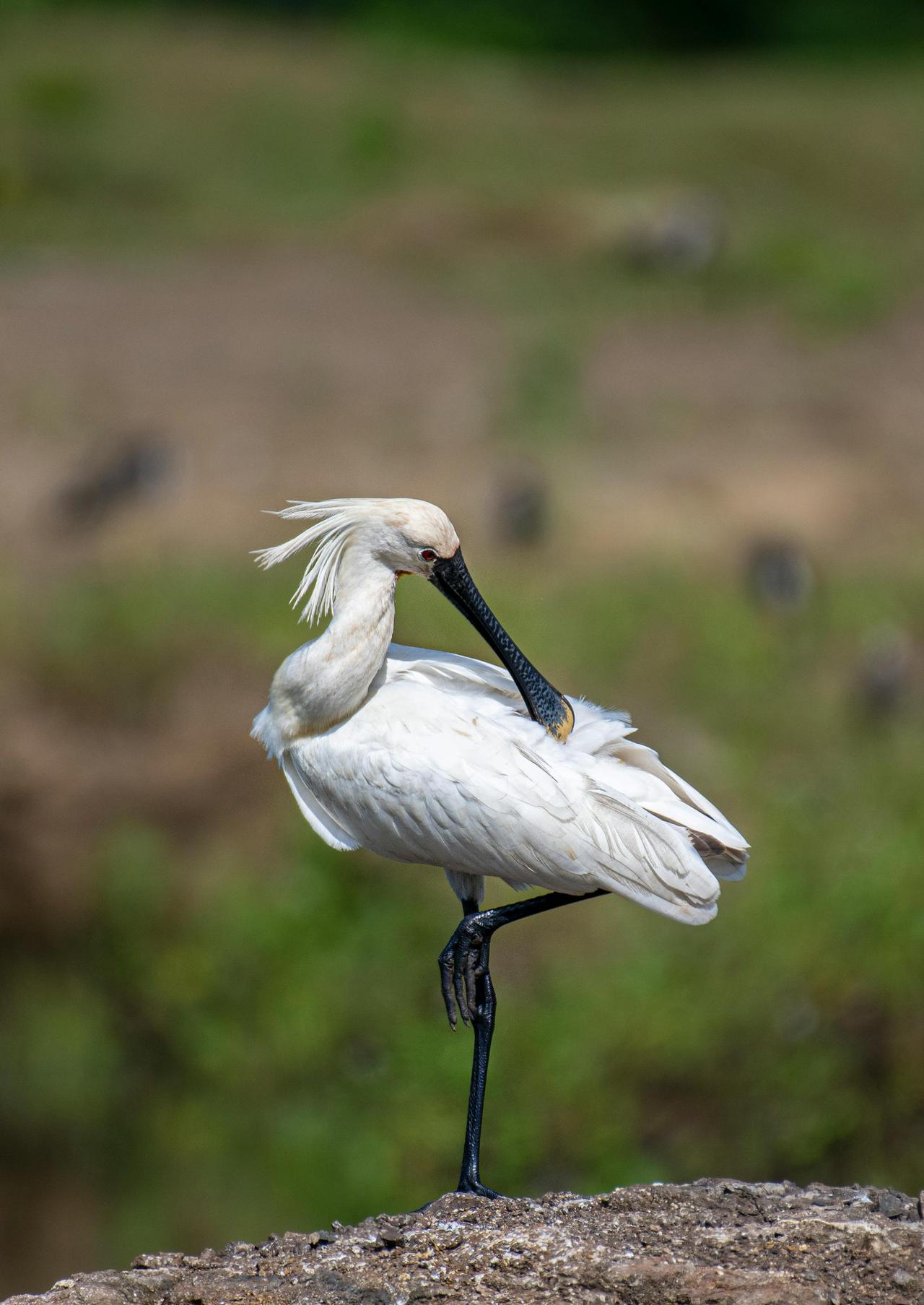
Spoonbill (Platalea leucorodia) (pexels)
Spoonbills are monogamous and typically breed in large, mostly single-species colonies. During the breeding season, males arrive at the colony site first and defend a designated territory. The nest is constructed from twigs, reeds, and fine grass stems carried by the male and arranged by the female, usually placed in trees, shrubs, or on isolated, sheltered ground-level islands. The female lays three to four eggs, with an incubation period averaging 24 to 25 days; both parents take turns incubating. Newly hatched chicks are covered in fluffy white down; their bills are initially short, soft, and fleshy. The characteristic flattened bill shape begins to develop approximately nine days after hatching and approaches the adult form by the end of the second week. Chicks leave the nest at an average age of 45 to 50 days, and individuals reach sexual maturity between three and four years of age.
The International Union for Conservation of Nature (IUCN) Red List classifies the species as "Least Concern" (LC). Although it does not face an immediate threat of global extinction, populations are vulnerable to environmental pollution, drainage of wetlands for agricultural or industrial purposes, human disturbance, and shrinking breeding habitats. Regional estimates suggest that the population within Türkiye ranges from 500 to 3000 individuals, in Russia from 2300 to 2800, and in other European countries approximately 2600 to 3200 individuals.
ORNITO.ORG. "Kaşıkçı (Platalea leucorodia)." Accessed April 28, 2026. https://ornito.org/Bird/Detail/251
Pexels. "Afrika Kaşıkçısı (Platalea alba) - Pilanesberg Milli Parkı." Accessed April 28, 2026. https://www.pexels.com/tr-tr/fotograf/guney-afrika-nin-kuzeybati-eyaleti-ndeki-pilanesberg-milli-parki-nda-afrika-kasikcisi-platalea-alba-33536151/
Pexels. "Kaşıkçı Kuşu Fotoğrafı 1." Accessed April 28, 2026. https://www.pexels.com/tr-tr/fotograf/34999795/
Pexels. "Kaşıkçı Kuşu Fotoğrafı 2." Accessed April 28, 2026. https://www.pexels.com/tr-tr/fotograf/34205458/
eBird. "Kaşıkçı (Platalea leucorodia)." Accessed April 28, 2026. https://ebird.org/species/eurspo1?siteLanguage=tr
İzmir Kuş Cennetini Koruma ve Geliştirme Birliği (İZKUŞ). "Kaşıkçı." Accessed April 28, 2026. https://izmirkuscenneti.gov.tr/kasikci/


No Discussion Added Yet
Start discussion for "Spoonbill (Platalea leucorodia)" article
Physical Characteristics
Habitat and Distribution
Feeding Behavior and Ecology
Reproduction and Biology
Population and Conservation Status