


This article was automatically translated from the original Turkish version.
+1 More
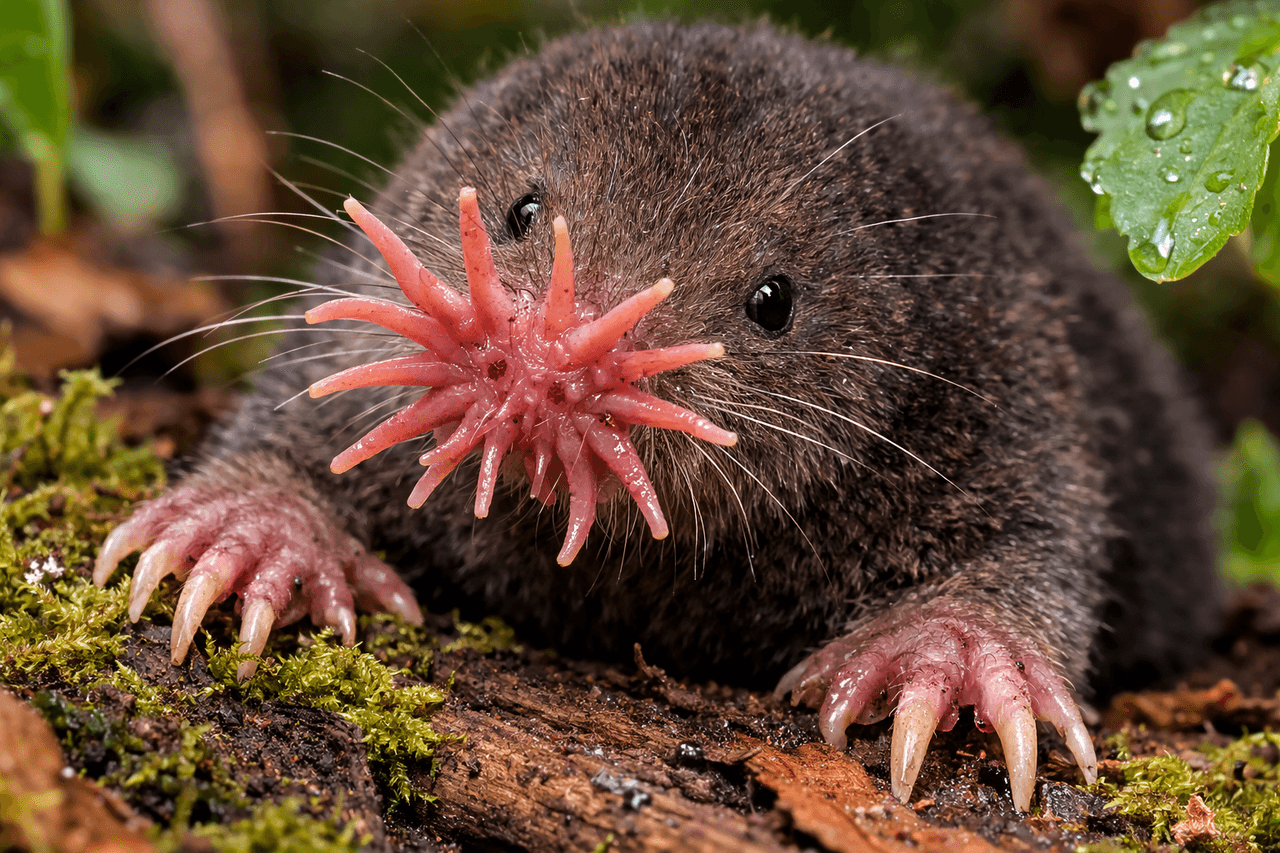
Star-nosed Mole
(Generated by Artificial Intelligence)
Star-nosed Mole (Condylura cristata)
Classification(s) | Mammal | ||||||||
|---|---|---|---|---|---|---|---|---|---|
Hydro-Olfaction | Has the ability to smell underwater | ||||||||
Super-Sense | Its nose contains more than 25,000 Eimer organs (receptors) | ||||||||
Record Holder | The fastest-feeding mammal in the world | ||||||||
Most Prominent Feature | 22-armed sensory nasal star | ||||||||
Habitat | Wetlands of North America | ||||||||
Darkness | Its eyes are almost completely nonfunctional; it 'sees' with its nose | ||||||||
Star-nosed mole (Condylura cristata), is a small mammal species endemic to eastern North America and belongs to the family Talpidae. It is characterized by a star-shaped organ on the tip of its nose, composed of 22 pink and mobile sensory appendages. This morphological structure provides a tactile navigation and hunting system in dark tunnels and underwater environments.
An adult star-nosed mole measures approximately 15 to 20 cm in length and weighs between 35 and 75 grams. Its body is covered with dense, black-brown, waterproof fur that provides insulation during aquatic activities. The forelimbs are enlarged and equipped with powerful claws adapted for digging. The hind limbs are five-toed and more slender. The tail is relatively long and has the capacity to store fat as an energy reserve during winter months; during this season, the tail’s diameter can expand to several times its normal size.【1】
The star-shaped structure on the nose is covered with approximately 25,000 microscopic touch receptors known as Eimer organs. These organs transmit data directly to the somatosensory cortex of the brain, enabling the animal to map its surroundings within milliseconds.【2】
The pair of appendages closest to the center of the star, known as the 11th pair, have the highest nerve density and function like a visual fovea, allowing detailed examination of prey. Thanks to this structure, the mole "sees" its environment by touch, as if scanning it with a high-resolution camera.【3】

Star-nosed Mole (Condylura cristata) in Nature
(Generated by Artificial Intelligence)
The species typically inhabits moist lowland areas with poor drainage, such as marshes, meadows, and riparian zones. These semi-aquatic moles remain active even beneath ice-covered water during winter. They can dig tunnel systems down to the water table, and their exit openings often lead directly into bodies of water.【4】
Star-nosed moles tend to be more social than other mole species. They may live in small colonies and share the same tunnel networks during winter. Natural predators include great horned owls, various hawks, weasels, minks, and large fish, particularly carp.【5】
Recognized as the fastest feeding mammal in the world, this animal can determine the edibility of prey in just 8 milliseconds and complete its entire hunting sequence in 230 milliseconds. Its diet primarily consists of earthworms, leeches, and aquatic insect larvae. Underwater, it also preys on small fish and crustaceans.
As a rare adaptation among mammals, it possesses the ability to smell underwater. While submerged, the mole expels air bubbles from its nose at a rate of about 10 per second; these bubbles contact objects, collect odor molecules, and are then re-inhaled through the nostrils. This method allows the mole to detect prey not only by touch but also by scent in aquatic environments.【7】
Star-nosed moles typically mate during spring, in March and April. Females give birth once per year. After a gestation period of approximately 45 days, they produce 2 to 7 young. At birth, the pups are hairless, about 5 cm in length, and weigh 1.5 grams. The star-shaped structure on their nose is initially fused to the face but opens and becomes functional within about two weeks. Pups begin leaving the nest briefly at 21 days, achieve full independence by day 30, and reach sexual maturity at approximately 10 months of age.
American Museum of Natural History. "The Star-Nosed Mole Has the World's Most Sophisticated Sniffer." Accessed March 10, 2026. https://www.amnh.org/explore/news-blogs/star-nosed-mole-scent.
Carnegie Museum of Natural History. "The Nose that 'Sees'." Accessed March 10, 2026. https://carnegiemnh.org/the-nose-that-sees/.
Gould, Edwin, William McShea, and Theodore Grand. “Function of the Star in the Star-Nosed Mole (*Condylura cristata*).” *Journal of Mammalogy* 74, no. 1 (1993): 108–116. Accessed March 10, 2026. https://doi.org/10.2307/1381909
Grand, Theodore, Edwin Gould, and Richard Montali. “Structure of the Proboscis and Rays of the Star-Nosed Mole (Condylura cristata).” Journal of Mammalogy 79, no. 2 (1998): 492–501. Accessed March 10, 2026. https://doi.org/10.2307/1382980
Natural History Museum. "Why do star-nosed moles have a 'hand' on their face?" Accessed March 10, 2026. https://www.nhm.ac.uk/discover/star-nosed-moles-have-a-hand-on-their-face.html.
Zera, Sean. "Condylura cristata (star-nosed mole)." Animal Diversity Web (ADW). Accessed March 10, 2026. https://animaldiversity.org/accounts/Condylura_cristata/
[1]
Zera, Sean. "Condylura cristata (star-nosed mole)." Animal Diversity Web (ADW), erişim tarihi 10 Mart 2026, https://animaldiversity.org/accounts/Condylura_cristata/
[2]
Carnegie Museum of Natural History. "The Nose that 'Sees'." Yazarlar: Lisa Miriello, erişim tarihi 10 Mart 2026, https://carnegiemnh.org/the-nose-that-sees/
[3]
Natural History Museum. "Why do star-nosed moles have a 'hand' on their face?" Yazarlar: Holly Chetan-Welsh, erişim tarihi 10 Mart 2026, https://www.nhm.ac.uk/discover/star-nosed-moles-have-a-hand-on-their-face.html
[4]
Zera, Sean. "Condylura cristata (star-nosed mole)." Animal Diversity Web (ADW), erişim tarihi 10 Mart 2026, https://animaldiversity.org/accounts/Condylura_cristata/
[5]
Zera, Sean. "Condylura cristata (star-nosed mole)." Animal Diversity Web (ADW), erişim tarihi 10 Mart 2026, https://animaldiversity.org/accounts/Condylura_cristata/
[7]
American Museum of Natural History. "The Star-Nosed Mole Has the World's Most Sophisticated Sniffer." erişim tarihi 10 Mart 2026, https://www.amnh.org/explore/news-blogs/star-nosed-mole-scent

Star-nosed Mole
(Generated by Artificial Intelligence)
Star-nosed Mole (Condylura cristata)
Classification(s) | Mammal | ||||||||
|---|---|---|---|---|---|---|---|---|---|
Hydro-Olfaction | Has the ability to smell underwater | ||||||||
Super-Sense | Its nose contains more than 25,000 Eimer organs (receptors) | ||||||||
Record Holder | The fastest-feeding mammal in the world | ||||||||
Most Prominent Feature | 22-armed sensory nasal star | ||||||||
Habitat | Wetlands of North America | ||||||||
Darkness | Its eyes are almost completely nonfunctional; it 'sees' with its nose | ||||||||
No Discussion Added Yet
Start discussion for "Star-nosed Mole (Condylura cristata)" article
Physical Characteristics and Morphology
Habitat and Ecology
Feeding and Hunting Strategies
Reproduction and Development