


This article was automatically translated from the original Turkish version.
+2 More
Status anxiety is defined as a deep socio-psychological concern experienced by individuals in the face of the threat of losing their current social position or the possibility of being devalued for failing to meet society’s criteria of success. This fundamental anxiety regarding one’s ability to maintain their place in the social hierarchy has become an increasingly widespread phenomenon in contemporary societies and is now addressed in academic literature in multidimensional ways.
The term “status” derives from the Latin word “statum,” meaning “standing.” In a narrow sense, it refers to an individual’s formal position within a group; in a broader sense, it denotes the value, prestige, and honor that society attributes to a person. According to sociologist Max Weber, status distinguishes between social groups based on the respect conferred upon individuals by others and manifests in their lifestyle.【1】

Visual Representing Status Anxiety (Generated by Artificial Intelligence)
In academic literature, status anxiety is primarily explained through two theoretical frameworks:
According to Alain de Botton’s analyses, modern societies are fueled by five primary sources of status anxiety:【4】
The fundamental aim of individuals pursuing wealth, power, or fame in society is to gain attention and approval through these means. High-status individuals are acknowledged, while low-status individuals are ignored by society. This dynamic drives individuals toward despair.
The term “snob,” originating from the 1800s English abbreviation “sine nobilitate” used to describe non-noble students, refers to the tendency to equate human worth solely with social position.【5】 Snobs carry an anxiety about proximity to power and authority. At the foundation of these status-centered relationships lie fear and insecurity.
With the rise of modern capitalism and the Industrial Revolution, rigid hierarchies between reference groups weakened, and the idea of equal opportunity became widespread. While aristocratic inequalities were once accepted, today’s expectation that everyone can achieve anything has amplified feelings of deprivation. Thinker Tocqueville described this condition as the modern individual’s restlessness, while Rousseau argued that poverty arises from the stimulation of desires.
The ideology of merit, which holds that an individual’s position in the social hierarchy is shaped by intelligence, talent, and effort, has made success the primary criterion in the modern era. In pre-modern times, poverty was explained through various narratives; under meritocratic systems, failure is attributed to personal inadequacy or laziness. This condition, supported by social Darwinism, creates a source of shame for those of low status.
In modern economies, securing permanent status has become increasingly difficult. Career success depends on an individual’s variable abilities, uncontrollable external chance factors, employer initiatives, workforce layoffs aimed at preserving profit margins, and the volatile crises of the global economy. These uncontrollable variables generate persistent insecurity.
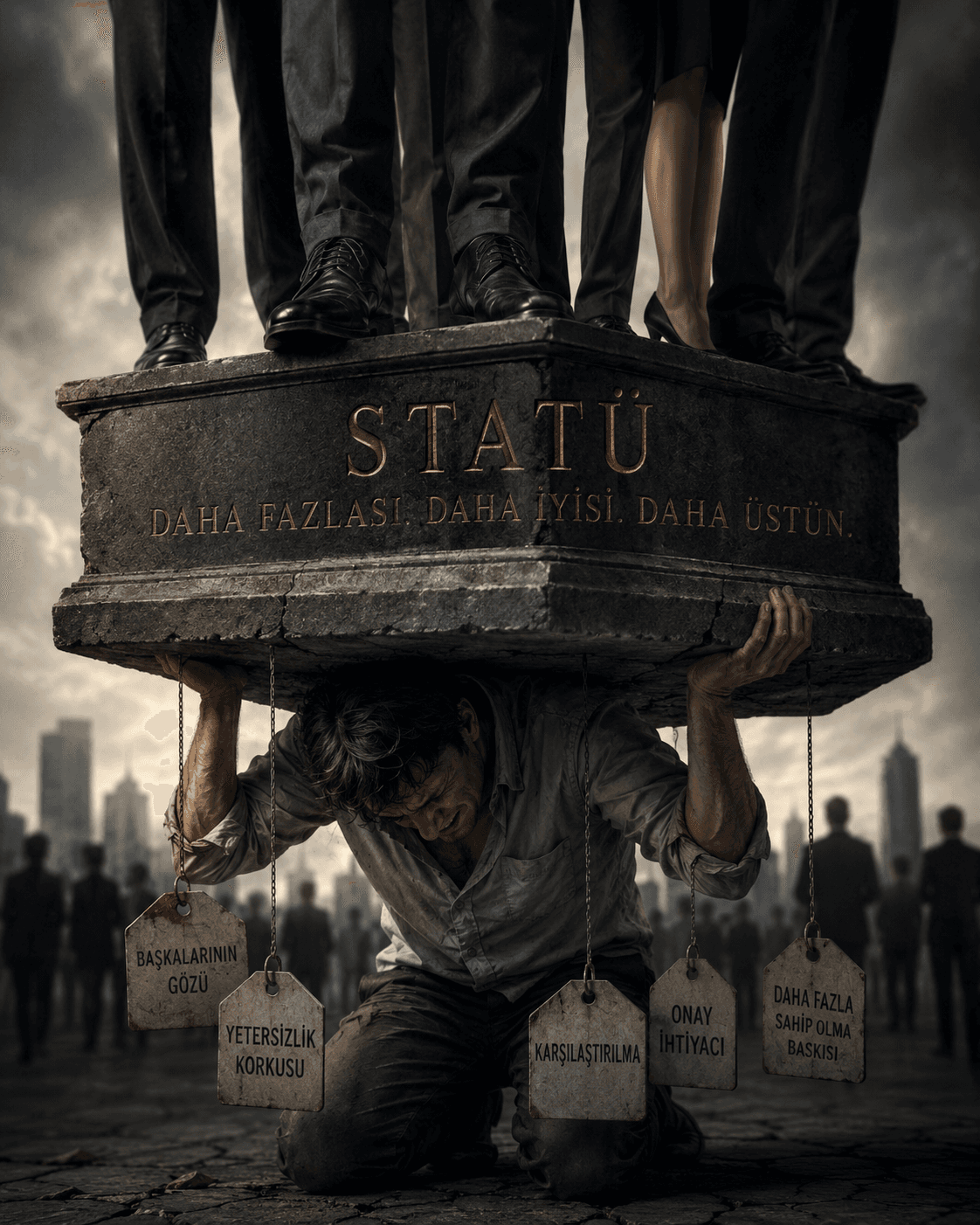
Visual Representing Status Anxiety (Generated by Artificial Intelligence)
Status anxiety manifests in workplaces as hidden envy and implicit competition. Research indicates that its most prominent effect on organizational behavior is the intention to leave one’s job. When individuals perceive their current status as inferior compared to peers, they feel unjustly treated and tend to avoid environments where they do not feel valued. Rising income inequality in society fuels status anxiety; in contexts perceived as economically threatening, individuals pursue status through more aggressive strategies.
As hereditary privileges have been replaced by achieved status, education has become the most legitimate vehicle for vertical social mobility. For masses deprived of wealth and capital inheritance, acquiring education is the pathway to new status. The Turkish Fundamental Law of National Education also legally commits to preparing individuals for life and equipping them with a profession or status.【6】
However, the educational system today faces crises in its function of conferring status. According to data from the Economic Policy Research Foundation of Türkiye, unemployment rates among university graduates are rising.【7】 A significant proportion of employed university graduates begin work at wages below the poverty line. The failure to achieve the expected economic power and prestige weakens the linear link between education and status.
Moreover, the legal requirement that only primary school graduation is necessary to hold high-status political positions in society reflects a sociological imbalance between education and status. When education fails to deliver the anticipated income and prestige, it undermines public trust in education and transforms status anxiety into a structural problem.
Various defense mechanisms exist to protect individuals from the psychological damage caused by hierarchical competition:

Visual Representing Status Anxiety (Generated by Artificial Intelligence)
Altın, Muhterem. "Türkiye’de Eğitim, Statü ve Sosyal Hareketlilik." Mecmua: Uluslararası Sosyal Bilimler Dergisi 5, pp. 180-196. Accessed March 28, 2026. https://dergipark.org.tr/tr/download/article-file/1269506
Kılınç, Muhammed Çağrı, and Deniz Dirik. "Statü Endişelerinin İş Tutumları ile Etkileşimine Dair Bir Araştırma." *Balıkesir Üniversitesi Sosyal Bilimler Enstitüsü Dergisi* 26, pp. 229–245. Accessed March 28, 2026. https://dergipark.org.tr/tr/download/article-file/4039031
Yılmaz, Mevlüt. "Statü Endişesi." Fırat Üniversitesi Sosyal Bilimler Dergisi 33, pp. 343-350. Accessed March 28, 2026. https://dergipark.org.tr/en/download/article-file/3204470
[1]
Muhammed Çağrı Kılınç ve Deniz Dirik, "Statü Endişelerinin İş Tutumları ile Etkileşimine Dair Bir Araştırma," Balıkesir Üniversitesi Sosyal Bilimler Enstitüsü Dergisi 26 (2025): syf 234,Erişim Tarihi:22 Mayıs https://dergipark.org.tr/tr/download/article-file/4039031.
[2]
Muhammed Çağrı Kılınç ve Deniz Dirik, "Statü Endişelerinin İş Tutumları ile Etkileşimine Dair Bir Araştırma," Balıkesir Üniversitesi Sosyal Bilimler Enstitüsü Dergisi 26 (2025): syf 234-235,Erişim Tarihi:22 Mayıs https://dergipark.org.tr/tr/download/article-file/4039031.
[3]
Muhammed Çağrı Kılınç ve Deniz Dirik, "Statü Endişelerinin İş Tutumları ile Etkileşimine Dair Bir Araştırma," Balıkesir Üniversitesi Sosyal Bilimler Enstitüsü Dergisi 26 (2025): syf 234,Erişim Tarihi:22 Mayıs https://dergipark.org.tr/tr/download/article-file/4039031.
[4]
Muhammed Çağrı Kılınç ve Deniz Dirik, "Statü Endişelerinin İş Tutumları ile Etkileşimine Dair Bir Araştırma," Balıkesir Üniversitesi Sosyal Bilimler Enstitüsü Dergisi 26 (2025): syf 230,Erişim Tarihi:22 Mayıs https://dergipark.org.tr/tr/download/article-file/4039031.
[5]
Muhterem Altın, "Türkiye'de Eğitim, Statü ve Sosyal Hareketlilik," Mecmua: Uluslararası Sosyal Bilimler Dergisi , syf 235,Erişim Tarihi:22 Mayıs https://dergipark.org.tr/tr/download/article-file/1269506.
[6]
Muhterem Altın, "Türkiye'de Eğitim, Statü ve Sosyal Hareketlilik," Mecmua: Uluslararası Sosyal Bilimler Dergisi 5, no. 10 (2020): syf 186-188 ,Erişim Tarihi:22 Mayıs https://dergipark.org.tr/tr/download/article-file/1269506.
[7]
Muhterem Altın, "Türkiye'de Eğitim, Statü ve Sosyal Hareketlilik," Mecmua: Uluslararası Sosyal Bilimler Dergisi 5, syf 188-189,Erişim Tarihi:22 Mayıs https://dergipark.org.tr/tr/download/article-file/1269506.


Key Factors Triggering Status Anxiety
Lack of Love
Snobbery
Expectation of Equality
Meritocracy
Uncertainty and Lack of Trust
Effects on Organizational Behavior and Work Life
Education, Social Mobility, and the Crisis of Merit
Philosophical, Artistic, and Political Coping Strategies