This article was automatically translated from the original Turkish version.
+2 More
Director(s) | Muhsin Ertuğrul, İhsan İpekçi | ||||||||
|---|---|---|---|---|---|---|---|---|---|
Screenwriter(s) | Muhsin Ertuğrul | ||||||||
Music(s) | Hasan Ferit Alnar Hüseyin Sadettin Arel | ||||||||
Production Year | 1931 | ||||||||
Genre | Musical Drama | ||||||||
Country | Türkiye Egypt Greece | ||||||||
Producer(s) | İpek Film | ||||||||
In the Streets of Istanbul is a musical–drama film produced in 1931 by İpek Film, directed by Muhsin Ertuğrul and İhsan İpekçi, with a screenplay by Ertuğrul. It is a co-production involving Türkiye, Egypt and Greece. The film premiered for the first time on 1 December 1931.【1】
This production is recorded in Turkish cinema history as the first sound film and also holds the distinction of being the first co-production to bring together three countries. Due to its high budget by the standards of the time, it became an industrial milestone in early Republican cinema.
The film centers on the tension between two brothers who are both attracted to the same woman. The female character sustains her livelihood by singing in nightclubs and receiving financial support from her relationships. One brother, Rahmi, works at a bank and commits embezzlement by spending the institution’s funds due to his loyalty to the woman. The exposure of this act creates both financial debt and loss of reputation for his family and intensifies the conflict between the brothers. The other brother’s subsequent nervous breakdown is linked narratively to the nightclub scene, which serves as the physical climax of the story.
The narrative weaves together themes of crime, debt, familial responsibility and personal desire. Rather than relying on major action sequences, it follows the psychological and emotional unraveling of the characters under economic and emotional pressure. The story places at its core the struggle between “individual social obligations” and “the consequences of personal weaknesses”.
The film is the product of a multinational production process, both economically and culturally. The collaboration between Türkiye, Egypt and Greece is evident across multiple levels—from casting and language use to filming locations and distribution strategy. The sound recording was done outside Türkiye, thus providing a regional solution to the limitations of local studio facilities.

A still from the film "In the Streets of Istanbul" (MUBI)
Because the film was shot silently and later dubbed, it is regarded as the first example marking Türkiye’s transition to sound cinema. The presence of Turkish, French, Arabic and Greek languages in the film reflects both the commercial logic of the co-production and Istanbul’s multilingual social structure in the early 20th century.
Musical elements are integrated as part of the dramatic flow. The songs performed by the characters are not merely entertainment sequences but structural components that advance the narrative. Rahmi’s rendition of “Tükenmez Yollarda”, Semiha Berksoy’s lullaby and Hazım Körmükçü’s folk melodies define the film’s musical identity.
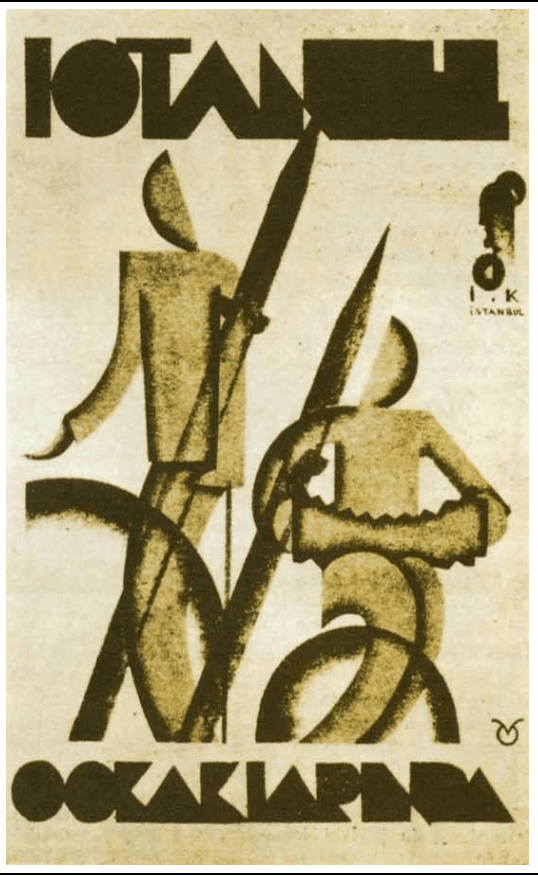
In the Streets of Istanbul is recognized as one of the earliest examples of modern graphic design in Turkish cinema. The film poster is the first locally designed poster following the alphabet reform. The designer is Vedat Ar. The Art Deco-inspired geometric composition, abstract figures and typographic simplicity reflect the era’s aspiration toward modernization.【2】

Poster for "In the Streets of Istanbul" (IMDb)
The film’s significance in cinema history is tied more to its production and technical characteristics than to its content. It is regarded as a foundational reference for the following reasons:
The film features prominent figures from the theatrical and performing arts circles of the period:
Cemiloğlu, Meltem, and Halit Turgay Ünalan. "Yapay Zekâ Yoluyla Erken Cumhuriyet Dönemi Film Afişlerinin Yeniden Yorumlanması: İstanbul Sokaklarında Film Afişi Üzerine Bir Deneme." Anadolu Üniversitesi Sosyal Bilimler Dergisi 23, Özel Sayı (2023): 455-478. Accessed December 1, 2025.
IMDb. "İstanbul Sokaklarında." Accessed December 1, 2025. https://www.imdb.com/title/tt0292384/?ref_=ttpl_ov_i.
Mubi. "İstanbul Sokaklarında." Accessed December 1, 2025. https://mubi.com/tr/tr/films/istanbul-sokaklarinda.
Orakçı, Meryem. “Türk-Yunan İlişkilerinin Sinemadaki İz Düşümü: İlk Türk-Yunan Ortak Yapımı Filmler.” *Cumhuriyet Tarihi Araştırmaları Dergisi (CTAD)* 19, no. 37 (Spring 2023): 591–630. Accessed December 1, 2025. https://ctad.hacettepe.edu.tr/19_37/19.pdf.
Özdamar, Zeynep. "İstanbul'un 1950-1990 Dönemindeki Kentsel Gelişiminin Türk Sinemasındaki Temsili." Master's thesis, İstanbul Teknik Üniversitesi, 2006. https://polen.itu.edu.tr:8443/server/api/core/bitstreams/105b7849-d648-4d41-b6f3-df505612fa4d/content
[1]
Meryem Orakçı, “Türk-Yunan İlişkilerinin Sinemadaki İz Düşümü: İlk Türk-Yunan Ortak Yapımı Filmler,” Cumhuriyet Tarihi Araştırmaları Dergisi (CTAD) 19, sy. 37 (Bahar 2023), s. 605.
[2]
Meltem Cemiloğlu ve Halit Turgay Ünalan. "Yapay Zekâ Yoluyla Erken Cumhuriyet Dönemi Film Afişlerinin Yeniden Yorumlanması: İstanbul Sokaklarında Film Afişi Üzerine Bir Deneme." Anadolu Üniversitesi Sosyal Bilimler Dergisi 23, Özel Sayı (2023), s. 462.

Director(s) | Muhsin Ertuğrul, İhsan İpekçi | ||||||||
|---|---|---|---|---|---|---|---|---|---|
Screenwriter(s) | Muhsin Ertuğrul | ||||||||
Music(s) | Hasan Ferit Alnar Hüseyin Sadettin Arel | ||||||||
Production Year | 1931 | ||||||||
Genre | Musical Drama | ||||||||
Country | Türkiye Egypt Greece | ||||||||
Producer(s) | İpek Film | ||||||||
No Discussion Added Yet
Start discussion for "Streets of Istanbul (Film)" article
Plot and Narrative Framework
Production Context and Co-Production
The Emergence of the "First Sound Film", Language and Musical Structure
Poster Design and Visual Identity
Historical Position and Place in Cinema Scholarship
Cast