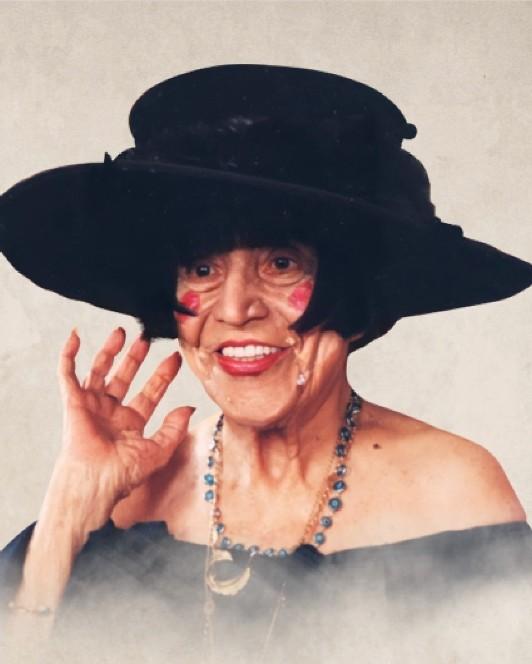
+2 More

Birth | 24 May 1910 | ||||||||
|---|---|---|---|---|---|---|---|---|---|
Place of Birth | Istanbul | ||||||||
Death | 15 August 2004 | ||||||||
Babası | Ziya Cenap Berksoy | ||||||||
Annesi | Fatma Saime Hanım | ||||||||
Awards and Titles | 1998: State Artist 1984: Atatürk Opera Award 1961: DTCF Painting Award | ||||||||
Semiha Cenap Berksoy (1910–2004) was Türkiye’s first female opera artist. She was active in theatre, opera, and painting, and throughout her artistic career she built bridges between performing arts and visual arts. Her prolific output across multiple artistic disciplines and her long-lasting career made her a significant figure in the history of Turkish performing arts during the Republic era.
Semiha Berksoy was born on 24 May 1910 in the Çengelköy neighborhood of Istanbul. Her father, Ziya Cenap Berksoy, was a finance clerk and poet; her mother, Fatma Saime Hanım, was a sculptor and painter. At the age of eight, she lost her mother to the Spanish flu pandemic, and shortly thereafter, her uncle Basri Cenap Bey, with whom she had moved to live, died of tuberculosis. These losses deeply affected her emotional development and her orientation toward art.
She began her primary education at Esma Han Kaya Sultan Primary School in Sultanahmet and completed it at Moda İnas Numune Primary School. The Kuşdili Theatre, located opposite her family’s home in Kuşdili, heightened her interest in performing arts. During her school years, she demonstrated notable achievements in drawing and composition. From childhood, she was engaged with theatre, painting, and literature.

Infographic on Semiha Berksoy’s life (Anadolu Agency)
In 1928, she was admitted to the vocal class of Nimet Vahid Hanım, a renowned soprano and voice specialist, at the Istanbul Municipal Conservatory. During the same period, her paintings earned her a scholarship to the Namık İsmail Atelier of the Academy of Fine Arts. In 1929, she performed arias from Puccini and Rimsky-Korsakov in her first concert in Istanbul.
While receiving painting instruction at the academy, she continued to pursue performing arts. In 1930, she won the entrance examination for the Darülbedayi Theatre School by portraying the role of “Kate” in Shakespeare’s The Taming of the Shrew. The theatre training she received there refined her stage discipline and acting technique.
In 1934, she portrayed the role of “Ayşim” in Özsoy, the first Turkish opera composed by Ahmed Adnan Saygun at the request of Atatürk. This performance marked a pivotal turning point in her artistic career.
In 1936, she was accepted into the Opera Department of the Berlin State Higher Music Academy on a state scholarship. After completing her studies under Professor Paul Lohmann, she graduated with first-class honors in 1939. In the same year, she performed the title role of “Ariadne” in Richard Strauss’s Ariadne auf Naxos, becoming the first Turkish soprano to appear on stage in Western Europe.
In 1940, she returned to Türkiye and gave her first concert with Cemal Reşit Rey. In 1941, she took the lead role in Tosca, directed by Carl Ebert, becoming the first Turkish artist to perform a professional opera in Türkiye. She later performed in works such as Madame Butterfly, Lüküs Hayat, and Deli Dolu. She played an active role in the founding of the Ankara State Opera and was appointed as a soloist of the institution in 1950.
From 1951 onward, she assumed leading roles in operas such as Tiefland, Tosca, and Fidelio. In 1952, she participated in the Beirut Festival and gave concerts both domestically and internationally. In 1954, she performed the role of “Mother” in Hansel and Gretel, and in 1955, she gave a concert at the Munich Culture Days.
In 1931, she starred in the lead role of İstanbul Sokaklarında, Türkiye’s first sound film, directed by Muhsin Ertuğrul. In 1932, she joined the Darülbedayi ensemble and performed as a prima donna in major plays and Turkish operettas of the era.
She portrayed the character “Fatma” in Nazım Hikmet’s operetta Bu Bir Rüyadır. She also played leading roles in works by Cemal Reşit and Ekrem Reşit Rey.
From 1933 onward, she performed in both Turkish and foreign plays at the Istanbul City Theatre. She participated in the operetta Lüküs Hayat, staged as part of the Republic’s 10th anniversary celebrations.
In 1958, she joined the State Theatre ensemble. She appeared in works such as Macun Hokkası, İstanbul Efendisi, Dışarıdakiler, Kaneviçe, Karayar Köprüsü, Cadı Kazanı, and İvan İvanoviç Var mıydı Yok muydu?. Her success in character roles drew significant attention. During the 1960s, she primarily performed in Turkish plays and world classics. In 1963, she celebrated her jubilee with the role of “Azucena” in Verdi’s Il Trovatore.
In 1972, she retired from the State Opera and Ballet as a dramatic soprano but continued her activities in theatre and other artistic fields.
From 1929 onward, she pursued painting at the Namık İsmail Atelier. She produced works in sculpture and ceramics. From the 1960s, she focused primarily on painting. She held exhibitions in Berlin in 1969, Paris in 1972, Ankara in 1973, and at the Istanbul AKM Art Gallery in 1982. Her works were exhibited in Moscow and Leningrad in 1985. In 1995, the Semiha Berksoy Opera Foundation was established to preserve her legacy and protect her works.

Semiha Berksoy’s Funeral Ceremony (Anadolu Agency)
In 1996, she participated in Kutluğ Ataman’s project “Semiha b. Unplugged.” In 1998, she was awarded the title of State Artist. In 2003, a retrospective exhibition of her work was held at the İş Sanat Kibele Art Gallery.
Semiha Berksoy passed away on 15 August 2004 at the age of 94. Her funeral prayer was held at Teşvikiye Camii. She was laid to rest in Çengelköy, the neighborhood where she was born.
Alem Dergisi. "Semiha Berksoy’un Hayatı, Sanatı ve Eserleri." Accessed August 14, 2025. https://www.alem.com.tr/sanatcilar/semiha-berksoyun-hayati-sanati-ve-eserleri-1083209
Anadolu Ajansı. “Türk Operasının Öncü Sanatçılarından Semiha Berksoy.” Accessed August 14, 2025. https://www.aa.com.tr/tr/kultur/turk-operasinin-oncu-sanatcilarindan-semiha-berksoy/3303368
Anadolu Ajansı. “Türk Sanat Hayatında İlklerin Kadını: Semiha Berksoy.” Accessed August 14, 2025. https://www.aa.com.tr/tr/kultur/turk-sanat-hayatinda-ilklerin-kadini-semiha-berksoy/2661393
Kültür ve Yaşam. “İlklerin Sanatçısı Semiha Berksoy’un İlham Veren Hayatı.” Halkbank. Accessed August 14, 2025. https://kulturveyasam.com/ilklerin-sanatcisi-semiha-berksoyun-ilham-veren-hayati/
Semiha Berksoy Opera Vakfı. “Semiha Berksoy.” Semiha Berksoy Opera Vakfı. Accessed August 14, 2025. https://www.semihaberksoyoperavakfi.org/semiha-berksoy
Söylenti Dergi. “İlk Türk Kadın Opera Sanatçısı: Semiha Berksoy.” Söylenti Dergi. Accessed August 14, 2025. https://www.soylentidergi.com/ilk-turk-kadin-opera-sanatcisi-semiha-berksoy/
TRT World. “Turkey’s First Female Opera Singer Semiha Berksoy.” TRT World. Accessed August 14, 2025. https://trt.global/world/article/14487319
Şahin, Feyza Kurnaz. “Semiha Cenap Berksoy (1910–2004).” *Atatürk Ansiklopedisi*. Accessed August 14, 2025. https://ataturkansiklopedisi.gov.tr/detay/265/Semiha_Cenap_Berksoy_(1910-2004)
[1]
Semiha Berksoy Opera Vakfı. “Semiha Berksoy.” Semiha Berksoy Opera Vakfı. Erişim 14 Ağustos 2025. https://www.semihaberksoyoperavakfi.org/semiha-berksoy

Birth | 24 May 1910 | ||||||||
|---|---|---|---|---|---|---|---|---|---|
Place of Birth | Istanbul | ||||||||
Death | 15 August 2004 | ||||||||
Babası | Ziya Cenap Berksoy | ||||||||
Annesi | Fatma Saime Hanım | ||||||||
Awards and Titles | 1998: State Artist 1984: Atatürk Opera Award 1961: DTCF Painting Award | ||||||||
Early Life and Education
Educational Journey
Özsoy Opera and Foreign Education
Opera Career in Türkiye
Significant Opera Roles
Theatre and Cinema Work
Theatre Roles【1】
Painting and Other Artistic Activities
Awards and Honors
Later Years and Death