Mussels are shelled marine animals commonly found in oceans, belonging to the class Bivalvia. Their defining characteristic is a hard, two-part shell that encloses the body. These shells are connected by a hinge and provide protection for the organism. Mussels typically attach themselves to rocky surfaces on the seafloor using strong fibrous threads called byssal threads. However, they can also form colonies on metallic or hard surfaces such as ship hulls and pier supports. From a health perspective, mussels grown in open seas and natural rocky environments are considered cleaner and more desirable.
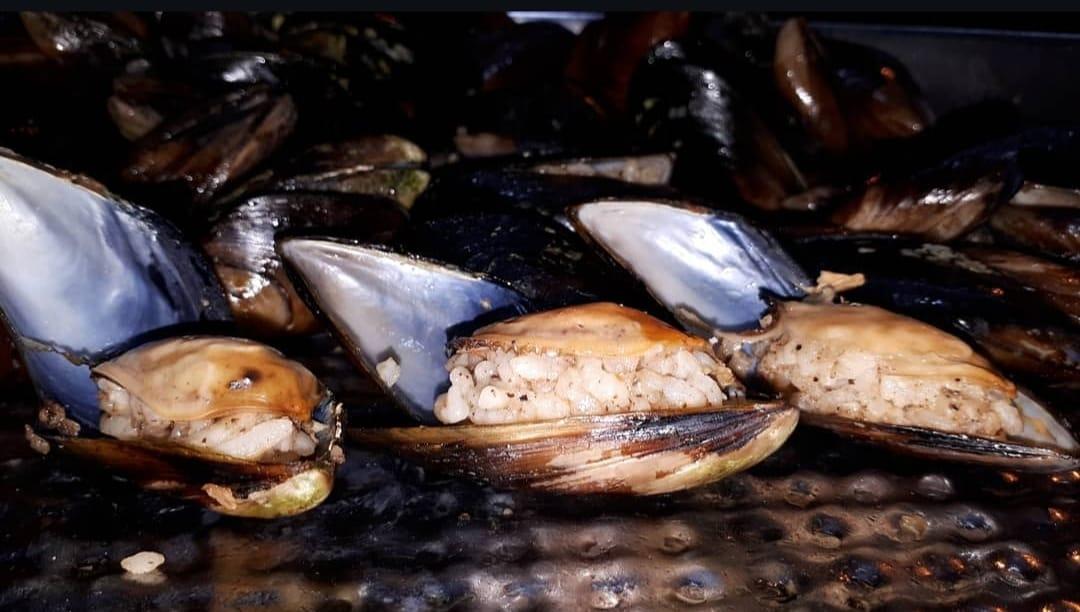
Mussels stuffed with rice is a popular street food unique to Turkish cuisine. It is prepared by filling mussels harvested from the sea with a specially prepared rice pilaf.
Mussels stuffed with rice. (Photo: Gülbahar Berfin Aksoy)
In the first step, the outer surfaces of mussels obtained from the sea must be carefully cleaned. This process involves removing algae, dirt and other marine residues. Then, the shells are opened slightly on one side only, without fully separating them. This opening must be sufficient to allow removal of algae, sand and other debris from inside. This step is crucial for both hygiene and flavor.
Preparing the Rice Pilaf Filling
The preparation of the rice pilaf filling, which gives stuffed mussels their distinctive flavor, may vary according to taste. However, the general ingredients and approximate quantities used are as follows (for an average of 20–25 mussels):
- 1 kg mussels in shells
- 250 g rice
- 1 onion
- 1 teaspoon pine nuts
- 1 teaspoon currants
- 1 teaspoon cinnamon
- 1 teaspoon black pepper
- 1 tablespoon dill
- 1 tablespoon mint
- 4–5 sprigs parsley
- 4–5 sprigs dill
- 2 teaspoons salt
- 1/2 cup olive oil
- 7 cups water
- Rice is placed in warm water sufficient to cover it and left to soak for 15 minutes. This step helps release some of the rice’s starch, allowing it to cook into separate grains and preventing clumping. Using warm water accelerates this process. Soaking allows the rice to absorb water and swell, making it easier to cook.
- Onions and pine nuts are finely chopped and sautéed in olive oil until the onions turn pink. Finely chopping the onions ensures their flavor is evenly distributed throughout the dish. Pine nuts are similarly chopped to enhance both texture and taste. Olive oil, a characteristic flavor of Mediterranean cuisine, adds a pleasant aroma to the sautéed onions. The onions turning pink indicates the ideal point where their sweetness begins to develop and their aroma becomes pronounced.
- The drained rice is added to the onions and sautéed for another 5 minutes. Draining the rice removes excess water. Sautéing it with the onions helps lightly cook the outer layer of the rice grains and enhances their flavor. This step also allows the rice to better withstand the addition of liquid later.
- Then currants, mint, cinnamon, black pepper, dill, and salt are added, sautéed for another 2 minutes, and 5 cups of water are added. At this stage, the spices and currants that give stuffed mussels their unique aroma are introduced. Currants add sweetness and a hint of tartness, mint provides freshness, cinnamon adds warmth, black pepper contributes mild heat, and dill offers a rich and complex aroma. Salt balances the flavors. Brief additional sautéing helps release the aromas of the spices. The 5 cups of water added at this point provide the necessary liquid for cooking the rice. The ratio of water to rice determines the final consistency of the pilaf.
- After cooking over low heat until all the water is absorbed, the mixture is removed from heat and left to rest for 10 minutes. Cooking over low heat allows the rice to slowly swell and absorb all the flavors. Cooking until the water is fully absorbed ensures the rice is completely cooked. Letting it rest for 10 minutes after removing from heat (“steeping”) allows the rice to absorb residual moisture and become fluffier and more separate.
- Then finely chopped dill and parsley are added and thoroughly mixed. Fresh dill and parsley added after the resting period impart both a vibrant color and a pleasant aroma to the filling. Finely chopping them ensures their flavor is evenly distributed throughout the mixture.
Filling and Cooking the Mussels
- Each mussel is carefully opened and filled with about one teaspoon of the prepared filling, then closed and arranged in a pot. Careful opening and cleaning of the mussels is essential. A suitable amount of filling—approximately one teaspoon—is placed inside each mussel. Care must be taken not to overfill, as the filling may spill out during cooking. The filled mussels are arranged neatly in the pot.
- Two cups of boiling water are poured over the mussels, and a plate is placed on top to weigh them down. The boiling water added to the pot helps cook the mussels and keeps them moist. The plate placed on top acts as a weight to prevent the shells from opening during cooking and to keep the mussels submerged in the liquid.
- The pot is covered and cooked over low heat for 20 minutes. Cooking over low heat ensures the mussels cook slowly and evenly. A 20-minute cooking time is generally sufficient for the filling inside the mussels to be fully cooked.
- When removed from the pot, they are served with lemon, if desired. The cooked stuffed mussels are taken from the pot and served with fresh lemon wedges if preferred. Lemon juice adds a refreshing flavor that pairs exceptionally well with seafood.
Consumption and Nutritional Value
Stuffed mussels are typically consumed cold or warm, with lemon juice squeezed over them. Nutritionally, mussels are rich in important nutrients such as protein, iron, vitamin B12, and omega-3 fatty acids. The rice pilaf filling serves as a source of carbohydrates. However, it is important to pay attention to hygiene conditions when purchasing mussels from street vendors.