


+2 More

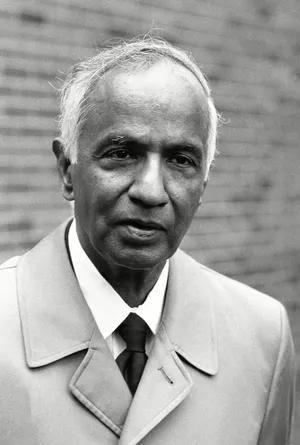
Subrahmanyan Chandrasekhar
Doğum tarihi | 1910-10-19 | ||||||||
|---|---|---|---|---|---|---|---|---|---|
Ölüm tarihi | 1995-08-21 | ||||||||
Dalı | Quantum Chemistry Fluid Dynamics General Relativity Astrophysics | ||||||||
Institutions Worked at | University of Cambridge Ballistic Research Laboratory Yerkes Observatory University of Chicago | ||||||||
Education | Trinity College Cambridge Madras University | ||||||||
Award(s) | Marcel Grossmann Prize (1994) Copley Medal (1984) Nobel Prize in Physics (1983) Heineman Prize (1974) Padma Vibhushan (1968) National Medal of Science (1966) Royal Medal (1962) Adams Prize (1948) | ||||||||
Citizenship | United States of America India British India | ||||||||
Subrahmanyan Chandrasekhar is regarded as one of the most influential astrophysicists of the 20th century. Chandrasekhar, known for his pioneering work on the structure and evolution of stars, laid the foundational principles of our understanding of stellar collapse through his discovery, now known as the Chandrasekhar Limit.
Awarded the Nobel Prize in Physics in 1983, Chandrasekhar left a profound impact not only through his theoretical contributions but also through his rigorous scientific methodology and commitment to excellence.
Subrahmanyan Chandrasekhar was born on 19 September 1910 in Lahore, then within the boundaries of British India (now in Pakistan). The son of a Tamil family, Chandrasekhar grew up in an intellectually stimulating environment. His father, C. Subrahmanyan Ayyar, was a railway inspector for the Indian government, and his mother, Sitalakshmi, was a well-educated woman who made significant contributions to her son’s intellectual development.
Chandrasekhar’s uncle was C. V. Raman, India’s first Nobel laureate in physics. This connection provided an important foundation for the young Chandrasekhar’s early exposure to science. After completing his education at Presidency College in Madras, he traveled to the University of Cambridge in 1930. At Cambridge, he began working under the guidance of astrophysicist Ralph Fowler.
In the early 1930s, Chandrasekhar began theoretical calculations on the final stages of a star’s life cycle. During this work, he calculated the maximum mass a white dwarf star could possess. This limit is approximately 1.4 solar masses and is known as the Chandrasekhar Limit. Stars exceeding this mass cannot remain as white dwarfs; instead, they collapse into neutron stars or black holes.
This theory was highly controversial at the time and was even criticized by Arthur Eddington, one of the leading physicists of the era. However, subsequent observations over the following decades confirmed Chandrasekhar’s predictions, and his theories on the evolutionary pathways of cosmic objects became fundamental to modern astrophysics.
In 1937, Chandrasekhar moved to the United States and began his position at the University of Chicago. He remained a faculty member there from 1937 until his death in 1995. He also served as editor of The Astrophysical Journal for nearly two decades (1952–1971), playing a major role in establishing the journal’s international reputation.
Chandrasekhar published significant scientific works not only on stellar structure but also on black holes, neutron stars, hydrogen ionization, fluid dynamics, relativity theory, and quantum mechanics. His approach was consistently grounded in mathematical precision and theoretical depth.
Subrahmanyan Chandrasekhar received numerous scientific honors throughout his life. The most notable among them was the 1983 Nobel Prize in Physics, which he shared with William A. Fowler, awarded specifically for his theoretical work on the structure and evolution of stars.
He was also awarded many prestigious honors, including membership in the Royal Society, the National Medal of Science, and the Copley Medal.
Chandrasekhar was known as a scientist of exceptional academic rigor and deep intellectual discipline. He was deeply attentive to his students and encouraged them to think critically. His wife, Lalitha Chandrasekhar, was also a highly educated scientist who supported him throughout his life.
Chandrasekhar placed great emphasis on the pursuit of aesthetic beauty in science. He expressed this view with the statement: “Scientific beauty is not merely about explaining how nature works; it must also be aesthetically satisfying.”
Subrahmanyan Chandrasekhar’s work formed the foundational pillars of modern astrophysics. Our understanding of black holes and neutron stars rests largely on his theoretical contributions. At the University of Chicago’s Enrico Fermi Institute, the Chandrasekhar Laboratory bears his name and preserves his scientific legacy.
Additionally, the Chandra X-ray Observatory, launched by NASA in 1999, was named in his honor and remains one of the primary telescopes for observing the most energetic phenomena in the universe.
Chandrasekhar, Subrahmanyan. “The Maximum Mass of Ideal White Dwarfs.” *Astrophysical Journal* 74 (1931): 81–82. https://ui.adsabs.harvard.edu/abs/1931ApJ….74…81C/abstract.
NASA. "Chandra X-ray Observatory." Accessed April 10, 2025. https://chandra.harvard.edu/.
NobelPrize.org. "The Nobel Prize in Physics 1983 – Subrahmanyan Chandrasekhar." Accessed April 10, 2025. https://www.nobelprize.org/prizes/physics/1983/chandrasekhar/biographical/.

Subrahmanyan Chandrasekhar
Doğum tarihi | 1910-10-19 | ||||||||
|---|---|---|---|---|---|---|---|---|---|
Ölüm tarihi | 1995-08-21 | ||||||||
Dalı | Quantum Chemistry Fluid Dynamics General Relativity Astrophysics | ||||||||
Institutions Worked at | University of Cambridge Ballistic Research Laboratory Yerkes Observatory University of Chicago | ||||||||
Education | Trinity College Cambridge Madras University | ||||||||
Award(s) | Marcel Grossmann Prize (1994) Copley Medal (1984) Nobel Prize in Physics (1983) Heineman Prize (1974) Padma Vibhushan (1968) National Medal of Science (1966) Royal Medal (1962) Adams Prize (1948) | ||||||||
Citizenship | United States of America India British India | ||||||||
No Discussion Added Yet
Start discussion for "Subrahmanyan Chandrasekhar" article
Early Life and Education
Chandrasekhar Limit and Stellar Evolution
Career and Academic Life
Awards and Honors
Personal Life and Character
Legacy and Impact