
This article was automatically translated from the original Turkish version.
+1 More
The 2025 Nobel Prize in Physics is a scientific award granted to three physicists — John Clarke, Michel H. Devoret, and John M. Martinis — for experimentally demonstrating the effects of quantum mechanics in macroscopic systems and for the discovery of energy quantization via macroscopic quantum tunneling in electrical circuits. The award was announced by the Royal Swedish Academy of Sciences on 7 October 2025.
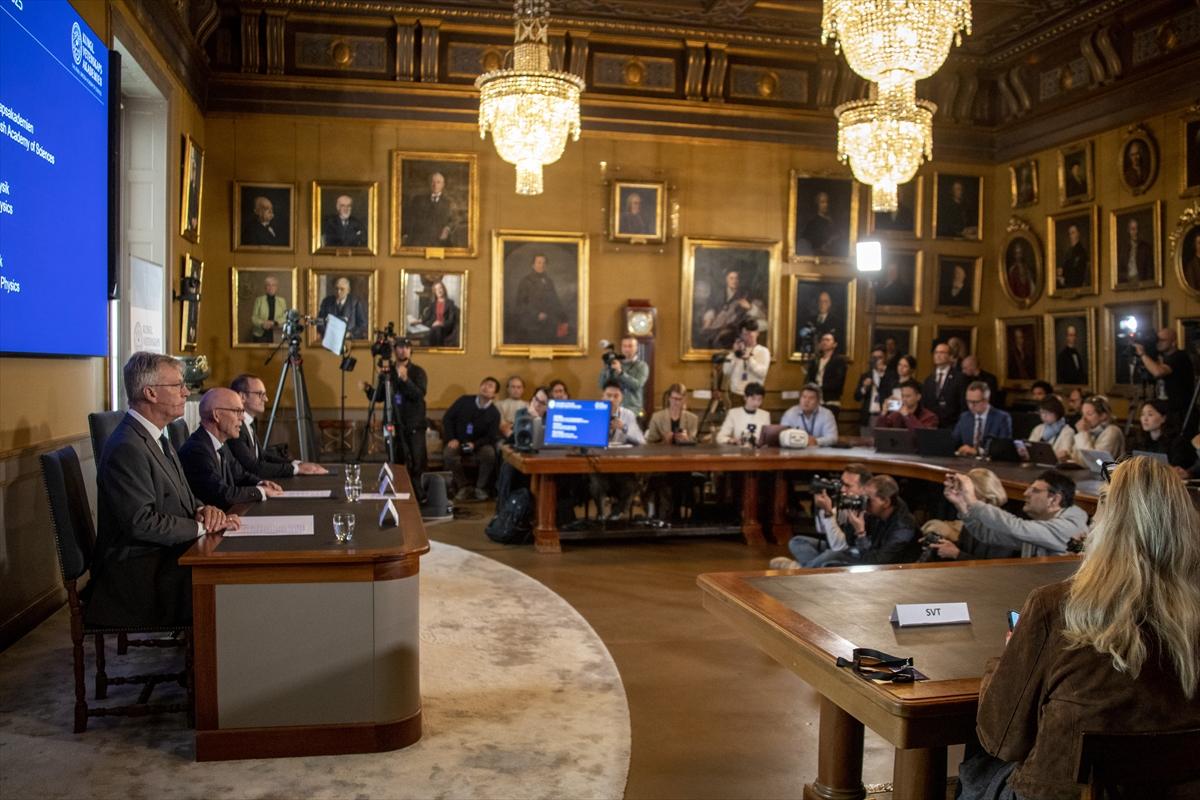
The recipients of the 2025 Nobel Prize in Physics are announced at a press conference held at the Royal Swedish Academy of Sciences, 7 October 2025 — (Anadolu Agency)
The 2025 Nobel Prize in Physics has been awarded for the discovery of macroscopic quantum tunneling and energy quantization observed in electrical circuits. According to the Academy, the laureates have experimentally demonstrated that fundamental properties of quantum mechanics apply to systems of a size that can be held in the human hand.
These experiments enabled the observation of quantum tunneling and quantized energy levels in superconducting circuits. The research demonstrated that quantum physics can be applied to macroscopic objects at laboratory scale and that these processes are measurable.
The research recognized by the prize was conducted in the mid-1980s at the University of California, Berkeley campus. During this period, Michel Devoret was a postdoctoral researcher and John Martinis was a student of John Clarke, both working in the same laboratory. The work focused on the Josephson junction, a structure composed of a thin insulating layer between two superconducting materials.
This structure, predicted by Brian Josephson in 1962, relies on the tunneling of electron pairs (Cooper pairs) across a barrier without energy loss. Clarke, Devoret, and Martinis experimentally demonstrated that this effect could be measured in a macroscopic system.
According to the data obtained, when the system remained in a stable (metastable) state at low temperatures, the current flowed without resistance. However, at times, quantum tunneling caused transitions out of this stable state. These transitions were recorded through measurements of current and voltage in the Josephson junction. When the temperature was lowered below a specific threshold, the current became independent of temperature, a direct observation interpreted as evidence of macroscopic quantum tunneling.
In addition, the researchers determined that this macroscopic quantum system possessed multiple energy levels. The Josephson junction was thus identified as a macroscopic counterpart of multi-level atomic systems. These findings laid the foundation for the development of superconducting quantum bits (qubits) and constitute the basis of quantum computing technologies.
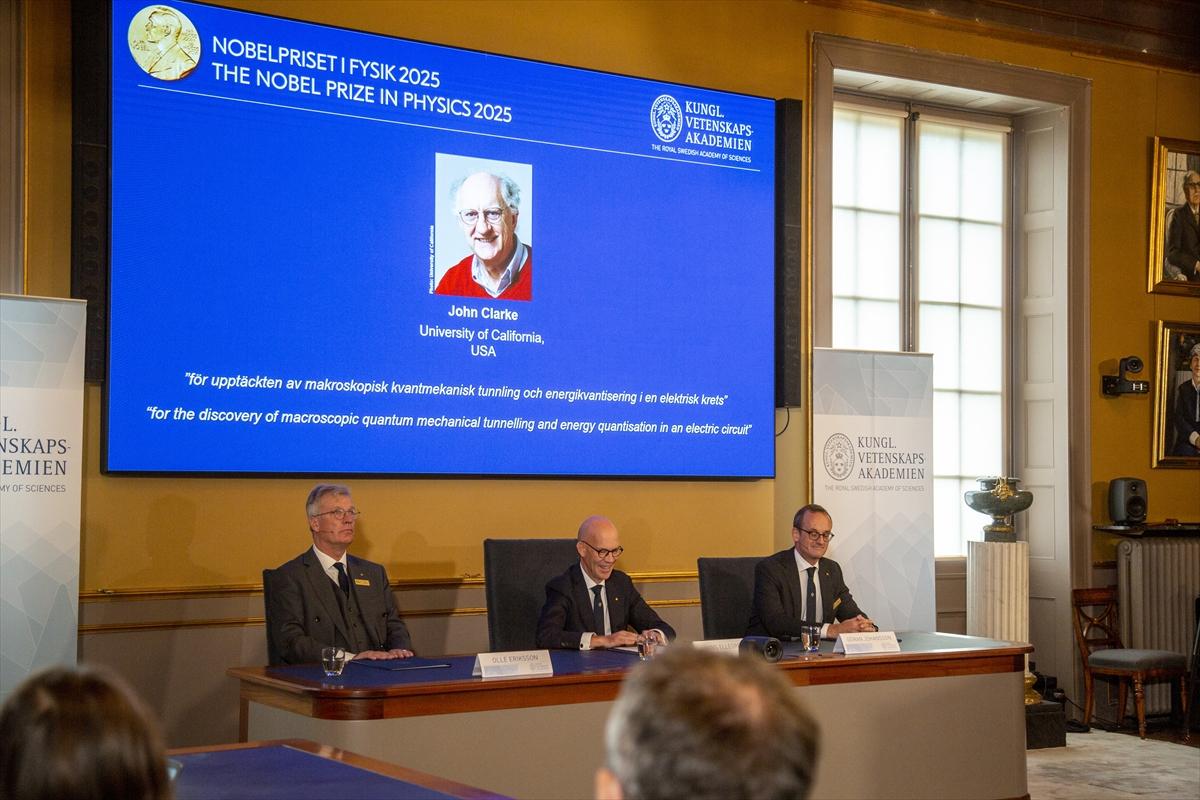
The recipients of the 2025 Nobel Prize in Physics are announced at a press conference held at the Royal Swedish Academy of Sciences, 7 October 2025 — (Anadolu Agency)
According to the Royal Swedish Academy of Sciences, the 2025 Nobel Prize in Physics “has paved the way for the development of next-generation quantum technologies such as quantum cryptography, quantum computers, and quantum sensors.”
Committee Chair Olle Eriksson noted that although the principles of quantum mechanics have been known for over a century, they continue to reveal new phenomena, and the work of Clarke, Devoret, and Martinis provides a concrete example of this.
These experiments demonstrated that quantum behavior is not limited to subatomic particles but can also be observed in macroscopic circuits under specific conditions. The research expanded the classical understanding that quantum physics pertains only to phenomena too small to be seen with the naked eye.
The 2025 Nobel Prize in Physics was announced on 7 October 2025 at a press conference in Stockholm. The prize amount of 11 million Swedish kronor (approximately 1.2 million US dollars) was shared equally among the three laureates. The award ceremony is scheduled to take place on 10 December 2025 in Stockholm, the anniversary of Alfred Nobel’s death.
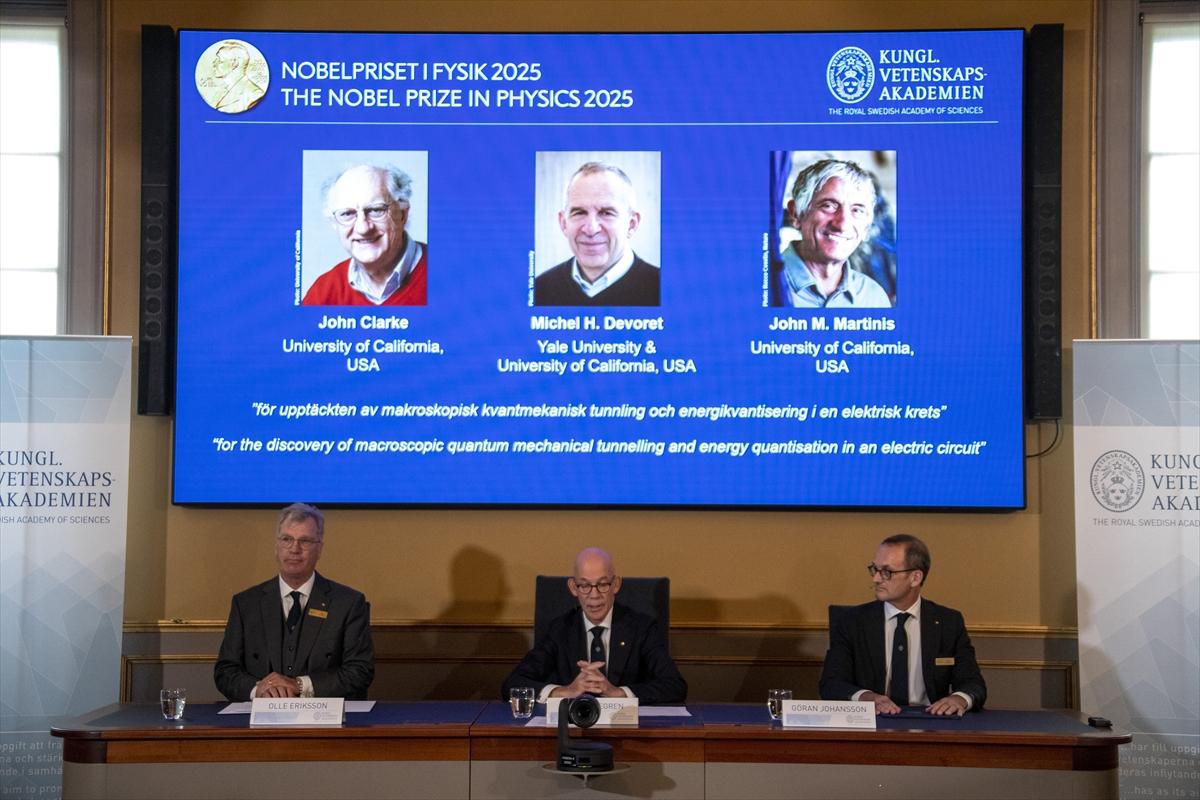
The recipients of the 2025 Nobel Prize in Physics are announced at a press conference held at the Royal Swedish Academy of Sciences, 7 October 2025 — (Anadolu Agency)
John Clarke was born in Cambridge, England, in 1942. He received his bachelor’s degree from the Department of Physics at the University of Cambridge in 1964 and his doctorate from the same university in 1968. He joined the University of California, Berkeley campus in 1969 and has remained there as a professor.
Michel Devoret was born in Paris, France, in 1953. He graduated from Ecole Nationale Supérieure des Télécommunications in 1975 and completed his PhD in physics at Paris-Saclay (Orsay) University in 1982. He conducted postdoctoral research in John Clarke’s group at Berkeley and later established his own research group at CEA-Saclay in France. In 2002 he moved to Yale University and in 2024 to the University of California, Santa Barbara campus. He also serves as Chief Scientist at Google Quantum AI.
John Martinis was born in the United States in 1958. He completed his undergraduate and doctoral studies at the University of California, Berkeley campus. He has been a professor at the University of California, Santa Barbara campus since 2004. In 2014 he joined Google Quantum AI laboratory with his team and led the 2019 experiments demonstrating “quantum supremacy.” In 2020 he moved to Silicon Quantum Computing in Australia and since 2022 has served as Chief Technology Officer at Qolab, the company he founded.
Anadolu Ajansı. “2025 Nobel Fizik Ödülünü John Clarke, Michel Devoret ve John Martinis Kazandı.” Accessed October 8, 2025. https://www.aa.com.tr/tr/bilim-teknoloji/2025-nobel-fizik-odulunu-john-clarke-michel-devoret-ve-john-martinis-kazandi/3709790#
Nobel Prize. "Nobel Prizes 2025." The Nobel Prize Official Website. Accessed October 8, 2025. https://www.nobelprize.org/all-nobel-prizes-2025/
Physics World. “John Clarke, Michel Devoret and John Martinis Win the 2025 Nobel Prize for Physics.” *Physics World*. Accessed October 8, 2025. https://physicsworld.com/a/john-clarke-michel-devoret-and-john-martinis-win-the-2025-nobel-prize-for-physics/
Reuters. “Trio win Nobel prize for revealing quantum physics in action.” Reuters. Accessed October 8, 2025. https://www.reuters.com/science/clarke-devoret-martinis-win-2025-nobel-prize-physics-2025-10-07/

No Discussion Added Yet
Start discussion for "2025 Nobel Prize in Physics" article
Reason for the Award
Experimental Work and Scientific Contributions
Impact on Quantum Technologies
Announcement and Ceremony
Brief Biographies of the Laureates
John Clarke
Michel H. Devoret
John M. Martinis