

This article was automatically translated from the original Turkish version.
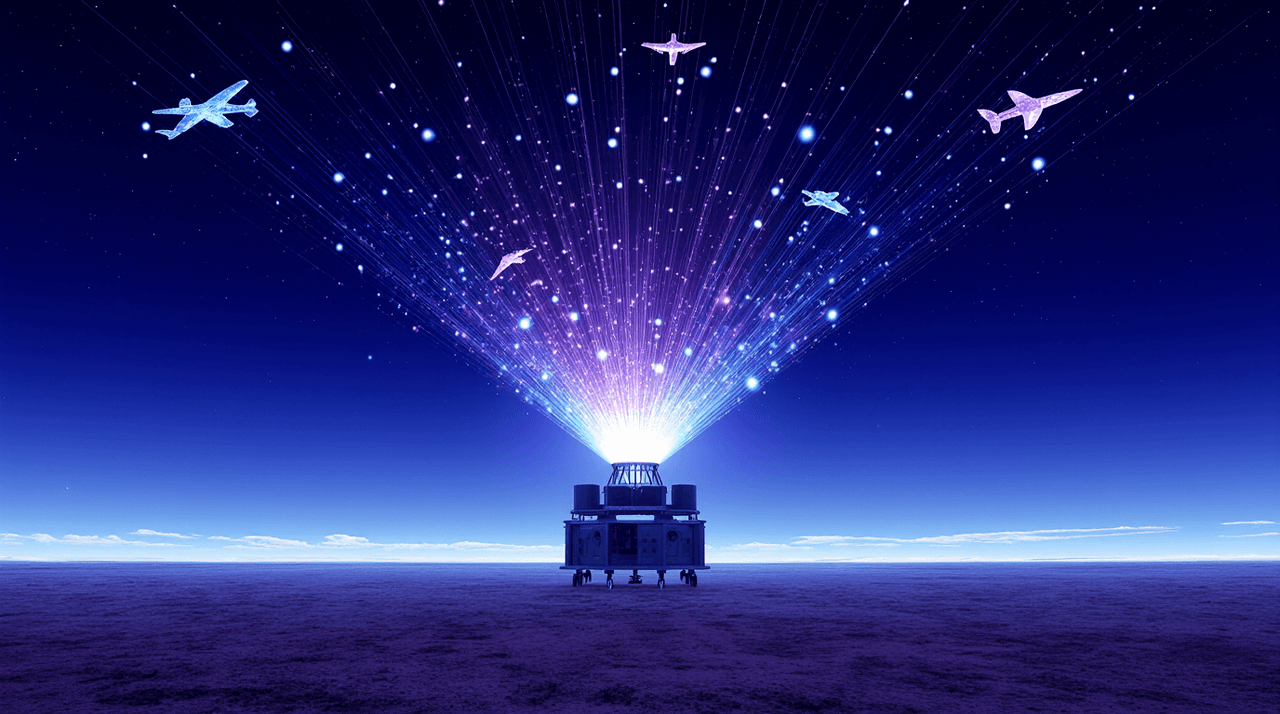
Quantum Radar Systems (Generated with Artificial Intelligence)
Purpose(s) | Detection of Low-Observable (Ghost) Targets and Resistance to Electronic Jamming | ||||||||
|---|---|---|---|---|---|---|---|---|---|
Component(s) | Entangled Photon Source (e.g. Correlation Detector Idler Photons Signal Photons SPDC) | ||||||||
Main Challenge | Quantum Decoherence and Range Limitation | ||||||||
Fundamental Principle | Quantum Entanglement | ||||||||
Quantum radar; an advanced sensing system that employs the fundamental principles of quantum mechanics, particularly quantum entanglement (entanglement), instead of classical electromagnetic waves in target detection, tracking, and identification processes. This approach is based on preserving information sharing between photons via entanglement, thereby minimizing the impact of noise and signal loss encountered in classical systems during measurement.
Traditional radar systems exhibit limited performance in detecting stealth targets with low radar cross sections and are vulnerable to countermeasures such as electronic jamming or deception. Quantum radar research has been developed to eliminate these vulnerabilities, aiming to enhance the signal-to-noise ratio under low-visibility conditions and provide resistance against electromagnetic interference.
These systems operate on the principle of retaining one photon of an entangled photon pair, known as the “idler” photon, within a laboratory environment while directing the other photon toward the target and comparing the returned scattered signal. Through the resulting correlation data, the presence and location of the target can be determined with significantly higher accuracy than classical methods. Quantum radar technology is regarded as one of the application areas of the era known as the Second Quantum Revolution. Alongside quantum communication, quantum cryptography, and quantum computing, this technology holds the potential to become a fundamental component of future high-sensitivity sensing systems in defense and aerospace industries.
Traditional radar systems transmit electromagnetic waves such as radio or microwave signals toward a target via a transmitter and collect the returning reflected signals using a receiver. The round-trip time between the transmitted and returned signals provides distance information, the direction of arrival gives angular position, and the Doppler shift in signal frequency reveals the target’s linear velocity. These basic measurements enable the calculation of quantities such as target range, course, speed, and track motion, which are integrated into the radar processing chain through time-frequency analysis, signal-processing filters, and tracking (tracking) algorithms.
However, the effectiveness of classical radars can be significantly reduced by various countermeasures. One of the most important is low-visibility or “stealth” technology. Stealth designs reduce a target’s radar cross section (Radar Cross Section, RCS), causing the target to appear smaller or more ambiguous on radar displays. For example, there is a significant magnitude difference between the RCS value assigned to a fourth-generation F-16 fighter jet and the value reported for a fifth-generation F-22; a smaller RCS drastically reduces detectability by the same radar systems. RCS reduction strategies involve shaping the airframe with sharp edges and oriented surfaces to scatter radar energy in different directions, as well as using special coatings and composite materials that absorb or attenuate radar energy. These approaches may entail design trade-offs in terms of aerodynamics, structural integrity, and maintenance requirements.
Another limiting factor is electronic jamming and deception (deception) techniques. Jamming techniques aim to hinder the receiver’s ability to distinguish the true return signal by introducing intense, continuous, or target-specific interference at the radar’s operating frequency; deception techniques seek to transmit false target echo signals to convey incorrect position or velocity information. Traditional defensive measures against these threats include wideband transmission, frequency-hopping (frequency-hopping) transmission, adaptive filtering, and advanced signal-separation algorithms. Active electronically scanned array (AESA) radars exhibit higher resistance to jamming due to multiple transmission channels and rapid frequency-switching capabilities; however, high-power, sophisticated jamming systems can still pose significant challenges.
These limitations and countermeasures have directed research toward improving detection and tracking performance through the exploration of different physical principles, such as optical and laser-based lidar, and advanced signal-processing methods. The goal of quantum-based sensing approaches is to provide new measurement principles that either mitigate or complement the vulnerabilities faced by classical radars. This encourages the investigation of alternative physical mechanisms offering enhanced sensitivity, noise immunity, or resistance to deception beyond the limits of current systems.
Quantum radar technology is considered an extension of the era known as the “Second Quantum Revolution,” which emerged following the first quantum revolution of the early twentieth century that enabled innovations such as the transistor, laser, and semiconductor physics. This second revolution focuses on transforming quantum mechanical phenomena—such as superposition, entanglement (entanglement), and quantum measurement—from theoretical frameworks into practical technologies.
The principle of superposition states that a quantum particle—such as a photon or electron—can exist in multiple quantum states simultaneously until measured. This phenomenon opens the door to information processing methods impossible in classical systems and forms the foundation of quantum computing and high-precision measurement technologies. Quantum entanglement refers to the deep interdependence of the quantum states of two or more particles. This phenomenon, described by Albert Einstein as “spooky action at a distance” (spooky action at a distance), ensures that when the state of one particle is measured, the state of the other is instantly and deterministically determined, regardless of the distance between them. Entanglement plays a fundamental role in developing quantum communication protocols, quantum cryptography, and quantum sensors.
The engineering implementation of these physical principles has led to the development of next-generation technologies in fields such as quantum computing, quantum cryptography, and quantum sensing (quantum sensing). Quantum radar systems, as part of this framework, aim to overcome the limitations of classical radars—such as invisibility, signal attenuation, and jamming—by utilizing the principles of quantum entanglement and superposition in target detection and tracking. Thus, quantum radar technology is viewed not only as a military and defense application but also as a concrete implementation of the Second Quantum Revolution in the fields of quantum measurement science and information physics.
The operational principle of quantum radar is based on generating entangled photon pairs, transmitting one photon toward the target, and retaining the other at the station to measure the correlation between the two beams. In experimental implementations, the most commonly used technique is spontaneous parametric down-conversion (Spontaneous Parametric Down-Conversion, SPDC). SPDC is a physical process in which a high-energy pump laser photon is directed into a suitable nonlinear crystal (e.g., barium borate), resulting in the simultaneous and entangled generation of two lower-energy photons that satisfy energy and momentum conservation laws. In SPDC applications, Type-I and Type-II phase-matching regimes are employed to control polarization, frequency, and direction properties.
An experimental setup generally includes the following components: a pump laser, a nonlinear crystal (SPDC source), optical filters and beam splitters, a transmission channel to the target, receiver optics with photodetectors, and delay lines or quantum memory elements to temporarily store or time-delay the idler photons at the station. One of the two photons produced by SPDC is directed as the signal photon toward the target region; the other is retained as the idler photon within the detection chain. When the signal photons scatter from or interact with the target, their quantum states undergo changes; when the very weak number of returned photons reach the receiver, the recorded data are subjected to time-correlated correlation analysis with the stored idler photons.
Correlation analysis can provide specific signal-to-noise ratio (SNR) advantages compared to classical single-channel measurements because entangled coincidence measurements reveal common events distinguishable from background noise. Metrics used in the theoretical and experimental framework of this approach include coincidence counting, the second-order correlation function , and cross-correlation spectra. The quantum illumination paradigm, one of the quantum-based sensing protocols, proposes a framework in which detection probability exceeds that of classical methods in high thermal noise environments; however, this advantage may be limited to specific regimes of loss and jamming.
The main engineering and physical limitations encountered in practice are:
Quantum radar approaches promise capabilities such as detecting the presence of even a few photons interacting with a target, correlation-based distinguishability in high background noise, and increased resilience against certain deception and jamming scenarios. However, the sustained preservation of these advantages under real-world conditions depends on technological advances in materials science, quantum memory, low-loss optical transmission, and high-performance photon detection. Therefore, quantum radar prototypes are currently under active investigation through both theoretical analysis and laboratory-scale experiments, with a number of practical engineering challenges yet to be resolved for deployment at scale.
The most significant advantages of quantum radars over traditional radar systems stem from the quantum mechanical nature of the sensing process. These systems aim to enable measurements even under conditions of low visibility, high noise, and electronic jamming, overcoming the fundamental limitations of classical radars.
Aircraft equipped with low-visibility technology are designed to absorb or redirect most radar waves to minimize their radar cross section. As a result, the returning signals for traditional radar systems typically remain at the level of background noise, making detection difficult. Quantum radar systems, however, employ a different measurement principle: detection relies not on the power of the reflected signal but on its correlation with its entangled partner. By comparing the signal photons with their entangled idler photons, even extremely weak photons reflected from the target surface can produce a distinguishable signature within the background noise. Thus, quantum radar gains the capacity to confirm the presence of targets with reflectivity levels inaccessible to classical radar.
Another fundamental advantage of quantum radar is its natural resistance to environmental noise and electronic jamming (jamming). These systems detect only the quantum correlations of the entangled photon pairs they generate. Thermal noise photons in the environment or jamming signals emitted by adversarial systems lack this specific entangled state. Therefore, the radar can identify only the original entangled signals through correlation analysis and reject all others as noise. This property arises from the theoretical impossibility of copying entangled states due to the quantum no-cloning theorem. Consequently, quantum radars offer a high level of immunity against most classical electronic jamming techniques.
Quantum sensing techniques possess sensitivity beyond the measurement limits of classical sensors. These systems can discern extremely small phase, timing, or frequency changes in the signal returned from the target, thanks to superposition and entanglement. This enables the determination of a target’s position, velocity, or surface characteristics with much higher resolution. Additionally, the use of quantum correlations allows high-accuracy measurements with low-power signals, enhancing both energy efficiency and detection reliability.
These advantages make quantum radars appear as a promising solution for detecting stealth platforms, monitoring in highly electromagnetic noisy environments, and for sensitive military or space-based sensing applications. However, realizing this potential in practical systems requires significant engineering progress in preserving entanglement, reducing optical losses, and developing high-performance quantum photon detectors.
Despite its theoretical potential and scientific innovation, quantum radar technology remains largely in the experimental stage. Translating laboratory results into field-deployable systems is limited by a range of physical, engineering, and economic challenges. Research in this area progresses at the intersection of quantum physics and sensing engineering, focusing on both fundamental scientific validation and applied prototyping.
One of the most significant technical limitations is the phenomenon known as quantum decoherence. Entangled particles gradually or completely lose their quantum properties when interacting with their environment—such as air molecules, optical components, or thermal radiation. This disrupts the system’s quantum coherence, leading to entanglement degradation and weakening of correlation signals. As a result, the effective range of quantum radar systems remains limited by the duration of entanglement preservation and environmental conditions.
Experimental studies in this field have proposed various range values but have not yet established a standard benchmark. Some research suggests that quantum radars may operate effectively only over short distances under practical conditions, while other studies claim that correlation can be maintained over much larger distances experimentally. These discrepancies depend on parameters such as the efficiency of photon sources, losses in optical components, atmospheric effects, and the sensitivity of detectors. In all cases, progress in this field demonstrates the rapid global development of quantum radar research.
Many countries, particularly the United States, China, Canada, and Australia, are evaluating quantum radar systems as strategic research priorities. Projects in this domain focus on developing technological components such as quantum illumination protocols, high-efficiency photon sources, quantum memory systems, and integrated photonic architectures. In Türkiye, under the coordination of the Defense Industries Presidency (SSB), research and development activities are underway involving ASELSAN and various universities on quantum technologies, quantum communication infrastructure, and quantum radar prototypes. These projects are linked to goals of reducing external dependency in national defense technologies and developing indigenous next-generation sensor architectures.
Future assessments indicate that quantum radars may be deployed in the near term for short-range applications requiring high security. These systems are expected to play a complementary role in protecting military bases, critical infrastructure, and strategically important assets. As the technology matures, reduced costs and increased system reliability are anticipated to enable integration of quantum radars into network-centric defense architectures and, in the long term, partial replacement of conventional radar systems. Although quantum radar technology has not yet reached operational maturity, it is regarded as one of the most important application candidates of the Second Quantum Revolution in the field of defense technologies.
Galati, Gaspare, and Gabriele Pavan. “On Target Detection by Quantum Radar (Preprint).” *arXiv (Cornell University).* (2024). Accessed October 14, 2025. https://arxiv.org/abs/2403.00047.
Karsa, Athena, Alasdair Fletcher, Gaetana Spedalieri, and Stefano Pirandola. “Quantum Illumination and Quantum Radar: A Brief Overview.” *arXiv* (Cornell University). (2024). Accessed October 14, 2025. https://arxiv.org/html/2310.06049v2.
Mathews, Manoj. “A Study on Quantum Radar Technology Developments and Design Consideration for Its Integration.” *arXiv* (*Cornell University*). (2022). Accessed October 14, 2025. https://arxiv.org/abs/2205.14000.
Wang, J., and K. M. Wong. “Quantum Illumination Radars: Target Detection.” *IET Radar, Sonar & Navigation* 18. (2024): 1541-1553. Accessed October 14, 2025. https://doi.org/10.1049/rsn2.12592.
Zhuang, Quntao, and Jeffrey H. Shapiro. “Ultimate Accuracy Limit of Quantum Pulse-Compression Ranging.” *Physical Review Letters* 128 (2022): 010501. Accessed October 14, 2025. https://doi.org/10.1103/physrevlett.128.010501.


Quantum Radar Systems (Generated with Artificial Intelligence)
Purpose(s) | Detection of Low-Observable (Ghost) Targets and Resistance to Electronic Jamming | ||||||||
|---|---|---|---|---|---|---|---|---|---|
Component(s) | Entangled Photon Source (e.g. Correlation Detector Idler Photons Signal Photons SPDC) | ||||||||
Main Challenge | Quantum Decoherence and Range Limitation | ||||||||
Fundamental Principle | Quantum Entanglement | ||||||||
No Discussion Added Yet
Start discussion for "Quantum Radar Systems" article
Traditional Radar Systems and Their Limitations
Quantum Technologies and the Second Quantum Revolution
Principle of Operation of Quantum Radar
Advantages of Quantum Radars
Detection of Stealth Aircraft
Resistance to Noise and Jamming
High Sensitivity and Resolution
Current Status, Challenges, and Future Vision