


This article was automatically translated from the original Turkish version.
+1 More
Support Vector Machines (SVM) are one of the supervised learning methods and are used for both classification and regression problems. SVM is a powerful algorithm that performs effectively especially on high-dimensional datasets. Its primary objective is to find an optimal hyperplane that separates or classifies the data.
Although support vector machines are used in both classification and regression analysis in the literature, they are generally preferred as a machine learning method for classification tasks. This method is based on a supervised learning model. During the algorithm’s operation, different kernel functions can be applied depending on the type of data, enabling both linear and nonlinear classification. If separable data are used in the classification process, all data points can typically be classified by a single hyperplane. However, if the data are not fully separable, classification using a single plane of the same dimension is often not possible. Therefore, different kernel functions are employed.
The logic of SVM is based on the following steps:
1- Data Transformation:
2- Finding the Hyperplane:
3- Support Vectors:
4- Kernel Trick:
5- Optimization:
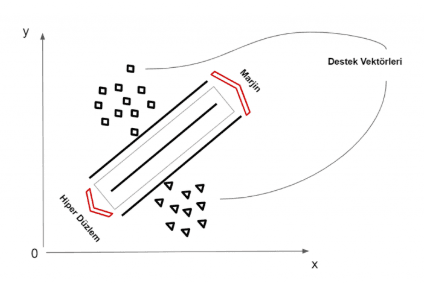
Two-dimensional representation of Support Vector Machines
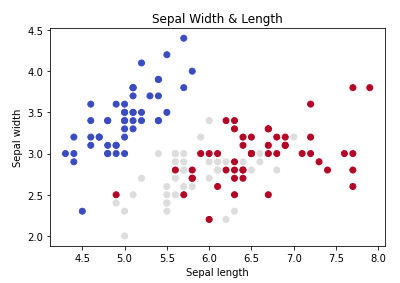
To observe correlations between species, the distribution of features—sepal length and sepal width—is analyzed.
Visualization of feature distribution:
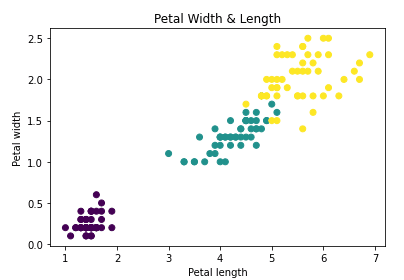
Similarly, the distribution of petal length and petal width from the dataset is examined.
Feature distribution on the graph:
A SVM model is constructed using the first two features (sepal length and sepal width) to predict the species of the flower.
Kernel operations are performed on the building using both linear and nonlinear modeling.
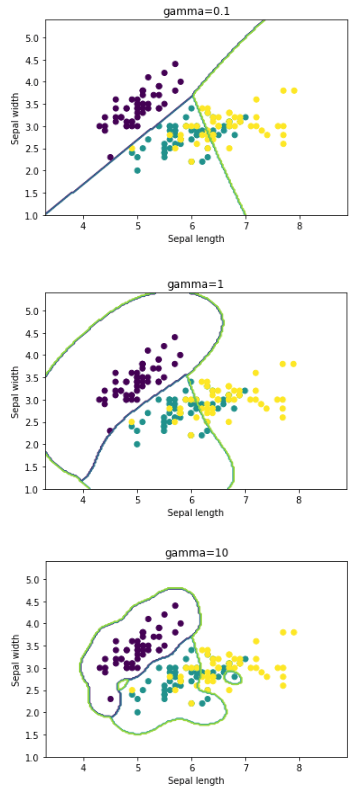
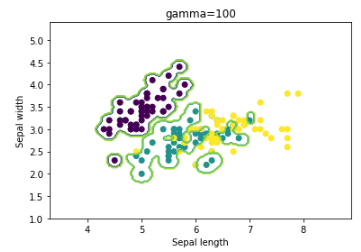
When the classification models are visualized, the following graphs are obtained:
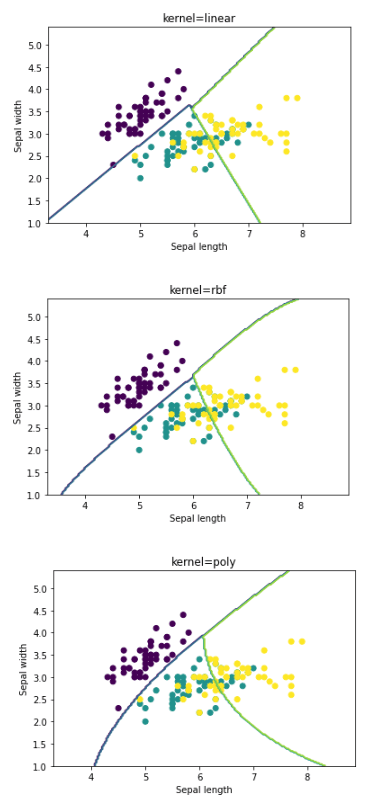
Hyperparameter tuning is performed by observing various kernels with different gamma (γ) values (0.1, 1, 10, 100).
In the resulting graphs, an increase in the gamma value leads to increased model fit.
GeekforGeeks. "Support Vector Machine Algorithm," 2025. https://www.geeksforgeeks.org/support-vector-machine-algorithm/
IBM. "What are support vector machines?"
Kayaalp, K. Metlek, S. Makine Öğrenmesinde, Teoriden Örnek Matlab Uygulamalarına Kadar Destek Vektör Makineleri. İksad Yayıncılık. Ankara, 2020.
Ozturk, M. "Python ile Sınıflandırma Analizleri - Destek Vektör Makineleri." 2021. https://miracozturk.com/python-ile-siniflandirma-analizleri-destek-vektor-makinasi-dvm/
Scikit-learn. "Support Vector Machines."

No Discussion Added Yet
Start discussion for "Support Vector Machines" article
Definition
Working Principle
Applications
Application Example on the Iris Dataset Using the Support Vector Machine Algorithm
Advantages and Disadvantages