This article was automatically translated from the original Turkish version.
+1 More
Geographical Boundary | Şanlıurfa Province | ||||||||
|---|---|---|---|---|---|---|---|---|---|
Type of Geographical Indication | Origin Name | ||||||||
Registration Date | 27 July 2021 | ||||||||
Registration Number | 812 | ||||||||
Applicant/Registrant(s) | Suruç Municipality | ||||||||
Suruç Pomegranate (Latin scientific name: Punica granatum L.) is a variety of pomegranate cultivated within the boundaries of Şanlıurfa province, particularly renowned in the Suruç district. It is a highly valued agricultural product in the region due to its color, taste, and aroma. It was officially registered on 27 July 2021 by the Suruç Municipality for protection, effective from 17 July 2020. Its registration number is 812 and the type of geographical indication is "Place Name".
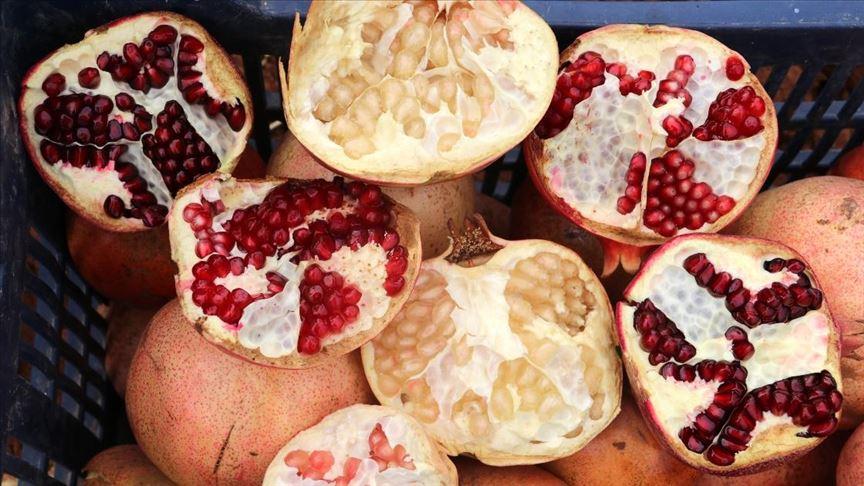
The Suruç Pomegranate is a large to medium-sized fruit with a skin color featuring red and pink tones over a yellow base. Its arils are large and easily separable. With soft seeds and a sweet, pleasant flavor, it is predominantly consumed as a table pomegranate.
The Suruç Pomegranate acquires its unique characteristics due to the climatic conditions of its growing region (microclimate), the permeable moist and cool soil structure, dry air conditions during fruit development, and ideal sunlight exposure. Approximately 60% of the fruit’s weight consists of arils. These arils are soft, pink to light red in color, and the fruit has a medium-thin, elastic skin.
The juice yield of the Suruç Pomegranate is at least 45%. In terms of acidity, it falls within both the sweet pomegranate group (titratable acidity less than 1% citric acid) and the semi-sweet pomegranate group (titratable acidity between 1% and 2% citric acid). The fruit weight ranges from 250 to 650 grams. Its shape is not perfectly spherical but slightly flattened along the stem and calyx axis. The soluble dry matter content (Brix value) is at least 15%, and the phenolic compound content is at least 1300 mg/L. The main organic acids present are citric acid, ascorbic acid, and malic acid, while the primary phenolic compounds are quercetin, caffeic acid, and catechin.

Image of Suruç Pomegranate (Anadolu Agency)
The Suruç Pomegranate is a perennial, shrub-like plant with a strong root system, multiple trunks, and dense branching. Its fruit is large and slightly flattened spherical in shape. It is a hardy crop that can withstand temperatures as low as −10°C, thrives under various climatic and soil conditions, requires minimal maintenance, remains on the tree for extended periods, and is suitable for storage. The specified geographical area offers highly favorable climatic conditions for pomegranate cultivation during summer and autumn months. Annual average rainfall of 500 mm is sufficient, but spring rainfall is preferred. Dry air conditions during fruit development positively influence fruit quality.

Image of Karaköprü and Suruç Pomegranate (Anadolu Agency)
The Suruç Pomegranate can be marketed for extended periods using modern preservation methods. In cold storage, it can be kept for up to six months in food-grade plastic bags at approximately 6°C and 85–90% relative humidity, or up to seven months using modified atmosphere packaging (MAP). Under traditional storage, sound fruits can be stored for up to two months in clean, dry, cool, and shaded environments, either displayed or packed in crates.
Monitoring of the Suruç Pomegranate geographical indication is carried out by a monitoring body consisting of at least three members, coordinated by the Suruç Municipality, with participation from one representative each of the Suruç Municipality, Şanlıurfa Provincial Directorate of Agriculture and Forestry, Suruç District Directorate of Agriculture and Forestry, and the Faculty of Engineering at Harran University. Monitoring is conducted at least once annually and reported in accordance with Law No. 6769 on Industrial Property, and submitted regularly each year to the Turkish Patent and Trademark Office. The monitoring body verifies compliance with the approved usage of the geographical indication, as well as adherence to harvesting, storage, and preservation conditions and the production methods outlined in the "Production Method" section.
Anadolu Ajansı. "'SGüneydoğu'nun nar çeşitleri koruma altına alınıyor." Accessed July 14, 2025. https://www.aa.com.tr/tr/turkiye/guneydogunun-nar-cesitleri-koruma-altina-aliniyor/2041164
Anadolu Ajansı. "'Suruç Narı', AB Coğrafi İşaret Tescil Belgesi Aldı." Accessed July 14, 2025. https://www.aa.com.tr/tr/ekonomi/suruc-nari-ab-cografi-isaret-tescil-belgesi-aldi/2910150
Anadolu Ajansı. "Güneydoğu’nun Nar Çeşitleri Koruma Altına Alınıyor." Accessed July 14, 2025. https://www.aa.com.tr/tr/turkiye/guneydogunun-nar-cesitleri-koruma-altina-aliniyor/2041164
Turk Patent and Trademark Office. "Suruç Narı." *Geographical Indications Portal*. Accessed July 14, 2025. https://ci.turkpatent.gov.tr/cografi-isaretler/detay/2344
Turkish Patent and Trademark Office. "Suruç Narı." *Geographical Indications Portal.* Accessed July 14, 2025. https://ci.turkpatent.gov.tr/Files/GeographicalSigns/f3091f57-4b31-466e-8231-94f9c82cb902.pdf

Geographical Boundary | Şanlıurfa Province | ||||||||
|---|---|---|---|---|---|---|---|---|---|
Type of Geographical Indication | Origin Name | ||||||||
Registration Date | 27 July 2021 | ||||||||
Registration Number | 812 | ||||||||
Applicant/Registrant(s) | Suruç Municipality | ||||||||
No Discussion Added Yet
Start discussion for "Suruç Pomegranate (Punica granatum L.)" article
Distinctive Characteristics
Production Method
Storage and Preservation Conditions
Monitoring