

This article was automatically translated from the original Turkish version.
+1 More
Province İt Belongs to | Balıkesir | ||||||||
|---|---|---|---|---|---|---|---|---|---|
Population | 37.750 | ||||||||
Area(s) | 621 km² | ||||||||
Elevation(s) | 63 metre | ||||||||
District Governor | Turgut GÜLEN | ||||||||
Mayor(s) | Hakan Yıldırım SEMİZEL | ||||||||
Number of Neighborhoods | 55 | ||||||||
Distance to City Center | 44 km | ||||||||
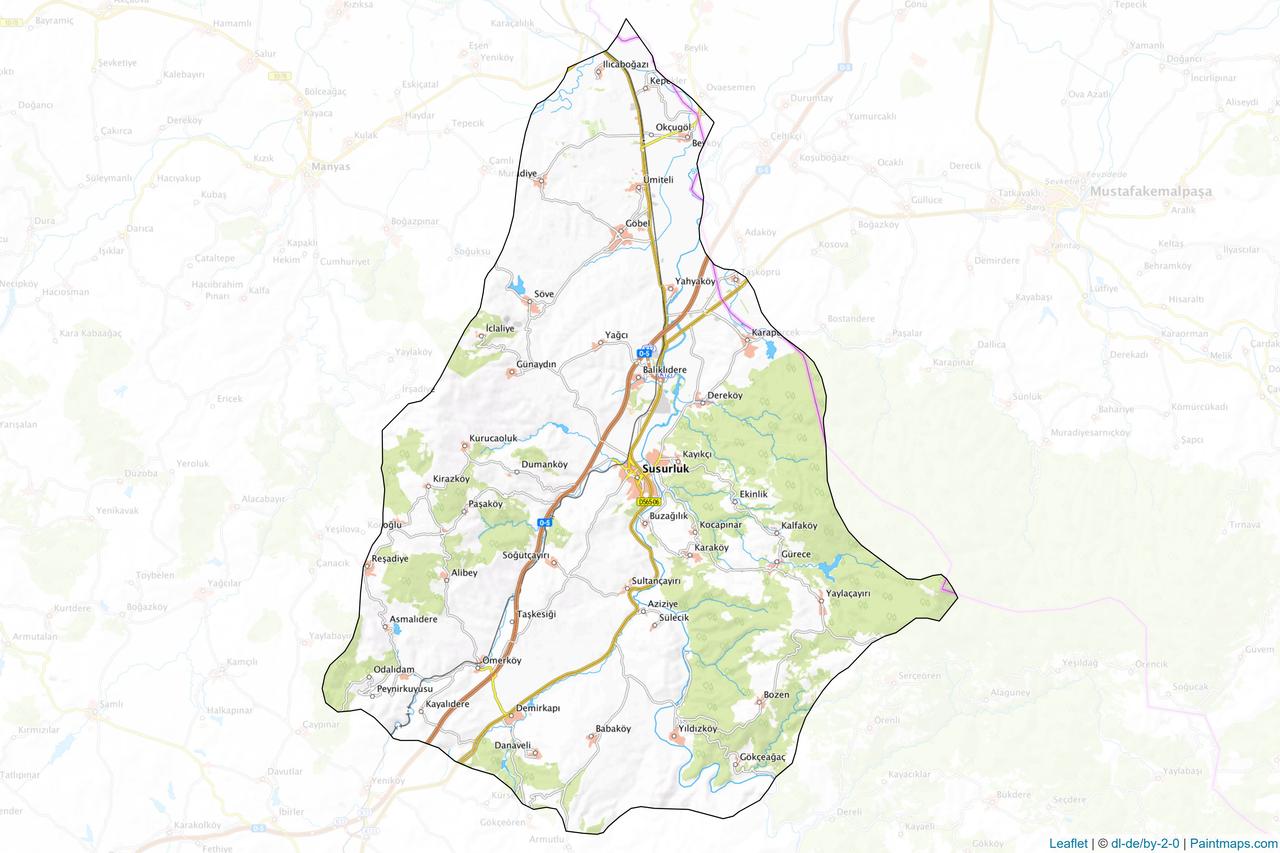
Susurluk is a district in the southern part of Türkiye’s Marmara Region, under the jurisdiction of Balıkesir Province. Due to its location at the intersection of the highways connecting Istanbul, İzmir, Balıkesir and Bandırma, it enjoys a favorable position for transportation. Susurluk covers an area of 621 km² and has an elevation of 63 meters above sea level. According to TÜİK 2024 data, its population is 37,750.
The history of human settlements in Susurluk and its surroundings extends back to antiquity. The region was successively under the control of the Mysians, Phrygians, Lydians, Romans and Byzantines. After the Seljuks, it came under the administration of the Karesi Beylik and was incorporated into Ottoman territory during the reign of Orhan Gazi.
The land on which the district now stands was originally a forested and marshy area belonging to the İne Bey Vakfı, one of the Karesi beys. This area was managed as a farm under the name “Susığırlık” by the descendants of İne Bey. In 1634 (Hijri 1050), a group known as the Hacı Hatip Oğulları migrated from Karaman and established the first village settlement here. Due to its strategic location, it became an important resting point for caravans traveling between Bursa and Istanbul. To meet this need, Mustafa Çelebi, a member of the Janissary Corps, built a caravanserai and a mosque.
The district’s population increased following migrations of Turks from the Balkans and the Caucasus after the Ottoman-Russian wars of 1858 and 1877–1878, and later through the resettlement of Turkmen tribes organized by Ahmed Vefik Pasha.
Despite its village status in the mid-19th century, Susurluk was granted permission to hold markets due to its strategic importance. It was elevated to the status of a subdistrict (nahiye) in 1892 and became a district in 1926.
During the War of Independence, the district was the site of fierce clashes between the nationalist forces of Anzavur Ahmet and Çerkez Ethem and the Kuva-yi Milliye units. It was liberated from enemy occupation on 5 September 1922. This date is annually commemorated with ceremonies as “Liberation Day”.

Historical Photograph of Susurluk District (Susurluk Municipality)
According to a widespread legend, the district’s name originated from the abundance of water in the region and the large number of cattle herds, leading to its being called “Susığırlık”, which over time evolved into “Susurluk” in local speech.
Situated northeast of the city center of Balıkesir, Susurluk covers an area of 621 km² and has an elevation of 63 meters above sea level. Its geographical structure consists of the Simav Çayı valley running north-south and the rugged terrain and plains surrounding it. The plains around the valley are fertile agricultural lands. The district’s forested area amounts to 28,505.5 hectares.
Rivers: The most important river in the district is the Simav Çayı, which is known as the Susurluk Çayı within this region. The Hatap, Göbel and Çaylak streams feed into this river.
Elevations: The most prominent elevations in the district are Çataldağ in the east, at 1,336 meters, and Keltepe in the west, at 881 meters.
The district exhibits characteristics of a Mediterranean climate but is dominated by a transitional climate between the Marmara and Aegean regions. The annual average precipitation is 72.4 kg per square meter, with an average of 93.1 rainy days per year.
The Granite Wall, part of Susurluk’s natural heritage, is one of the district’s significant geological formations. It was shaped over thousands of years by natural processes and erosion, resulting in large, solid granite blocks. This natural structure serves as a point of interest for visitors interested in photography and nature hiking. The surrounding area, with its walking trails and panoramic views, offers visitors an immersive experience in nature.

Granite Wall (Susurluk Municipality)
The district’s economy is primarily based on agriculture and animal husbandry. In recent years, modern livestock farming in well-equipped stables and cooperative activities have made significant contributions to the local economy. In addition to agriculture and animal husbandry, trade, crafts and industry have also developed.
Major industrial establishments in the district include a sugar factory, sunflower oil plant, cheese factory, frozen food facility, and tomato paste and canning plants. Woodworking, as well as the production of tables, chairs and furniture, are also prominent economic activities.
Susurluk benefits from well-developed transportation infrastructure due to its strategic location. The Istanbul–İzmir Motorway passes through the district’s boundaries. It is 44 km from Balıkesir, 108 km from Bursa, 54 km from Bandırma, 28 km from Mustafakemalpaşa and 33 km from Manyas. The İzmir–Bandırma railway line also runs through the district. The nearest civilian airport is Bursa Yenişehir Airport, located 108 km away.
Paintmaps. "Türkiye Harita Aracı." Paintmaps. Accessed August 16, 2025. https://tools.paintmaps.com/tr/harita-kirpma/TR/4-890462063.
Susurluk Belediyesi. "Susurluk'un Doğal Harikası Granit Duvarı." Susurluk Belediyesi. Accessed August 16, 2025. https://susurluk.bel.tr/haber/susurluk-un-dogal-harikasi-granit-duvari.
Susurluk Municipality. "Coğrafi Yapısı." Susurluk Municipality. Accessed August 16, 2025. https://susurluk.bel.tr/icerik/cografi-yapisi.
T.C. Ministry of Culture and Tourism, Balıkesir Provincial Directorate of Culture and Tourism. “Susurluk.” Balıkesir Provincial Directorate of Culture and Tourism. Accessed August 16, 2025. https://balikesir.ktb.gov.tr/TR-65878/susurluk.html.
T.C. Susurluk District Governorship. "Mahalli İdareler." Accessed August 16, 2025. http://www.susurluk.gov.tr/mahalli-idareler.
Türkiye Statistical Institute (TÜİK). "Adrese Dayalı Nüfus Kayıt Sistemi Sonuçları, 2024." Publication No: 53783. Accessed August 16, 2025. https://data.tuik.gov.tr/Bulten/Index?p=Adrese-Dayali-Nufus-Kayit-Sistemi-Sonuclari-2024-53783
“Ekonomi.” Susurluk Belediyesi. Accessed August 16, 2025. https://susurluk.bel.tr/icerik/ekonomi.
“Tarihçe.” Susurluk Belediyesi. Accessed August 16, 2025. https://susurluk.bel.tr/icerik/tarihce
Province İt Belongs to | Balıkesir | ||||||||
|---|---|---|---|---|---|---|---|---|---|
Population | 37.750 | ||||||||
Area(s) | 621 km² | ||||||||
Elevation(s) | 63 metre | ||||||||
District Governor | Turgut GÜLEN | ||||||||
Mayor(s) | Hakan Yıldırım SEMİZEL | ||||||||
Number of Neighborhoods | 55 | ||||||||
Distance to City Center | 44 km | ||||||||
No Discussion Added Yet
Start discussion for "Susurluk (District)" article
History
Etimology
Geographical Structure
Climate
Natural Attractions
Granite Wall
Economy and Industry
Transportation