


This article was automatically translated from the original Turkish version.
+2 More
Province(s) | Bursa | ||||||||
|---|---|---|---|---|---|---|---|---|---|
Region(s) | Marmara Region | ||||||||
Population | Approximately 120,000 (2023 | ||||||||
Former Name(s) | Kirmasti | ||||||||
District Governor | Mehmet Okur | ||||||||
Mayor(s) | Şükrü Erdem | ||||||||
Area | 1.621 | ||||||||
Highest Point | Çataldağı | ||||||||
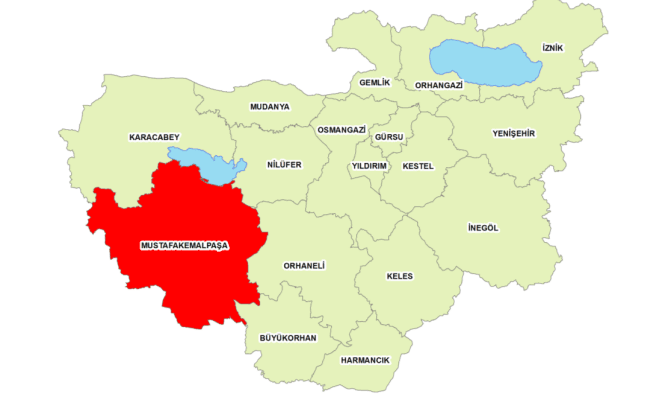
Mustafakemalpaşa is a district of Bursa Province in Türkiye’s Marmara Region. It is located in the northwestern part of the Anatolian Peninsula, at the western edge of the Marmara Region. Geographically, it is bordered by Uluabat Lake to the north, the central district of Bursa to the northeast, Karacabey and Susurluk to the west, Kepsut to the southwest, Dursunbey to the south, and Orhaneli to the east. The Mustafakemalpaşa Creek, which flows through the center of the district, is the region’s most significant river. The district covers an area of approximately 1,621 km².
The district center lies at an elevation of 25–40 meters above sea level, while the southern parts of the district feature mountainous and elevated terrain averaging 400–500 meters in elevation. The highest point in the district is Çataldağı.
Climate-wise, Mustafakemalpaşa exhibits characteristics of the Mediterranean climate: long, hot summers and short, mild winters. The average humidity is 71.6%, with an annual average temperature of 14.2 °C. Annual precipitation amounts to approximately 680 mm. About 79,633 hectares of the district are covered by forests, the majority of which consist of deciduous tree species. Beyond the forest boundary, elevation decreases gradually, giving way to shrublands and pasture areas. Agricultural activities are carried out in the arable lands.
Economically, agriculture plays a major role in Mustafakemalpaşa; the terrain allows for the cultivation of various crops. Additionally, forest resources, livestock farming, and animal-based economic activities are prominent in the district.

Mustafakemalpaşa (Mustafakemalpaşa Municipality)
Historically, the Mustafakemalpaşa region has been inhabited since ancient times. The district’s former name was “Kirmasti,” reportedly derived from a female ruler known as Kirmastorya during the Byzantine period, and it was previously known as “Kyundakos.” Settlement in the area dates back to the Hittite civilization, followed by successive rule under the Kingdom of Bithynia, the Romans, the Byzantines, the Seljuks, and the Karesians.
The ancient site of Miletopolis near Mustafakemalpaşa is one of the most significant archaeological areas indicating the region’s ancient past. It remains uncertain whether Miletopolis was founded by the Cyzicenes, Athenians, or directly by the Milesians, but sources indicate its location along the lake shore. Over time, as lake waters receded, settlements were relocated to higher ground.
During the Ottoman period, the Mustafakemalpaşa region was incorporated into Ottoman territory in 1336 following Orhan Bey’s conquest of the Karesian lands. Until the 19th century, it was administered as the Sincan Nahiye under Mihaliç. It gained independent district status in 1881. The first district governor was Hacı Salih Hayri Efendi.
In the early 20th century, Mustafakemalpaşa was a multicultural settlement inhabited by diverse ethnic groups including Muslims, Greeks, Armenians, and Jews. Immigrants from the Balkans and the Caucasus made significant contributions to the district’s demographic structure. During the War of Independence, Mustafakemalpaşa was occupied by Greek forces on 2 July 1920 and liberated by the Turkish army on 14 September 1922. Following the War of Independence, on 31 December 1922, a municipal council decision renamed the district “Mustafakemalpaşa” in honor of Mustafa Kemal Paşa.
The district contains several historically significant structures and cultural heritage sites, including the Lala Şahin Türbesi, Hamzabey Camii and Türbesi, Şeyhmüftü Camii and Türbesi, Dorak Treasures, and Kestelek Ruins. Natural attractions such as Suuçtu Waterfall and Suçıktı Meadow also draw attention.

Lala Şahin Paşa Türbesi (Mustafakemalpaşa Municipality)
Lala Şahin Paşa Türbesi is located on a small hill near the Mustafakemalpaşa Creek and has stood for over 600 years. It was built for Lala Şahin Paşa, the tutor of Sultan Murad I. The complex originally included a mosque, madrasa, bathhouse, and zawiya. Over time, the bathhouse was demolished and replaced by a modern bathhouse constructed by the Red Crescent. The Lala Şahin Türbesi is situated approximately 750 meters from the district center.

Suuçtu Waterfall (Mustafakemalpaşa Municipality)
Suuçtu Waterfall is located in the Çataltepe neighborhood of Mustafakemalpaşa district, near Muradiyesarnıç Village, above the Karadere stream. It is approximately 17 kilometers from the district center. The waterfall was formed by the collapse of a fault line and attracts attention with its 38-meter drop. Although water flow decreases during summer months, the reservoir fills in winter, creating a striking natural景观.
Throughout the 20th century, the district experienced significant developments in infrastructure, education, and culture. The construction of a bridge begun in 1926, the erection of a bronze statue of Mustafa Kemal Atatürk in 1935, the opening of the Halkevi in 1937, and the establishment of a power plant in 1938 all contributed to the district’s modernization. Mustafakemalpaşa has also historically served as a center for various social and cultural movements, particularly during the War of Independence, when it hosted important activities of the Kuva-yi Milliye organizations. The district’s population increased steadily from the second half of the 20th century onward, and urbanization accelerated rapidly.
BEBKA. *Mustafakemalpaşa İlçe Raporu*. Accessed June 25, 2025. https://www.bebka.org.tr/admin/datas/sayfas/198/mustafakemalpasa-ilce-raporu_1568787385.pdf
Mustafakemalpasa Belediyesi. "Foto Galeri." Accessed June 25, 2025. https://www.mustafakemalpasa.bel.tr/mustafakemalpasa/foto-galeri
Mustafakemalpasa Belediyesi. "Lalaşahin Paşa Türbesi." Accessed June 25, 2025. https://www.mustafakemalpasa.bel.tr/mustafakemalpasa/lalasahin-pasa-turbesi
Mustafakemalpasa Belediyesi. "Suuctu Şelalesi." Accessed June 25, 2025. https://www.mustafakemalpasa.bel.tr/mustafakemalpasa/suuctu-selalesi
Mustafakemalpasa Belediyesi. "Tarihçe." Accessed June 25, 2025. https://www.mustafakemalpasa.bel.tr/mustafakemalpasa/tarihce
Mustafakemalpasa Kaymakamlığı Governorship. "İlçemizin Tarihi." Accessed June 25, 2025.
T.C. Bursa Valiliği. "Mustafakemalpaşa." Accessed June 25, 2025. http://www.bursa.gov.tr/mustafakemalpasa

Province(s) | Bursa | ||||||||
|---|---|---|---|---|---|---|---|---|---|
Region(s) | Marmara Region | ||||||||
Population | Approximately 120,000 (2023 | ||||||||
Former Name(s) | Kirmasti | ||||||||
District Governor | Mehmet Okur | ||||||||
Mayor(s) | Şükrü Erdem | ||||||||
Area | 1.621 | ||||||||
Highest Point | Çataldağı | ||||||||
No Discussion Added Yet
Start discussion for "Mustafakemalpaşa (District)" article
Geographical Features
History
Cultural Values