

This article was automatically translated from the original Turkish version.
+2 More
Province(s) | Bursa | ||||||||
|---|---|---|---|---|---|---|---|---|---|
Region(s) | Marmara Region | ||||||||
Distance(s) | 58 km from the center of Bursa | ||||||||
District Governor | Muhammed Furkan Tuna | ||||||||
Mayor(s) | Ali Osman Tayır | ||||||||
Area(s) | 764 km² | ||||||||
Elevation(s) | 487 m | ||||||||
Population | 18.543 (2022) | ||||||||
Number of Neighborhoods | 61 | ||||||||
Orhaneli is a mountainous district of Bursa Province in Türkiye’s Marmara Region. Throughout history, the area has been inhabited by various civilizations and is known for its geographical location, natural resources, and cultural heritage.
The history of Orhaneli dates back to the time of the Roman Emperor Hadrian, who established the region as a hunting reserve. During this period, the area was named “Hadrianoaia” and later “Atranos.” Atranos retained its significance as a settlement throughout the Roman and Byzantine eras and became a tekfurluk center from 1261 onward.
Before the Ottoman period, the region came under the influence of the Anatolian Seljuks, and the first Turkish Turkmen and Yörük settlements were established during this time. The transition to Ottoman rule occurred in 1325 when Durdu Bey, acting on behalf of Orhan Gazi, conquered Atranos. After the conquest, the settlement was named “Beyce.” The district’s current name, Orhaneli, was officially assigned in 1934 by a decision of the Grand National Assembly of Türkiye in honor of Orhan Gazi.
Atranos, one of the nahiyas under the Sultanönü Sancağı—the first sanjak of the Ottoman Empire—was recorded in the 16th century as the private estate of Şah Veli. According to the 1521 tax registers, the area consisted of one town, 87 villages, six hamlets, four hamlets attached to villages, and five large farms. Until 1869, Beyce was a subdistrict under Harmancık; in 1881 it became a district and in 1888 it established a municipal administration. The district was occupied by Greek forces on 8 July 1921, and the occupation ended on 9 September 1922. During the occupation, a fire destroyed much of the district’s written archives.
During the Republican era, Keles (1953), Büyükorhan, and Harmancık were gradually separated from Orhaneli to become independent districts; as a result, many villages were detached from Orhaneli. In 2006, a law brought five villages under the jurisdiction of Bursa Metropolitan Municipality, reducing Orhaneli’s total area.
Orhaneli has significant potential for nature and thermal tourism. Its main tourist attractions include:
Sadağı Canyon: Located 6 km from Orhaneli, the Sadağı Canyon is the second largest canyon in Bursa. Accessible via the villages of Serçeler and Sadağı, the canyon features a stream flowing between rock walls that reach up to 60 meters in height. Hiking along the stream is possible, and in some sections, visitors must enter the water. The most striking feature of the canyon is the Rock Bathhouse, traditionally believed to have been built by Emperor Hadrian for his wife. The structure, fed by a 60°C hot spring, has been largely preserved. Wooden bridges and staircases have been installed along the trail to ensure safe passage.

Sadağı Canyon (Republic of Türkiye, Orhaneli District Governorship)
Karagöz Statue: Karagöz, one of the symbols of our national culture, was originally named Kambur Bâli Çelebi and hailed from Karaoğlanlar Village in Orhaneli. During the construction of the Orhan Mosque under Sultan Orhan, he worked as a blacksmith. His witty exchanges with the mason Hacivat disrupted the construction, leading to their execution by the sultan. According to another version, only Karagöz was executed, while Hacivat died while on pilgrimage.
To console the sultan, Sheikh Küşterî used a curtain to recreate Karagöz and Hacivat in shadow play, thus giving birth to the traditional Turkish shadow theatre.
Every year in the third week of June, the “Traditional Karagöz Culture Festival” is held in Orhaneli. The district’s recreational area bears the name Karagöz, and a large Karagöz statue stands along the intercity road.
Other tourist sites include Ağaçhisar Hot Springs, Urfiye Water, Şükriye Mud, Kurt Dağı, and Karakoca Location.

Karagöz Statue (District Governorship of Orhaneli, Republic of Türkiye)
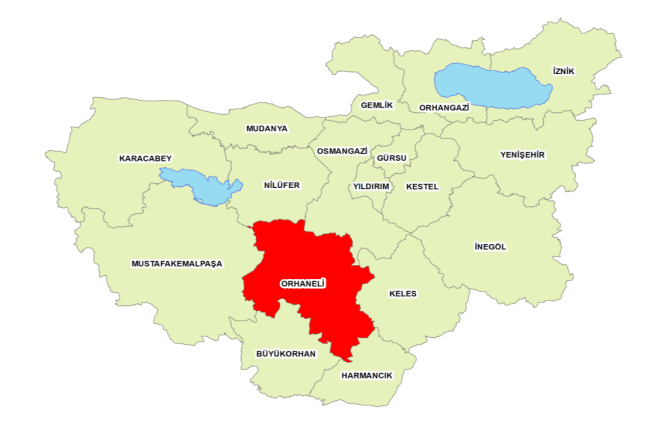
Orhaneli lies at the intersection of the Northern Aegean and Southern Marmara regions. To its east is Keles, to the west Mustafakemalpaşa, to the north Osmangazi and Nilüfer, and to the south Büyükorhan and Harmancık. It is located 58 km from the city center of Bursa and sits at an elevation of approximately 487 meters above sea level. Its total area is 764 km².
The district features rugged terrain shaped by the extensions of Uludağ, with mountainous areas, highland pastures, and forests surrounding it. Highland pastures such as Altıntaş Yaylası are present. Orhaneli Çayı (formerly known as Kocasu) is one of the district’s most important water sources.
The climate combines characteristics of the Mediterranean, Marmara, and Aegean continental climates. The annual average temperature is 14°C, with summer averages of 24.5°C and winter averages of 6.5°C. The lowest recorded temperature is -39.6°C. Precipitation occurs mostly in spring and autumn, and snowfall is common during winter months.
Orhaneli is composed of 63% forest and semi-natural areas and 33% agricultural land. Common tree species include oak, pine (black pine, red pine, and yellow pine), beech, and juniper. In the 2000s, forest coverage was measured at approximately 49,956 hectares. However, forest area has gradually decreased due to expansion of agricultural land, coal mining operations, and road construction.
The district’s economy is based on agriculture, animal husbandry, forestry, and mining. Major agricultural products include strawberry, cherry, raspberry, and wild blueberry. Small and large livestock farming are important sources of livelihood. Fruit farming has developed in recent years through modern techniques.
Orhaneli is rich in underground resources. The main resources include:
The local population identifies itself as “Turkmen,” “Yörük,” “Karakeçili Yörük,” and in some areas as “Manav.” This reflects the cultural continuity of the first Turkish tribes to settle in the region.
Karaoğlanlar Village in Orhaneli is recognized as the birthplace of Karagöz, a central figure in the Turkish shadow theatre tradition. A significant portion of the population lives in villages. The age structure of the population shows a high proportion of elderly residents. As a mountainous district, Orhaneli, like Keles, Harmancık, and Büyükorhan, is experiencing population decline. Investment and infrastructure development are needed to prevent emigration and encourage return migration.
Bursa Büyükşehir Municipality. "Bursa." Accessed June 25, 2025.
Bursa Valiliği. “Orhaneli.” Accessed June 25, 2025.
Kalkınma Kütüphanesi. Orhaneli İlçe Raporu. https://www.kalkinmakutuphanesi.gov.tr/assets/upload/dosyalar/orhaneli_ilce_raporu.pdf. Accessed June 25, 2025.
Orhaneli Belediyesi. "Tarihçe." Accessed June 25, 2025.
Orhaneli Belediyesi. *Orhaneli Belediyesi Resmî Web Sitesi*. Accessed June 25, 2025.
Orhaneli Kaymakamlığı Governorship. "Karagöz Heykeli." Accessed June 25, 2025.
Orhaneli Kaymakamlığı Governorship. "Orhaneli Tarihçe." Accessed June 25, 2025.
Orhaneli Kaymakamlığı. "Sadağı Kanyonu." Accessed June 25, 2025.

Province(s) | Bursa | ||||||||
|---|---|---|---|---|---|---|---|---|---|
Region(s) | Marmara Region | ||||||||
Distance(s) | 58 km from the center of Bursa | ||||||||
District Governor | Muhammed Furkan Tuna | ||||||||
Mayor(s) | Ali Osman Tayır | ||||||||
Area(s) | 764 km² | ||||||||
Elevation(s) | 487 m | ||||||||
Population | 18.543 (2022) | ||||||||
Number of Neighborhoods | 61 | ||||||||
No Discussion Added Yet
Start discussion for "Orhaneli (District)" article
History
Tourism
Geography and Climate
Vegetation and Land Use
Economy
Culture and Population