

This article was automatically translated from the original Turkish version.
+2 More
Province(s) | Bursa | ||||||||
|---|---|---|---|---|---|---|---|---|---|
Region(s) | Marmara Region | ||||||||
District Formation Date | 1987 | ||||||||
Population | Approximately 862,516 (2023) | ||||||||
Area(s) | 714 km² | ||||||||
District Governor | Ali Partal | ||||||||
Mayor(s) | Erkan Aydın | ||||||||
Number of Neighborhoods | 136 | ||||||||
Number of Streets and Avenues | 8,802 | ||||||||
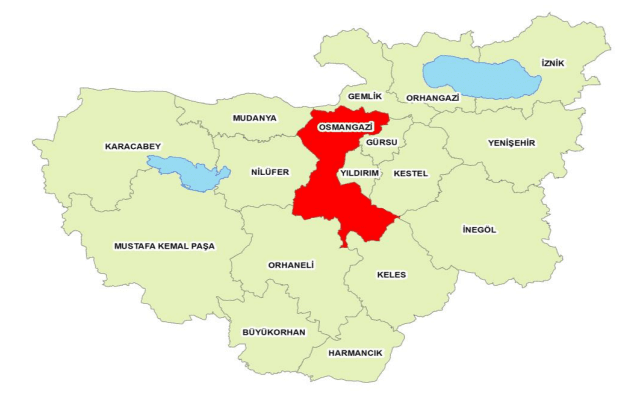
Osmangazi district is located in the center of Bursa Province within Türkiye’s Marmara Region and constitutes an administrative unit in the southern part of the Marmara Region. To the east, the district begins at the Gökdere Valley; to the west, it is bounded by the Nilüfer Stream and the New Mudanya Road. Its northern boundary is formed by the Samanlı Mountains, the Nilüfer River, and the Bursa Plain. The district lies at a key intersection of the roads connecting İzmir, Istanbul, and Eskişehir. It is 31 kilometers from Mudanya Port, 74 kilometers from Yalova, and 30 kilometers from Gemlik.
The district covers an area of approximately 71,400 hectares and has a population of 862,516, making it more populous than many provinces in Türkiye. Osmangazi contains 136 neighborhoods and 8,802 streets and avenues. The district sits at an average elevation of 150 meters above sea level, while Mount Uludağ (2,543 m), which extends in an east-west direction, is its most prominent elevation. Annually, Mount Uludağ experiences an average of 25 days of snowfall, with snow depth reaching up to 2.50 meters.
Osmangazi, situated within one of the transitional climate zones of the Marmara Region, exhibits climatic diversity. Annual precipitation ranges between 500 and 700 millimeters, with the highest rainfall occurring in winter and spring months; June and July are the driest periods. The average annual temperature is around 14 °C. The most influential winds in the region are yıldız, poyraz, and lodos.
The geological and morphological structure of Osmangazi consists of the Bursa Plain and Mount Uludağ. These variations in elevation cause significant differences in climate factors such as temperature, precipitation, and pressure. Data collected from the Bursa Meteorological Station (100 m), Uludağ-Sarıalan (1620 m), and Uludağ-Zirve (1877 m), all operated by the General Directorate of Meteorology, demonstrate that climatic variables vary considerably across different altitudes within the district.

Osmangazi Historical Images(Republic of Türkiye Osmangazi Subgovernorship)
Osmangazi derives its name from Osman Gazi, the founder of the Ottoman Empire, and with a 698-year history, it has served as one of the capitals of Ottoman history. The city of Bursa and its surroundings have hosted numerous civilizations throughout history, including the Kingdom of Bithynia, the Roman, Byzantine, and Ottoman empires.
In antiquity, Bursa was known as Prusa and was founded in 184 BCE by King Prusias I of Bithynia. During the Roman period, it became an important city, acquiring judicial authority and the right to mint coins under Roman law and administration. In the Byzantine era, it consisted of a network of villages and farms. During the Anatolian Seljuk period, the region experienced brief changes in control.
Ottoman rule began in 1326 when Orhan Bey besieged and blockaded Bursa, eventually securing its surrender. The Ottomans permitted the local Greek population to continue their economic activities such as weaving, sericulture, and pottery. After the conquest, Orhan Gazi made Bursa the capital and commissioned major construction projects. During the reign of Bayezid I, structures such as the Ulu Camii contributed significantly to the city’s aesthetic and religious identity.
Bursa suffered extensive damage during Timur’s invasion in 1402 but recovered under the rule of Murad II. Although its importance diminished after the Ottoman capital was moved to Istanbul, the region remained a significant center. The city was occupied by Greek forces between 1920 and 1922 but was liberated shortly thereafter.
Population data for Bursa prior to the Republic were limited, but from the Ottoman period onward, especially after the 15th century, population growth became evident. The city’s population, estimated at around 30,000 in the 15th century, exceeded 60,000 by 1573, of which approximately 4,500 were non-Muslims. Migration from neighboring provinces due to the Celali rebellions significantly contributed to this population increase.
In the 19th century, a major earthquake in 1855 caused the population to halve. The population, which stood at approximately 35,000 in 1861, ranged between 76,000 and 90,000 by the end of the century. In 1927, the total population of the central district was recorded as 127,139, with 61,451 classified as urban and 65,688 as rural. Due to the effects of wartime conditions, the female population outnumbered the male population until 1945.
In 1987, when Bursa was granted metropolitan municipality status, the districts of Osmangazi, Nilüfer, and Yıldırım were established. In 1990, the districts of Gürsu and Kestel were separated from Yıldırım. Prior to 1990, the central district of Bursa encompassed all five of these districts. Osmangazi’s population has now reached 862,516.
Osmangazi is not only an agricultural center with fertile farmland but also stands out due to its advanced industrial facilities and commerce. The district hosts numerous industries including automobile and automotive parts manufacturing, textiles, towels, knitted goods, footwear, agricultural machinery, furniture, leather, plastics, machinery, and metal products. Additionally, industries such as electric motors, casting, woodworking machinery, welding equipment, stoves, and cutlery have developed. Oil and flour mills are also among the production facilities operating in the district.
Social life in Osmangazi is vibrant, with 554 restaurants, various cinemas and shopping centers, and 88 hotels located within the district. With a daytime population exceeding one million, Osmangazi serves as the economic and social hub of Bursa.
Bursa Valiliği. “Osmangazi.” Accessed June 23, 2025. http://www.bursa.gov.tr/osmangazi
Istanbul University. *Osmangazi İlçesi Sosyal ve Ekonomik Yapısı Üzerine Bir İnceleme*. Accessed June 23, 2025. https://nek.istanbul.edu.tr/ekos/TEZ/58009.pdf
Kalkınma Kitaplığı. *Osmangazi İlçe Raporu*. Accessed June 23, 2025. https://www.kalkinmakutuphanesi.gov.tr/assets/upload/dosyalar/osmangazi_ilce_raporu.pdf
Osmangazi Belediyesi. "Osmangazi Hakkında." Accessed June 23, 2025. https://www.osmangazi.bel.tr/osmangazi-hakkinda
Osmangazi Belediyesi. "Tarihi Resimler." Accessed June 23, 2025. http://www.osmangazi.gov.tr/tarihi-resimler
Osmangazi Belediyesi. "Ulu Çarşı." Accessed June 23, 2025. https://www.osmangazi.bel.tr/tarihi/default/ulu-carsi
Osmangazi Kaymakamlığı Governorship. "İlimizin Tarihi ve Coğrafi Yapısı." Accessed June 23, 2025. http://www.osmangazi.gov.tr/ilemizin-tarihi-ve-cografi-yapisi
Shutterstock. “Bursa, Turkey November 10, 2020 Aerial View.” Accessed June 23, 2025. https://www.shutterstock.com/tr/image-photo/bursa-turkey-november-10-2020-aerial-1917591761

Province(s) | Bursa | ||||||||
|---|---|---|---|---|---|---|---|---|---|
Region(s) | Marmara Region | ||||||||
District Formation Date | 1987 | ||||||||
Population | Approximately 862,516 (2023) | ||||||||
Area(s) | 714 km² | ||||||||
District Governor | Ali Partal | ||||||||
Mayor(s) | Erkan Aydın | ||||||||
Number of Neighborhoods | 136 | ||||||||
Number of Streets and Avenues | 8,802 | ||||||||
No Discussion Added Yet
Start discussion for "Osmangazi (District)" article
Climate Characteristics
Historical Development
Population and Demographics
Economy and Industry