


This article was automatically translated from the original Turkish version.
+1 More
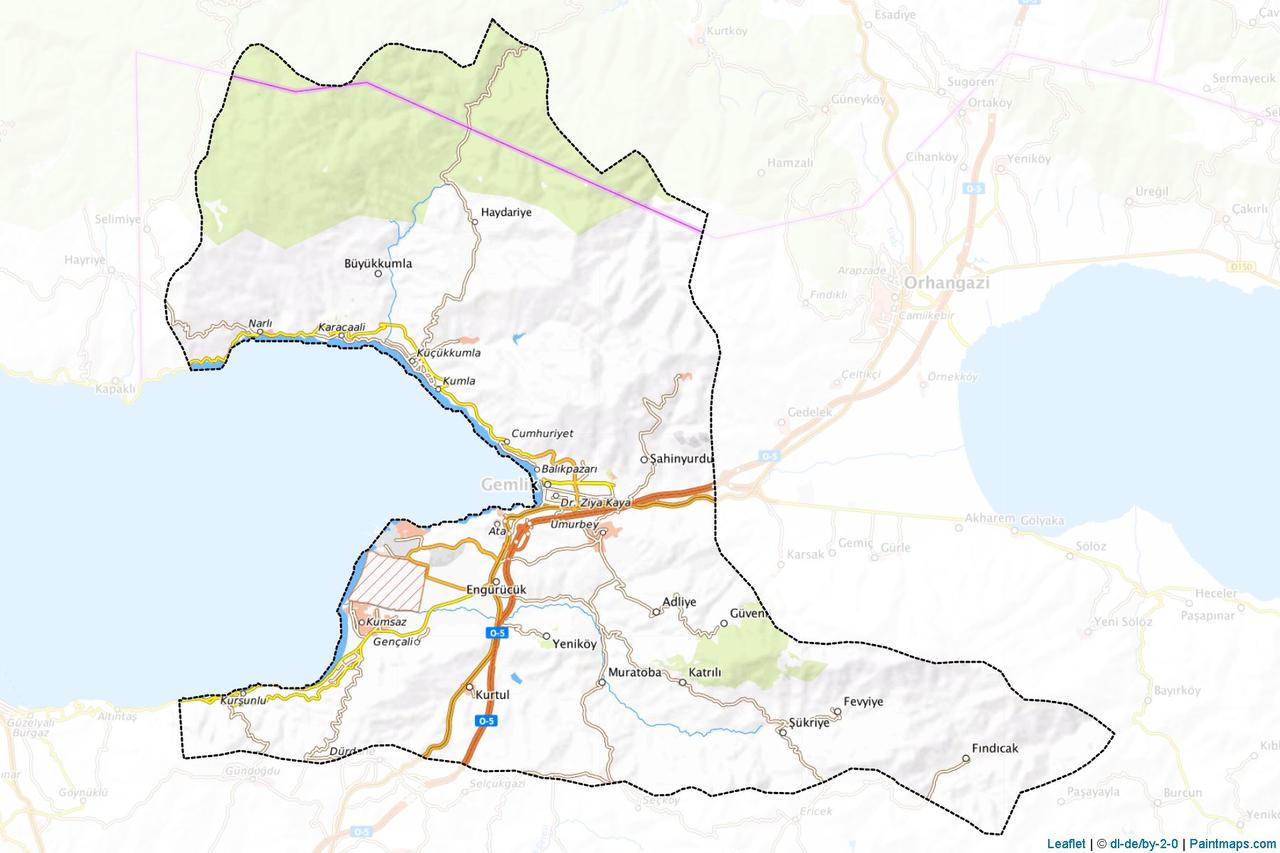
Gemlik (District)
Location | 32 km north of Bursa on the coast of Gemlik Bay in the Sea of Marmara | ||||||||
|---|---|---|---|---|---|---|---|---|---|
Coordinate(s) | 29.13° east longitude 40.12° north latitude | ||||||||
Area(s) | 413 km² | ||||||||
Neighboring Districts | North: Yalova (Armutlu, Çınarcık), east: Orhangazi, southeast: Yenişehir, south: Kestel, Gürsu, Osmangazi, west: Mudanya | ||||||||
District Governor | Osman Aslan CANBABA | ||||||||
Mayor(s) | Şükrü DEVİREN | ||||||||
Gemlik is an important port district in Türkiye’s Marmara Region,隶属于 Bursa Province, renowned for its olive cultivation and situated along the coast of the Sea of Marmara.
In antiquity, Gemlik was one of the earliest settlements established in the Bursa region, with its history extending back to the 12th century BCE. According to legend, it was founded and named after Syrus, a companion of Heracles who had gone missing. In 630 BCE, colonists from Miletus re-established the settlement under the name Kios. It subsequently came under the rule of the Lydians (556 BCE), the Persians (499 BCE), the Delian League (466 BCE), and again the Persians (412 BCE). In 334 BCE, the city passed into the hands of Alexander the Great, then to Lysimachus in 301 BCE, and to Seleucus I in 281 BCE. By 280 BCE, it had become an independent city-state under the protection of the Kingdom of Bithynia. However, in 202 BCE, it was captured and plundered by King Philip V of Macedon and subsequently granted to King Prusias I of Bithynia, after which it was renamed Prusias ad Mare (Prusias by the Sea). Between 89–85 BCE and 73–71 BCE, the city was occupied by Mithridates VI of Pontus and was incorporated into the Roman Republic in 74 BCE.
In 395 CE, Gemlik became part of the Eastern Roman Empire. In 1087, it was captured by the Seljuk commander Ebul Kasım, who gave it the name “Gemilik,” meaning “the place where ships dock and are built.” Over time, this name evolved into “Gemlik.” In 1097, during the First Crusade, the city reverted to Eastern Roman control and, except during the Latin Empire’s occupation from 1207 to 1224, was incorporated into the Empire of Nicaea in 1261. In 1336, during the reign of Orhan Bey, Gemlik came under Ottoman rule and became a town endowed with the Yıldırım Camii and Medresesi. Its economy revived with the construction of the Gemlik-Bursa road in 1856, and a municipal administration was established.
During the War of Independence, Gemlik was occupied by British forces on 6 July 1920, transferred to Greek forces on 8 July 1920, and liberated on 11 September 1922 by the Kocaeli Group under the command of Halit Pasha. Following the Treaty of Lausanne, the Christian population departed through the population exchange, and Turkish migrants from Greece settled in their place.
Introduction Video about Gemlik (TRT News)
Gemlik is located 32 kilometers north of Bursa, along the tranquil shores of the Gemlik Bay of the Sea of Marmara. The district lies at 29.13 degrees east longitude and 40.12 degrees north latitude, covering an area of 413 km². It is bordered by Armutlu and Çınarcık of Yalova to the north, Orhangazi to the east, Yenişehir to the southeast, Kestel, Gürsu, and Osmangazi to the south, and Mudanya to the west.
The slopes of the Samanlı and Katırlı Mountains surrounding Gemlik Bay form the district’s terrain. Numerous plains, including the Engürücük and Gemlik plains, lie between the mountains and the coast; the district center is situated at the western end of the Gemlik Plain. The highest point in the district is Üçkaya Hill in the Katırlı Mountains. The district is poor in rivers and lakes; the Karsak Çayı (Sazlık Deresi) carries the most water, while the Kocadere is the longest river. The Kocadere originates in the Katırlı Mountains, irrigates the Engürücük Plain, and flows into the bay. The bay is a natural basin formed by the Tuzla and Kapaklı capes; its waters are calm and waveless, with depths ranging from 1 to 150 meters. Geologically, the district consists of both ancient and recent rock formations, characterized by volcanic masses and sedimentary basins.
Gemlik generally experiences a Mediterranean climate with transitional characteristics toward a Black Sea climate. Temperatures range from +42.6°C to -25.7°C; annual precipitation varies between 456.2 mm and 1217.4 mm, with an average of 113 rainy days per year. July, with 22 mm of rainfall, is the driest month, while December, with 98 mm, is the wettest. Average temperatures are 23.3°C in July and 5.8°C in January.
The vegetation consists of maquis, forests, and olive groves. Forty-three percent of the soil is used for olive groves, 44 percent for cropland, 5 percent for meadows and pastures, and 8 percent is unsuitable for cultivation. Olive groves define the agricultural character of the district.
According to the 1891 Ottoman census, Gemlik had a population of 38,812: 43 percent Armenian (16,623), 39 percent Turkish (15,340), and 17 percent Greek (6,575), with 61 percent of the population being Christian. After the War of Independence, the Christian population left through the population exchange, and Turkish migrants from Greece settled in their place. Today, 80 percent of the district’s urban population is engaged in trade, with salted olives, oil, and soap being the most prominent commodities. Health infrastructure includes one state hospital (260 beds), one private hospital (7 beds), nine family health centers, and four health houses. There is one doctor per 990 people and 38 beds per 10,000 people. In 2018, 10,059 patients were hospitalized and 9,531 surgeries were performed. However, suicide cases increased between 2016 and 2018, with 159 incidents recorded.
Gemlik’s economy is based on agriculture, industry, fishing, and trade. Türkiye’s most flavorful table olives are produced in Gemlik. Apples, pears, peaches, beans, artichokes, cucumbers, tomatoes, peas, eggplants, and peppers are also cultivated. Türkiye’s first canning factory (Rifat Minare Koll. Şti.) was established here, leading to the development of vegetable farming and canning industries. Livestock farming is common in the mountain villages, while poultry farming is increasing in the district. Fishing is a significant source of income due to the bay’s rich variety of fish.
Olive oil production leads the industrial sector. The Sümerbank Artificial Silk Factory, established in 1937, played a role in the district’s development but has since been closed. Factories such as Tügsaş, Borusan, Çimtaş, Borçelik, and MKS form the industrial infrastructure. The district’s quarried veined marble, diabase (found in only two locations worldwide), and gypsum contribute significantly to the economy. The Bursa Free Zone, providing employment for 7,000 people, holds an important place in the district’s economic structure. As a port city, Gemlik is a strategic hub for maritime transport in the Marmara Region.
Gemlik is a first-class tourist district. Holiday homes, hotels, motels, camping areas, and pensions in Kurtululu, Küçük Kumla, Büyük Kumla, and Karacaali accommodate tourists. The Celal Bayar Library, Museum, and memorial tomb in Umurbey are major attractions. The Balıkpazarı Camii (converted from a church) and Çarşı Ali Paşa Camii are historical structures. The natural beauty of the bay and its calm waters further enhance tourism.
2024 data from the Address-Based Population Registration System indicates that Gemlik’s population is 123,361, with 245 people per square kilometer. Intensive urbanization is observed on the slopes due to rapid urbanization and migration. The old urban fabric, especially along the coastline, is being destroyed. The main street of the district is İstiklal Caddesi. The Kumla–Armutlu road is also developing as a new main thoroughfare.
Bursa Valiliği. "Gemlik." Accessed April 20, 2025. http://www.bursa.gov.tr/gemlik.
Gemlik Belediyesi. "Gemlik." Accessed April 20, 2025. https://gemlik.bel.tr/tr/gemlik.
Gemlik Kaymakamlığı. "Coğrafi Konumumuz." Accessed April 20, 2025. http://www.gemlik.gov.tr/cografi-konumumuz.
Gemlik Kaymakamlığı. "Coğrafya." Accessed April 20, 2025. http://www.gemlik.gov.tr/cografya1.
Gemlik Kaymakamlığı. "Sağlık Durumu." Accessed April 20, 2025. http://www.gemlik.gov.tr/saglik-durumu.
Gemlik Kaymakamlığı. "Tarihçe." Accessed April 20, 2025.
Nüfusu.com. "Gemlik, Bursa Nüfusu." Accessed April 20, 2025. https://www.nufusu.com/ilce/gemlik_bursa-nufusu.
TRT Haber. "Yakın Rotalar: Gemlik." TRT Haber Youtube Kanalı. Accessed April 20, 2025. https://www.youtube.com/watch?v=OIwiqczN1N4
Gemlik (District)
Location | 32 km north of Bursa on the coast of Gemlik Bay in the Sea of Marmara | ||||||||
|---|---|---|---|---|---|---|---|---|---|
Coordinate(s) | 29.13° east longitude 40.12° north latitude | ||||||||
Area(s) | 413 km² | ||||||||
Neighboring Districts | North: Yalova (Armutlu, Çınarcık), east: Orhangazi, southeast: Yenişehir, south: Kestel, Gürsu, Osmangazi, west: Mudanya | ||||||||
District Governor | Osman Aslan CANBABA | ||||||||
Mayor(s) | Şükrü DEVİREN | ||||||||
Geographical Structure
Climate and Vegetation
Social Structure
Economic Structure
Tourism Potential
Demographic Structure