

This article was automatically translated from the original Turkish version.
+2 More
Province(s) | Bursa | ||||||||
|---|---|---|---|---|---|---|---|---|---|
District Formation Date | 1987 | ||||||||
Area(s) | 423 km² | ||||||||
Elevation(s) | 100–150 metre | ||||||||
Number of Neighborhoods | 42 neighbourhoods, 22 villages (total 64 administrative units) | ||||||||
District Governor | Murat Süzen | ||||||||
Mayor(s) | Şadi Özdemir | ||||||||
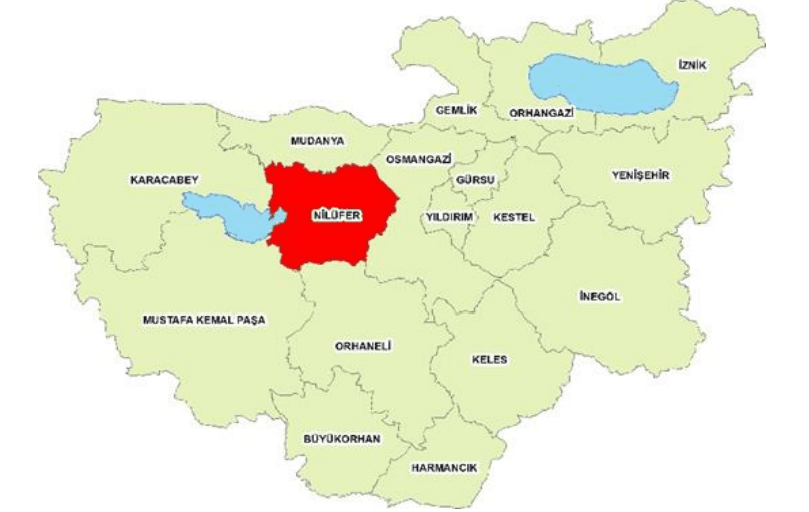
Nilüfer is a central district of Bursa Province in Türkiye’s Marmara Region, distinguished by its urban and economic development. It is located approximately 10 kilometers west of Bursa’s city center. To the east of the district lies Osmangazi, to the west Karacabey and partially Mustafakemalpaşa along with Lake Uluabat, to the north Mudanya, and to the south Orhaneli. The total area of the district is 423,181 decares (approximately 423 km²). Its elevation ranges from an average of 100 to 150 meters above sea level. Due to its geographical position and development trajectory, Nilüfer has become one of Bursa’s primary settlement centers expanding toward the west.
The district of Nilüfer derives its name from the Nilüfer Creek, which flows through it; the creek itself is named after Nilüfer Hatun, the wife of Ottoman Sultan Orhan Gazi. The region has been inhabited since prehistoric times, as evidenced by archaeological excavations at sites such as Aktopraklık Höyüğü in Akçalar and Tepecik Höyüğü in Alaaddinbey Mahallesi. These findings date the history of Nilüfer back to the 6th millennium BCE.
During antiquity, the district gained prominence through settlements such as Gölyazı (Apollonia ad Rhyndacum), which served as a religious and commercial center during the Roman and Byzantine periods. Places like Misi (modern-day Gümüştepe) also held significance in the context of early Christianity. After its conquest by Orhan Gazi in 1316, the region was incorporated into Ottoman rule and fortified with strategic castles.
With Bursa’s elevation to metropolitan municipality status in 1987, Nilüfer was established as one of three central districts alongside Osmangazi and Yıldırım. Since then, urbanization has accelerated significantly through large-scale housing projects.
Nilüfer District comprises a total of 64 administrative units: 42 neighborhoods and 22 rural neighborhoods (former villages). Notable neighborhoods within the district include Ataevler, Altınşehir, İhsaniye, Özlüce, Görükle, and Kayapa. Rural areas include villages such as Ayva, Dağyenice, Fadıllı, and Üçpınar. Local governance and public services are managed by the Bursa Metropolitan Municipality and Nilüfer Municipality.
Gölyazı is situated on a peninsula and island area on Lake Uluabat, approximately 42 kilometers west of Bursa. Its ancient name, Apollonia ad Rhyndacum, dates back to the 6th century BCE. The settlement developed during the Roman and Byzantine eras and features layered architectural remains including the Temple of Apollo, an ancient theater, city wall fragments, Byzantine churches, and Ottoman-era mosques and bathhouses. The peninsula and its surroundings are protected as a SIT (Special Environmental Protection Area). The approximately 750-year-old “Ağlayan Çınar” (Weeping Plane Tree) in the village square is under special protection.
Following the 1924 population exchange, Gölyazı became home to Turkish settlers from Thessaloniki, leaving traces of a Turkish-Rum cultural blend. The local economy relies on agriculture, fishing, and tourism. The shallow, reed-filled structure of Lake Uluabat creates unique natural beauty. Visitors enjoy fish meze, lake tours, and sunset views from Zambak Tepesi. The site is easily accessible via the Bursa–İzmir highway. Gölyazı is a significant cultural and tourism center, notable for its historical richness and natural environment.
The former name of Gümüştepe is “Misi.” Misi was one of the settlements established by the Misians who migrated from Thrace to Anatolia in 1816 BCE. Christian monks arrived in the region in 183 CE and conducted missionary activities, including theological debates. It is believed that a copy of the Bible was buried in the Misipoli Monastery; however, the monastery was looted in the 1950s.
In 1316, Orhan Gazi captured Misi and constructed fortresses to besiege Bursa. Some sources indicate that Misi briefly served as a temporary capital. Its importance declined after Bursa’s conquest in 1326.
Located at a sharp gorge of the Nilüfer Creek, Misi has historically been a strategic transit point along the Silk Road.
Ayvaini Cave, located within the boundaries of Ayva Village in Nilüfer, is the sixth longest cave in Türkiye, stretching 5.5 kilometers. The cave is hydrologically active, with underground waters emerging from its entrance.
The district has a total of 28 accommodation facilities (16 with tourism operation licenses and 12 with municipal licenses). As of 2021, the average occupancy rate was 42.9 percent, with an average stay duration of 1.84 nights.

Ayvaini Cave (Republic of Türkiye, Nilüfer Subgovernorship)
Nilüfer District lies within the Marmara climate zone, characterized by mild, rainy winters and hot, dry summers. The highest precipitation occurs during winter and spring, while July is the driest month. Annual average rainfall ranges between 500 and 700 millimeters. The average relative humidity is 58 percent. The district features a combination of maquis and forested areas, predominantly composed of broadleaf trees such as oak, chestnut, and hornbeam. According to CORINE 2018 data, land use in the district consists of agricultural areas (45 percent), forests and semi-natural areas (36 percent), artificial areas (14 percent), and water bodies and wetlands (5 percent).
Nilüfer is the district of Bursa with the fastest population growth. According to 2021 data, the total population is 518,382, of which 49.3 percent are male and 50.7 percent are female. In terms of age distribution, the largest groups are 40–44 years (9.16 percent), 35–39 years (8.98 percent), and 30–34 years (8.41 percent), indicating a high concentration of the working-age population. According to the Socio-Economic Development Survey conducted by the Ministry of Industry and Technology in 2022, Nilüfer ranks 8th nationally and 1st within Bursa, with a score of 4,072 points, placing it among first-tier developed districts.
Nilüfer District has a highly developed healthcare infrastructure. It includes 11 hospitals (3 public and 8 private), 16 private medical centers or clinics, and 41 oral and dental health clinics. As of 2020, the total number of hospital beds was 3,266. The number of intensive care beds per 1,000 people is 1.41. Additionally, the Nilüfer Public Health Education and Research Centers operate in collaboration with Uludağ University Faculty of Medicine.
Nilüfer is Bursa’s district with the largest industrial infrastructure. It hosts six organized industrial zones: Bursa OSB, Nilüfer OSB, Hasanağa OSB, Kayapa OSB, Bursa Leather Specialized OSB, and TOSAB Textile Dyeing OSB. Major industrial enterprises located in these zones include Oyak Renault, Bosch, Sifaş, Coşkunöz, Besaş, SKT, and Polylen. The Bursa OSB alone covers 712 hectares and provides employment for 63,000 people. The Beşevler Small Industrial Site is the district’s only small industrial site. Fully occupied, it hosts 1,563 businesses and approximately 10,600 employees. Agricultural activities in the district focus on ornamental plants, vegetables, and cereal production. Livestock farming is limited but notable for egg-laying chickens, cattle, and small ruminants. Türkiye’s 7.39 percent of pig population is located in Nilüfer. Additionally, in 81 households, 5,198 beehives produce 34 tons of honey annually.
Ayvaini Mağarası. "T.C. Nilüfer Kaymakamlığı." Accessed June 22, 2025. https://www.nilufer.gov.tr/ayvaini-magarasii.
Bursa EskişehirBilecikKalkınma Kütüphanesi. "Nilüfer İlçe Report." Ministry of Industry and Technology Development Library, 2023. PDF file. Accessed June 22, 2025. https://www.kalkinmakutuphanesi.gov.tr/assets/upload/dosyalar/nilufer_ilce_raporu.pdf
“Cennetten Bir Köşe: Gölyazı.” *T.C. Bursa Valiliği*. Accessed June 22, 2025. https://www.bursa.gov.tr/cennetten-bir-kose-golyazi.
“Misi.” *T.C. Nilüfer Kaymakamlığı*. Accessed June 22, 2025. https://www.nilufer.gov.tr/misi-koyu. nilufer.gov.tr
“Nilüfer.” *T.C. Bursa Valiliği*. Accessed June 22, 2025. https://www.bursa.gov.tr/nilufer.
“Nilüfer.” *T.C. Nilüfer Kaymakamlığı*. Accessed June 22, 2025. https://www.nilufer.gov.tr/nilufer.

Province(s) | Bursa | ||||||||
|---|---|---|---|---|---|---|---|---|---|
District Formation Date | 1987 | ||||||||
Area(s) | 423 km² | ||||||||
Elevation(s) | 100–150 metre | ||||||||
Number of Neighborhoods | 42 neighbourhoods, 22 villages (total 64 administrative units) | ||||||||
District Governor | Murat Süzen | ||||||||
Mayor(s) | Şadi Özdemir | ||||||||
History
Administrative Structure
Tourism and Cultural Heritage
Gölyazı
Gümüştepe (Misi)
Ayvaini Cave
Natural Environment
Population and Demographics
Healthcare
Economy