


This article was automatically translated from the original Turkish version.
+1 More
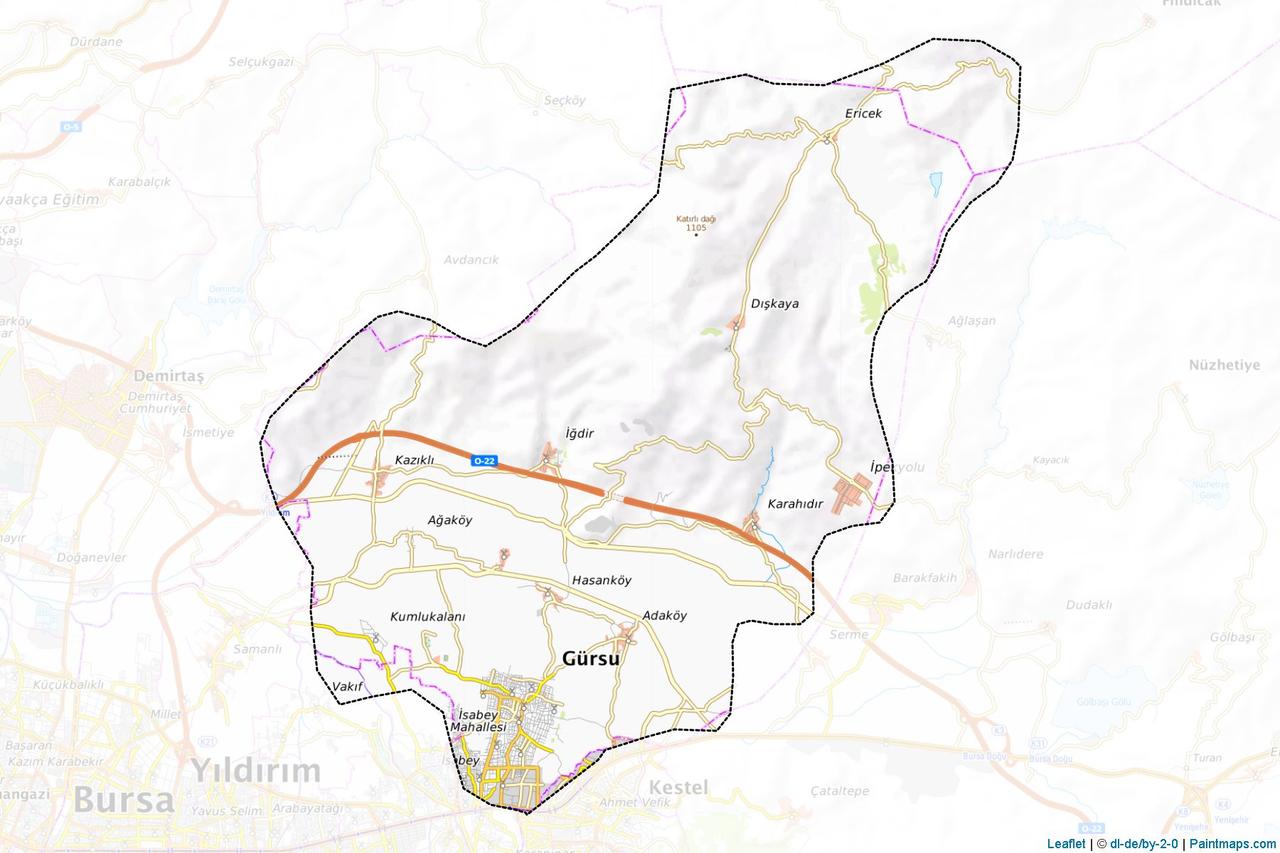
Gürsu (District)
Location | Bursa | ||||||||
|---|---|---|---|---|---|---|---|---|---|
Area(s) | 118 km² | ||||||||
Elevation(s) | 100 metre | ||||||||
Population (2024) | 104.867 | ||||||||
Mayor(s) | Mustafa Işık | ||||||||
District Governor | Murat Kütük | ||||||||
Gürsu is a district located in the northeastern part of Bursa Province in Türkiye’s Marmara Region. Covering an area of 118 km², the district is situated on lands stretching from the foothills of Uludağ to the Bursa Plain. In recent years, Gürsu has experienced development due to its potential in industry, agriculture, and tourism. The district contains historical structures from the Ottoman period, including plane trees, houses, baths, and mosques, which reflect the region’s cultural and historical fabric.
Gürsu’s origins trace back to a settlement established before the 15th century under the name “Susığırlık,” derived from the extensive rearing of water buffaloes (susığırı) in the region. Due to the presence of multiple settlements named Susığırlık and the abundance of water sources, the district adopted the name “Gürsu” in 1931. It became a subdistrict center in 1926 and gained district status on 9 May 1990 under Law No. 3644, beginning operations as a district in October 1991.
Gürsu bears traces from the Ancient, Roman, Byzantine, and Ottoman periods. It was particularly significant as a settlement during the Roman and Byzantine eras.
The İpekyolu Mahallesi, established at the Kozluca locality along the ancient Silk Road, reflects this heritage. Archaeological excavations have uncovered evidence of prehistoric settlements. The ancient road at Dışkaya Harmanlar Mevkii and the Kozluca locality have been registered as a First-Degree Archaeological Site.
During the Ottoman period, Gürsu became known for sericulture, with the third floors of houses designated for raising silkworms. Historical houses, the bathhouse, and the Orta Camii—which was originally a church—form the district’s cultural heritage. Fifty-six examples of civil architecture, a historical mill, and 62 plane and linden trees have been officially registered.
Gürsu is located 12–13 km from the center of Bursa, on a flat plain. It covers an area of 118 km² and lies at an elevation of 100 meters above sea level. To its west are Yıldırım and Osmangazi, to the north Gemlik, and to the east and south Kestel. Of the district’s 11,300 hectares, 42.8% is used for agriculture, 46.6% is forested, and the remainder consists of pasture, residential areas, and land unsuitable for farming. The forest stretching from Karahıdır Kavaklarbaşı Hill to Gerdirme Spring has been registered as a First-Degree Archaeological Site. There are no geothermal resources or mineral reserves in the area.
Gürsu exhibits the typical climate characteristics of the Marmara Region. Summers are hot (36–40°C), while winters are mild (8–10°C). Severe lodos storms occur during autumn due to air currents descending from Uludağ. The district’s vegetation consists of forested areas, maquis, and grasslands. Historical plane and linden trees are natural symbols of the district.
Gürsu is a settlement with rich cultural diversity. Before the Republic, the district had a substantial Greek population. After the War of Independence, settlements were established through population exchanges and migration from Greece, Bulgaria, former Yugoslavia, and Batumi. Today, locals coexist with migrants from Artvin, Erzurum, and Eastern Anatolia. In terms of education, the district operates 13 primary schools, 10 middle schools, 9 high schools, and 6 kindergartens.
According to the Socio-Economic Development Ranking prepared by the Ministry of Industry and Technology, Gürsu ranks 281st nationally and 11th within Bursa Province.
Gürsu’s economy is based on agriculture and industry. Forty-four percent of its 12,000 hectares of land is used for agriculture. Annually, 120,000 tons of fruit are produced, including 90,000 tons of Deveci and Santa Maria pears, 20,000 tons of peaches and nectarines, quince, plum, and apple. Cucumbers, lettuce, and purslane are cultivated in 320,000 m² of greenhouses. Livestock includes 1,940 head of cattle, 6,400 small ruminants, and 640 bee hives.
The Uludağ Organized Industrial Zone (GÜSAB) is the economic engine of the district. Spanning 185 hectares, it hosts 233 companies in textiles, automotive, metal, food, and energy sectors. With employment for 12,000 people and exports worth $500 million, the zone plays a vital role in Gürsu’s development. The Yeşilçevre Wastewater Treatment Plant purifies industrial waste, protects the environment, and provides irrigation water.
According to 2024 data, Gürsu’s population is 104,867. In 2021, 50.5% of the population was male and 49.5% female. The population pyramid highlights the highest concentrations in the 5–9 years (8.92%), 30–34 years (8.44%), and 10–14 years (8.43%) age groups, indicating a dense youth and working-age population. The district comprises 15 neighborhoods; Yenidoğan Neighborhood was transferred from Yıldırım District to Gürsu in 2004.
Tourism Potential
Gürsu holds significant tourism potential due to its historical and natural assets. Historical plane trees, Ottoman-era civil architecture, the bathhouse, Orta Camii, and the historical mill stand out as cultural heritage elements. The forested area stretching from Karahıdır Kavaklarbaşı Hill to Gerdirme Spring and the Silk Road ruins at Kozluca locality are of importance for archaeological tourism.
Gürsu occupies a place among the developing districts of Bursa Province through its historical heritage, agricultural production capacity, industrial activities, natural landscape, and cultural diversity.
Bursa Valiliği. “Gürsu.” Accessed April 20, 2025. http://www.bursa.gov.tr/gursu.
Gürsu Belediyesi. "Gürsu Tarihi." Accessed April 20, 2025. https://www.gursu.bel.tr/sayfa/gursu-tarihi.
Gürsu Kaymakamlığı. "Ekonomi." Accessed April 20, 2025. http://www.gursu.gov.tr/ekonomi.
Gürsu Kaymakamlığı. "Nüfus." Accessed April 20, 2025. http://www.gursu.gov.tr/nufus.
Gürsu Kaymakamlığı. "Tarih." Accessed April 20, 2025. http://www.gursu.gov.tr/tarih.
Gürsu Kaymakamlığı. "İklim ve Coğrafi Yapı." Accessed April 20, 2025. http://www.gursu.gov.tr/iklim-ve-cografi-yapi.
Kalkınma Kütüphanesi. “Gürsu İlçe Raporu.” Accessed April 20, 2025. https://www.kalkinmakutuphanesi.gov.tr/assets/upload/dosyalar/gursu_ilce_raporu.pdf.

Gürsu (District)
Location | Bursa | ||||||||
|---|---|---|---|---|---|---|---|---|---|
Area(s) | 118 km² | ||||||||
Elevation(s) | 100 metre | ||||||||
Population (2024) | 104.867 | ||||||||
Mayor(s) | Mustafa Işık | ||||||||
District Governor | Murat Kütük | ||||||||
History
Geographical Structure
Climate and Vegetation
Social Structure
Economic Structure
Demographic Structure