


This article was automatically translated from the original Turkish version.
+1 More
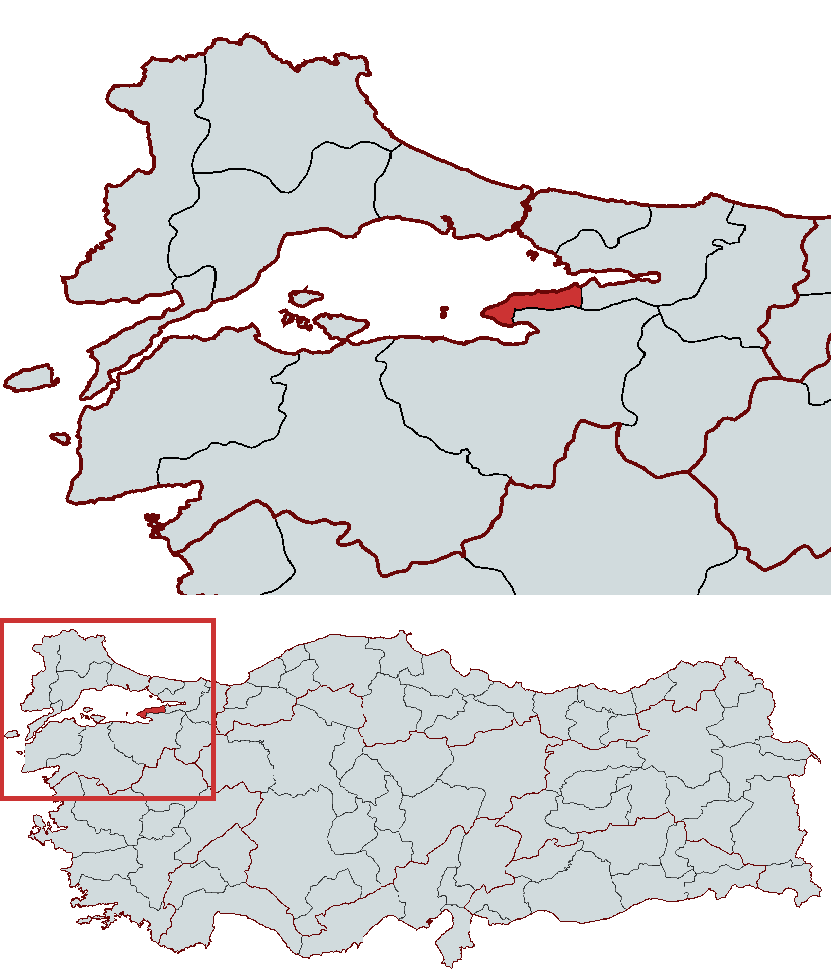
Yalova
Country | Türkiye | ||||||||
|---|---|---|---|---|---|---|---|---|---|
Region(s) | Marmara Region | ||||||||
Population | 307882 | ||||||||
Area(s) | 847 km² | ||||||||
Climate(s) | Mediterranean-Black Sea Transition Climate | ||||||||
Important Structure(s) | Atatürk Köşkü (Termal Atatürk Köşkü) Tarihi Çınarlı Yol Valide Hamamı Kurşunlu Hamam Yürüyen Köşk | ||||||||
Governor(s) | Hülya Kaya | ||||||||
Mayor(s) | Mehmet Gürel | ||||||||
License Plate Code | 77 | ||||||||
Yalova is the province with the smallest surface area in northwestern Türkiye, located in the southeastern part of the Marmara Region place. It is bordered by Sea of Marmara to the north and west, Kocaeli to the east, and Bursa and Gemlik Bay to the south. Situated along the northern coast of the Armutlu Peninsula and the northern slopes of the Samanlı Mountains, the province is noted for its natural beaches along the coastline and forested areas inland. Yalova, with a history extending back to antiquity, has been influenced by various civilizations including the Hittites, Phrygians, Bithynians, Romans and Byzantines like.
Also serving as a settlement center during the Ottoman period, city attained provincial status in 1995. Yalova exhibits transitional characteristics between Mediterranean and Black Sea climates and is distinguished by its thermal spas, natural beauty and historical structures. Its economy is based on agriculture, greenhouse farming, tourism and industry. The province was significantly affected by the 1999 Marmara Earthquake but has since rapidly resumed its development.
The region of Yalova and its surroundings has been inhabited since prehistoric times and has come under the influence of various civilizations. The earliest settlement traces date back to the 3000s BCE. Region was part of the Hittite territory Anatolia important, and later conquered by the Phrygians in the 1200s BCE. From the 5th century BCE, the region fell under Persian rule and became part of the Kingdom of Bithynia in the 3rd century BCE. In 74 BCE, Yalova came under the control of the Roman Empire and passed to the Byzantine Empire in 395 CE following the division of Rome.
During the Byzantine period, the thermal baths attracted considerable attention and were repaired and expanded during the reigns of Constantine I and Justinian I. Due to its proximity to Istanbul, the region remained an important health center until the Ottoman period. In 1302, it was the site of the Battle of Bafeus between Osman Bey and the Byzantines. After coming under Ottoman control in 1326, Yalova remained a settlement subordinate to Bursa, İzmit and Karamürsel for several centuries.
During the Ottoman period, Yalova continued to grow through the development of its thermal baths, improvement of road networks and expansion of agricultural activities. In the 19th century, during the reign of Abdülhamid II, urban development projects speed were initiated, leading to the construction of baths and hotels. The region suffered major damage in the great earthquake of 1894 and was subsequently rebuilt.
During the First World War and the War of Independence, Yalova, located at a strategic point, was occupied by Greek forces on 7 August 1920 and liberated by Turkish forces on 19 July 1921. Significant destruction occurred during the occupation period, and after the withdrawal of Greek troops, the city was rebuilt.
After the proclamation of the Republic, Mustafa Kemal Atatürk granted Yalova special status, visited the city frequently and expressed his affection for it by saying, “Yalova is my city.” In 1929, Yalova was organized as a district under Istanbul and developed into a tourist center due to its thermal springs and natural beauty.
Yalova attained provincial status on 6 June 1995 through law. It suffered extensive damage during the 1999 Marmara Earthquake and experienced population losses. However, it quickly recovered and continued its development in tourism, agriculture and industry. Today, it remains one of the important cities of the Marmara Region due to its natural beauty, thermal spas and historical heritage.
Yalova is located in northwestern Türkiye, in the southeastern part of the Marmara Region. Situated along the northern coast of the Armutlu Peninsula and the northern slopes of the Samanlı Mountains, the province has a surface area of 847 km², making it the smallest province in Türkiye. Its average elevation above sea level is 5 meters, with its highest point being Beşpınar Hill at 926 meters.
To the north and west lies the Sea of Marmara, to the east is Kocaeli, and to the south are Bursa and Gemlik Bay. Yalova’s coastline does not exhibit deep indentations or protrusions building but consists of a narrow coast strip. Along this coastal strip are natural beaches, and the shores of Çınarcık, Esenköy and Armutlu are particularly significant for tourism.
The topography of Yalova is generally composed of mountainous and forested areas. The southern part is covered by the Samanlı Mountains, which connect with the Kocaeli Mountain Range extending between İzmit and Sapanca from west to east. A large portion of the province’s land is covered by forests, with beech, oak, hornbeam, chestnut, cranberry and linden trees being common. Delmece Plateau is one of the province’s important nature tourism centers.
Yalova has fertile soils, and its plains generally extend along rivers. Its main plains are the Kocadere Plain, the Port Plain, the Samanlı-Kadıköy Plains, the Kazımiye Plain and Taşköprü Plain. These plains extend 1–2 km inland from the coast and play a vital role in agricultural production.
Small rivers such as Gökçedere, Kirazlı, Kılıçköy, Çınarcık and Taşköprü flow through the province. Additionally, lakes and wetlands such as Dipsiz Lake contribute to ecological diversity. Yalova lies in a transitional zone between Mediterranean and Black Sea climates. Summers are hot and dry, while winters are mild and rainy. The annual average temperature is 14.6 °C and the annual average rainfall is approximately 727.5 mm. Snowfall occurs in higher elevations during Winter months, but the coastal areas enjoy mild weather conditions.
Its geographical proximity to major cities such as Istanbul, Kocaeli and Bursa is a key factor supporting Yalova’s development in tourism, agriculture and industry.
As of 2024, Yalova’s total population is 307,882, with a population density of 363 people per km². 89.62% of the population lives in urban areas and 10.38% in rural areas. Since attaining provincial status in 1995, Yalova has become a migration area due to its proximity to major cities such as Istanbul, Bursa and Kocaeli. A temporary population decline occurred after the 1999 Marmara Earthquake, but population growth resumed in subsequent years due to development in industry, agriculture and tourism.
Yalova is a region with a high concentration of immigrants from the The Balkans and the Caucasus, and is home to various ethnic groups including Bosniaks, Albanians, Pomaks, Georgians, Laz people and Circassians house. In addition, internal migration from other regions has increased ethnic and cultural diversity.
Looking at the Age distribution, approximately 20% of the population is aged 0–14, 65% is aged 15–64, and 15% is aged 65 and over. Male and female population ratios are nearly equal, and a large portion of the economically active population is employed in agriculture, industry and tourism. The level of education is steadily rising, and the proportion of university graduates in the province is close to the national average. Due to its proximity to Istanbul, Yalova’s seasonal population has increased, and it has also become an attractive residential area for the elderly.
Yalova’s economy is based on agriculture, industry, trade and tourism. In agricultural production, greenhouse farming, fruit cultivation and floriculture hold significant importance. Thanks to favorable climatic conditions and fertile soils, vegetable and fruit production is widespread. Intensive greenhouse production and ornamental plant cultivation in Çiftlikköy, Altınova and the central district have made Yalova one of Türkiye’s leading flower production centers.
The industrial sector also plays a major role in Yalova’s economy. Shipbuilding, concentrated especially in the districts of Altınova and Çiftlikköy, is one of the main industrial pillars supporting the province’s economic development. Some of Türkiye’s largest shipyards are located in Altınova, where ship construction and repair activities are carried out. In addition, the chemical, textile, plastic and metal industries have also developed.
Tourism holds an important place in Yalova’s economic structure. It is an attractive center for thermal tourism, seasonal tourism and nature tourism. Coastal areas such as Çınarcık, Esenköy and Armutlu are heavily visited, especially during write months. The thermal spas in the Termal district attract interest in health tourism, and investments in this sector continue.
Due to its geographical proximity to major cities such as Istanbul, Bursa and Kocaeli, Yalova has an important transportation network.
Road Network
Yalova lies on the D-575 and E881 highways and is connected by road to Istanbul, Bursa and Kocaeli. Travelers coming from Istanbul can easily reach Yalova via the Osman Gazi Bridge and the D-575 highway. Continuous road access is also provided via connections to Bursa and Kocaeli.
Sea Transport
Yalova is one of the closest points to Istanbul for maritime access. Regular ferry services operated by İDO and private ferry companies run from Pendik, Yenikapı and Kartal in Istanbul to Yalova. Additionally, vehicle ferry services between Topçular and Eskihisar provide a link to Kocaeli.
Yalova is one of the important tourism centers of the Marmara Region due to its natural beauty, thermal spas, coastal tourism and opportunities for outdoor sports. Its proximity to major cities such as Istanbul, Bursa and Kocaeli makes it an attractive destination for week end and seasonal tourism.
Yalova is a major health tourism center due to its thermal springs and healing waters. The Yalova Thermal Spas, located within the boundaries of the Termal district, have been known since Roman and Byzantine times and have retained their importance through the Ottoman and Republican periods. Thermal waters with temperatures ranging from 55–65 °C are beneficial for rheumatic diseases, skin disorders, respiratory illnesses and metabolism conditions.
Main thermal facilities include:
Yalova’s location along the Sea of Marmara makes coastal tourism highly significant. The shores of Çınarcık, Esenköy and Armutlu are among the most popular destinations for vacationers during summer months. These areas feature summer resorts, beaches and entertainment venues and are also favored by day-trippers due to their proximity to Istanbul.
Main beaches include:
Yalova has significant potential for nature tourism due to its forested areas, waterfalls and plateaus. The province offers suitable areas for activities such as hiking, camping and trekking.
Main nature tourism sites:
Yalova is also an important culture tourism center due to its historical past. Numerous historical structures from the Ottoman and Republican periods remain.
Main historical and cultural sites:
Yalova offers various opportunities for outdoor sports and alternative tourism.
Tuncel, Metin. "Yalova." *TDV İslâm Ansiklopedisi.* Accessed February 9, 2025. https://islamansiklopedisi.org.tr/yalova.
Türkiye İstatistik Kurumu. "Cumhurbaşkanlığı İstatistik Portalı." Accessed February 9, 2025. https://cip.tuik.gov.tr/.
Yalova Belediyesi. "Yalova Hakkında." Accessed February 9, 2025. https://www.yalova.bel.tr/sayfa/yalova-hakkinda.
Yalova Valiliği. "Şehrimiz." Accessed February 9, 2025. http://www.yalova.gov.tr/sehrimiz.

Yalova
Country | Türkiye | ||||||||
|---|---|---|---|---|---|---|---|---|---|
Region(s) | Marmara Region | ||||||||
Population | 307882 | ||||||||
Area(s) | 847 km² | ||||||||
Climate(s) | Mediterranean-Black Sea Transition Climate | ||||||||
Important Structure(s) | Atatürk Köşkü (Termal Atatürk Köşkü) Tarihi Çınarlı Yol Valide Hamamı Kurşunlu Hamam Yürüyen Köşk | ||||||||
Governor(s) | Hülya Kaya | ||||||||
Mayor(s) | Mehmet Gürel | ||||||||
License Plate Code | 77 | ||||||||
History of Yalova
Geography and Climate
Population
Economy
Transportation
Tourism
Termal
Marine Tourism
Nature and Plateau Tourism
Historical and Cultural Tourism
Sports and Alternative Tourism