


This article was automatically translated from the original Turkish version.
+2 More
Keles (District)
Keles
Country | Türkiye | ||||||||
|---|---|---|---|---|---|---|---|---|---|
Province(s) | Bursa | ||||||||
Population | 11.171 | ||||||||
Distance to City Center (Km) | 61 | ||||||||
Elevation (M) | 1050 | ||||||||
Area (km²) | 640 | ||||||||
Keles is a small district located on the southern slopes of Uludağ, at the northernmost edge of the Inner Western Anatolia region of the Aegean Region, subordinate to Bursa. It has an area of 640 km² and comprises 35 villages and 7 neighborhoods.
According to the 2024 census, the population of Keles is 11,171, consisting of 5,615 males and 5,556 females.
In percentage terms, the population is 50.26 percent male and 49.74 percent female. The population density is 17.45. The overall population showed a growth trend until 1980, followed by a decline after that year. Due to insufficient utilization of the district’s agricultural land, forests, and underground resources, as well as limited investment in the region, there are very few employment opportunities. As a result, the district experiences significant out-migration to other cities and districts. For instance, according to the 1893 census, Bursa’s population was 121,590 while Keles had a population of 12,582. Today, Bursa’s population has increased approximately 26-fold to 3,238,618, whereas Keles’s population has declined to 11,171.
There are various claims regarding the origin of the name Keles, but the prevailing view is that the district’s name derives from a place name in Central Asia, introduced by the Kayı tribe of the Oghuz Turks. Today, geographical regions bearing the name Keles still exist in Central Asia. Some of these are:
The district’s history extends back to prehistoric times. Various civilizations have inhabited the region, including the Phrygians, Lydians, Bithynians, Romans, and Byzantines. Archaeological findings include small artifacts such as ornaments, coins, seals, and food storage vessels, as well as ruins of churches, temples, and baths. Furthermore, research has revealed the presence of a large temple on a dominant hill in the area. Studies indicate that during the Roman period, the region lay along the King’s Road, a major and busy trade route. The area first came under the control of the Seljuks of Anatolia in 1075. However, following the First Crusade in 1097, it reverted to Byzantine control. In the early 13th century, Ertuğrul Gazi and his affiliated tribes, belonging to the Kayı branch of the Oghuz Turks, settled in the nearby regions of Söğüt and Domaniç.
Ertuğrul Gazi conducted conquest campaigns in the region. After his death, his son Osman Gazi continued these efforts, and during his reign, Keles returned to Turkish control. The region was not occupied during the Ottoman period. However, on 8 July 1920, Greek forces occupying Bursa established a garrison in Keles on 10 July 1921, one year later. The Greek detachment initially set up its headquarters in Cuma Neighborhood and later moved to Yenice Neighborhood. The primary reason for the Greek military presence in Keles was to suppress local militia forces and especially to sever communication between Bursa and Ankara. During the occupation, communication between Bursa and Ankara was maintained by militia units operating through the mountainous regions of Tavşanlı and Kütahya. After the occupation of this area, Bursa’s connection to Anatolia and Ankara was completely cut off. The district was liberated from Greek occupation only on 11 September 1922.
The local population contributed hundreds of martyrs and veterans during World War I, the Gallipoli Campaign, and the Turkish War of Independence. The people of the region endured great suffering and experienced occupation for more than a year.
The district derives little benefit from the influence of the Sea of Marmara due to the shielding effect of Uludağ. Its climate can be considered a transitional zone between temperate and continental climates. As a result, winters are cold and wet. Keles stands out as the district in Bursa receiving the highest amount of precipitation.
The district lies south of Uludağ and southeast of Tepel Dağı. Its terrain includes both flat areas and mountainous regions. Although mountainous areas predominate, the land remains suitable for agriculture. Forests cover 57 percent of the district’s total area, making it one of Bursa’s most forested districts. Despite the presence of many rivers, the most significant and largest is the Kocasu River. It originates from the northern slopes of Murat Dağı near Kütahya’s Gediz and flows into Uluabat Lake. A separate river emerging from Uluabat Lake drains into the southern part of the Sea of Marmara. The Kocasu River is approximately 276 km long. The district’s vegetation is predominantly composed of pine forests and grasslands. As one moves toward the Uludağ region, trees such as fir, poplar, chestnut, and juniper become more common. Grassland areas are used as pastures.
The district’s economy is primarily based on agriculture and animal husbandry. Due to the mountainous, rugged, and forested nature of the land, agricultural productivity and diversity are limited. The main agricultural products are cherry, strawberry, sour cherry, and walnut. Cherry production is especially intensive in the region, accounting for approximately 3 percent of Turkey’s total cherry output. Both small and large livestock farming are practiced in the district. Goat and sheep breeding are particularly prominent. Dairy cattle farming is also an important economic activity. Additionally, forestry and forest product production hold significant economic importance in the district, which is largely covered by forests.

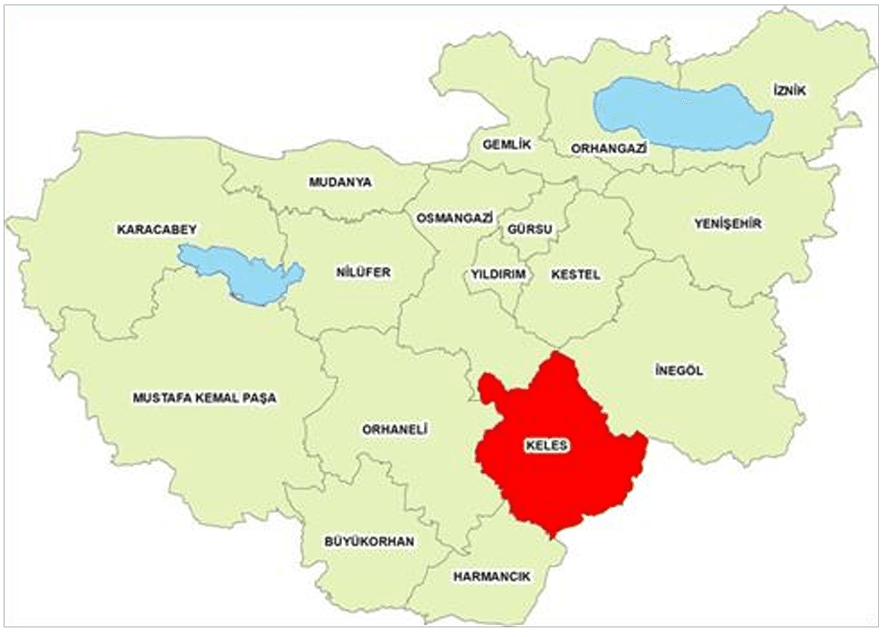
Location of Keles District within Bursa (Source: BEBKA Keles District Report)

Gelemiç Village, Bursa Keles (Source: Bursa Tourism Portal)
BEBKA Keles District Report. Accessed April 24, 2025. https://www.kalkinmakutuphanesi.gov.tr/assets/upload/dosyalar/keles_ilce_raporu.pdf
Bursa Uludağ University Keles Yazıcı. Accessed April 24, 2025.
Bursa Valiliği. Accessed April 24, 2025. http://www.bursa.gov.tr/keles
Bursa Şehit ve Şehitlikleri. Accessed April 24, 2025. https://www.bursa.bel.tr/dosyalar/yayinlar/cwcid9srj34k4w0.pdf
Keles Gelemiç Village. Accessed April 24, 2025. https://www.bursa.com.tr/tr/mekan/gelemic-koyu-keles-730/
Keles Kaymakamlığı Governorship. Accessed April 24, 2025. http://www.keles.gov.tr/ilcemizin-tarihi
Keles Nüfusu. Accessed April 24, 2025. https://www.nufusu.com/ilce/keles_bursa-nufusu
Kocasu Çayı Deltası ve Yakın Çevresinin Ekolojik Açıdan Değerlendirilmesi. Accessed April 24, 2025. https://nek.istanbul.edu.tr/ekos/TEZ/53763.pdf

Keles (District)
Keles
Country | Türkiye | ||||||||
|---|---|---|---|---|---|---|---|---|---|
Province(s) | Bursa | ||||||||
Population | 11.171 | ||||||||
Distance to City Center (Km) | 61 | ||||||||
Elevation (M) | 1050 | ||||||||
Area (km²) | 640 | ||||||||
Population
Origin of the Name
History
Climate and Geography
Economic Structure