

This article was automatically translated from the original Turkish version.
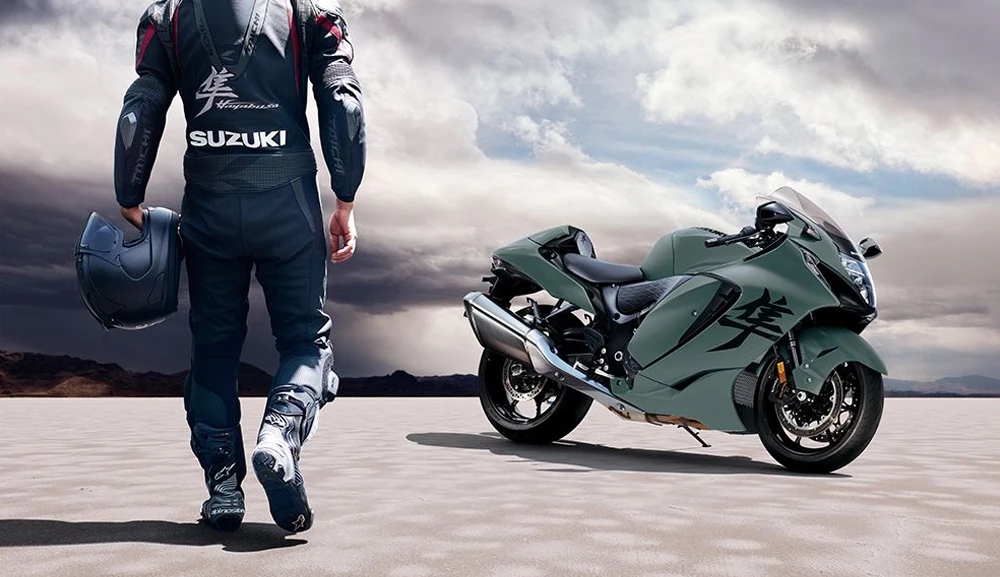
Suzuki GSX1300R Hayabusa is a sport motorcycle model produced by Suzuki Motor Corporation, distinguished by its aerodynamic design and high-speed capabilities. First introduced to the market in 1999, the model derives its name from the Japanese word "Hayabusa," meaning "peregrine falcon," a bird known for its high-speed dives. Production of the model is carried out at Suzuki’s Hamamatsu plant in Japan【1】, and since 2021 assembly has also commenced at Suzuki’s facilities in India【2】.
Suzuki Hayabusa (Suzuki Türkiye)
GSX1300R Hayabusa’s first generation was launched in 1999. The motorcycle is powered by a liquid-cooled, four-stroke, inline-four engine with a displacement of 1298 cc, producing 175 PS (128.7 kW) at 9800 rpm【3】. Upon its 1999 release, it became the fastest production motorcycle in the world, capable of exceeding 190 mph. According to the same source, the model’s high-speed capability contributed to the establishment of a voluntary agreement among European and Japanese manufacturers in 2000 to limit top speeds to 186 mph (300 km/h)【4】.

1999 | Hayabusa(GSX1300R) (Suzuki)
In the 2008 model update, the stroke length was increased by 2 mm, raising the engine displacement from 1298 cc to 1340 cc and boosting power output to 197 PS (145 kW). This generation introduced Suzuki Dual Throttle Valve (SDTV) system, titanium valves, and the Suzuki Drive Mode Selector (S-DMS), allowing riders to adjust power characteristics. According to the 2014 Suzuki Annual Report, a Japan-specific variant equipped as standard with an Electronic Toll Collection (ETC) device was introduced in February 2014【5】.

2008 | Hayabusa (GSX1300R) (Suzuki)
According to Suzuki’s February 2021 Global News bulletin, the motorcycle underwent a complete model overhaul after a 13-year gap, marking the transition to its third generation. The new generation features an updated 1340 cc engine compliant with Euro 5 emission standards, producing 140 kW (188–190 PS) at 9700 rpm. As stated in the April 2021 press bulletin, assembly operations were initiated at Suzuki Motorcycle India Private Limited (SMIPL) facilities to expand the international production network. To commemorate the 25th anniversary of production, a special 25th Anniversary Edition was released featuring a glass enamel badge on the fuel tank, a Hayabusa kanji logo on the drive chain, gold-anodized brake rotors, and a single-seat cowling【6】.

2021 | Hayabusa(GSX1300R) (Suzuki)
The motorcycle’s design was developed using wind tunnel testing to minimize aerodynamic drag, drawing inspiration from samurai armor and the physical characteristics of the peregrine falcon. Academic studies on the design indicate that, when accounting for its enclosed body shape and the rider’s tucked-in position, the model’s drag coefficient (Cd) measures 0.55【7】. The motorcycle features two Suzuki Ram Air Direct (SRAD) air intake ducts that direct high-pressure fresh air to the air filter.

Side view showing the Suzuki GSX1300R Hayabusa’s aerodynamically optimized body panels and profile from wind tunnel testing. (Suzuki)
The third-generation GSX1300R Hayabusa is equipped with a liquid-cooled, DOHC, inline-four engine with a displacement of 1340 cc, featuring a bore of 81.0 mm and a stroke of 65.0 mm. The compression ratio is 12.5:1, delivering 150 Nm of torque at 7000 rpm. The transmission is a six-speed constant mesh gearbox with a wet multi-plate clutch incorporating Suzuki Clutch Assist System (SCAS)【8】. The fuel system operates via ride-by-wire electronic throttle bodies.
The frame consists of an aluminum alloy twin-spar structure with a swingarm. The front suspension features fully adjustable KYB inverted telescopic forks, while the rear suspension uses a KYB link-type coil spring damper system. The braking system comprises dual 320 mm discs with four-piston Brembo Stylema calipers on the front wheel and a single 260 mm disc with a Nissin single-piston caliper on the rear wheel【9】.
According to the February 2021 press bulletin, the model features the Suzuki Intelligent Ride System (S.I.R.S.), integrated with a six-axis IMU (Inertial Measurement Unit). This electronic package includes the Suzuki Drive Mode Selector Alpha (SDMS-α) with three factory presets and three user modes, 10-level Motion Track Traction Control, Engine Brake Control, and a Bidirectional Quick Shift System. Additionally, as stated in the same bulletin, the motorcycle introduces for the first time in a production model the Active Speed Limiter system as standard equipment【10】.

TFT LCD instrument panel displaying Suzuki Intelligent Ride System data and ride modes. (Suzuki)
The motorcycle’s physical dimensions are 2180 mm in length, 735 mm in width, and 1165 mm in height. The wheelbase measures 1480 mm, the seat height is 800 mm, and the ground clearance is 125 mm. The wet weight is 264 kg, the dry weight is 220 kg, and the fuel tank capacity is 20 liters. Tire sizes are 120/70ZR17M/C (58W) for the front and 190/50ZR17M/C (73W) for the rear【11】.
[1]
Suzuki Motor Corporation. Corporate Outline. Hamamatsu: Suzuki Motor Corporation, 2024. Access 7 March 2026. https://www.globalsuzuki.com/ir/library/data/pdf/outline.pdf.
[2]
Suzuki Motor Corporation. "Suzuki Starts Assembly of the All-New Hayabusa in India." Global News, April 2021. Access 7 March 2026. https://www.globalsuzuki.com/globalnews/2021/pdf/0427.pdf.
[3]
Suzuki Motor Corporation. "Suzuki Digital Library: GSX1300R Hayabusa (1999)." Global Suzuki. Access 7 March 2026. https://www.globalsuzuki.com/motorcycle/smgs/digital-archive/2_bike/sports_078.php.
[4]
Barolo, Emanuele. "L’evoluzione tecnica e prestazionale della Suzuki Hayabusa." Bachelor’s Thesis, Alma Mater Studiorum Università di Bologna, 2022. Access 7 March 2026. https://amslaurea.unibo.it/id/eprint/27438/1/Barolo_Emanuele_Tesi.pdf.
[5]
Suzuki Motor Corporation. Annual Report 2014. Hamamatsu: Suzuki Motor Corporation, 2014. Access 7 March 2026. https://www.globalsuzuki.com/ir/library/annualreport/pdf/2014/2014-1.pdf.
[6]
Suzuki Motor Corporation. "Suzuki to Introduce the 25th Anniversary Model of the Flagship Motorcycle Hayabusa." Global News, July 2023. Access 7 March 2026. https://www.globalsuzuki.com/globalnews/2023/0630.html.
[7]
Barolo, Emanuele. "L’evoluzione tecnica e prestazionale della Suzuki Hayabusa." Bachelor’s Thesis, Alma Mater Studiorum Università di Bologna, 2022. Access 7 March 2026. https://amslaurea.unibo.it/id/eprint/27438/1/Barolo_Emanuele_Tesi.pdf.
[8]
Suzuki Türkiye. "Suzuki Hayabusa, Racing, Supersport." Doğan Trend Otomotiv. Access 7 March 2026. https://www.suzuki.com.tr/tr/motosiklet/hayabusa.html.
[9]
Suzuki Motor Corporation. "Suzuki Unveils the All-New Hayabusa." Global News, February 2021. Access 7 March 2026. https://www.globalsuzuki.com/globalnews/2021/pdf/0205a.pdf.
[10]
Suzuki Motor Corporation. "Suzuki Unveils the All-New Hayabusa." Global News, February 2021. Access 7 March 2026. https://www.globalsuzuki.com/globalnews/2021/pdf/0205a.pdf.
[11]
Suzuki Türkiye. "Suzuki Hayabusa, Racing, Supersport." Doğan Trend Otomotiv. Access 7 March 2026. https://www.suzuki.com.tr/tr/motosiklet/hayabusa.html.

No Discussion Added Yet
Start discussion for "Suzuki GSX1300R Hayabusa" article
History and Generations
First Generation (1999–2007)
Second Generation (2008–2020)
Third Generation (2021–Present)
Design and Aerodynamics
Technical Specifications and Equipment
Engine and Transmission
Chassis and Suspension
Ride Assistance Systems
Dimensions and Weight