


This article was automatically translated from the original Turkish version.
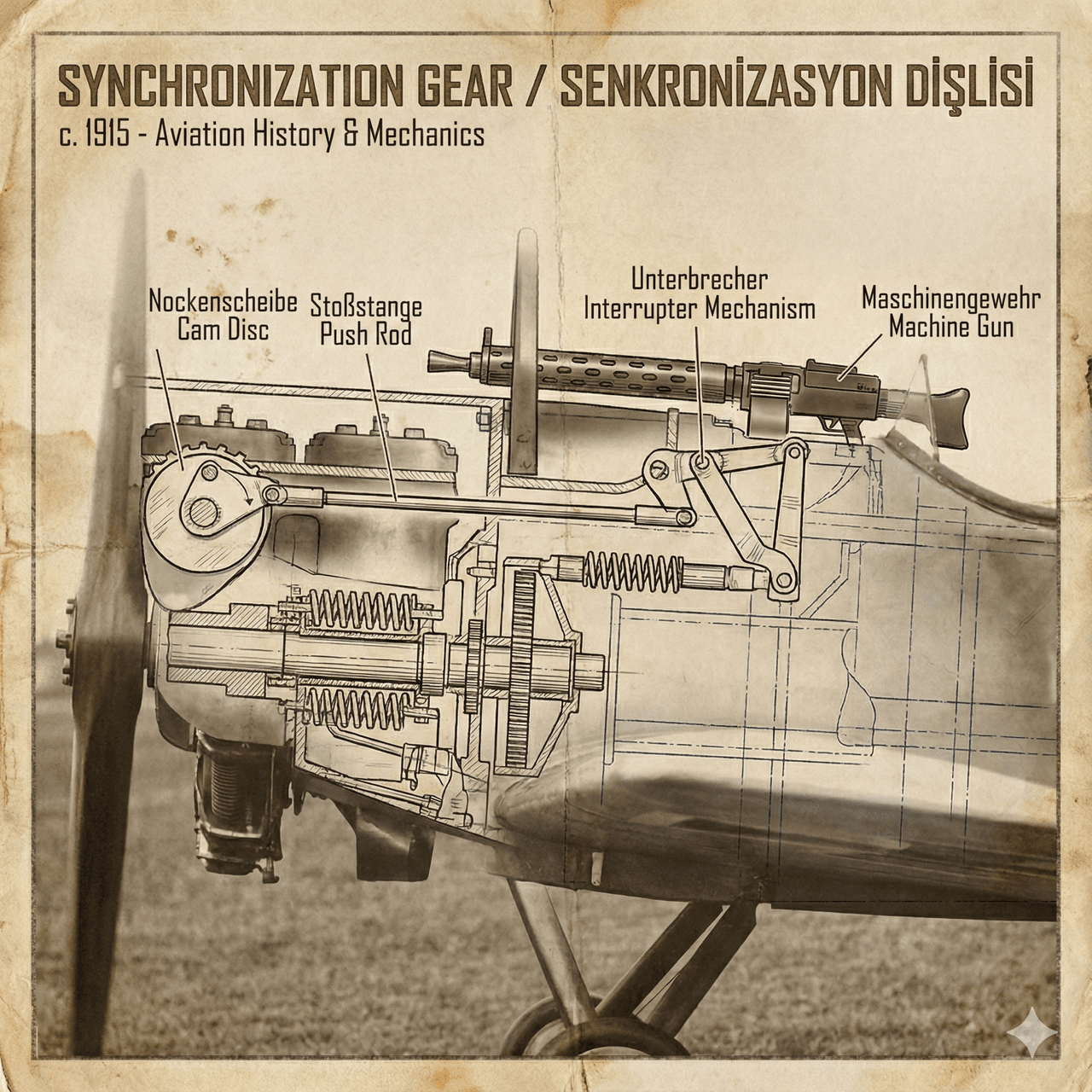
Senkronizasyon Dişlisi (Havacılık) (Yapay zeka ile oluşturulmuştur)
Synchronization gear (interrupter or gun synchronizer) is a mechanical device that enables a machine gun on a single-engine aircraft to fire through the arc of the spinning propeller without damaging the blades. Aviation history records this system as having fundamentally transformed the nature of air combat by turning the aircraft itself into a weapon, and it remained a standard component of military aircraft for decades.
A modern experimental simulation demonstrating the operating principle of the synchronization system and how bullets pass through the propeller blades without striking them. (The Slow Mo Guys)
At the start of World War I, machine guns were desired to be mounted directly in the pilot’s line of sight—that is, on the fuselage—but this created the problem of bullets striking the propeller. While early solutions included mounting the guns outside the propeller arc, on the upper wing or at an angle, these methods reduced accuracy. French engineer Raymond Saulnier worked on a system that would fire the gun only when the propeller blade was not in the line of fire, but early tests failed due to inconsistent bullet timing. Pilot Roland Garros devised a temporary solution by fitting steel deflector plates onto the propeller blades to deflect incoming bullets. With this system, Garros achieved the first aerial victories in April 1915, but approximately 10 percent of the bullets were lost, and the deflectors posed a risk of causing aerodynamic drag and engine damage.

Anthony Herman Gerard Fokker (New Netherland Institute)
In April 1915, Roland Garros’s aircraft crashed behind German lines, and the mechanism was examined by Anthony Fokker. Fokker and his team developed an interrupter mechanism that controlled firing based on the propeller’s position, replacing the deflector plates. According to technical archives by Woodman and Weyl, this system abandoned the French deflector concept and achieved true synchronization by directly linking the firing pin to the propeller shaft. Fokker integrated this mechanism into his Eindecker series of aircraft, producing a technological leap in aerial warfare.

Representative illustration showing details of the Fokker Eindecker aircraft and its machine gun mounting. (Generated by AI)
The technical operation of the system relies on an irregularly shaped cam disk connected to the engine’s crankshaft or propeller shaft. When a propeller blade moves into the path of a bullet, the cam disk triggers a pushrod and linkage system that physically prevents the gun from firing until the blade has passed. As propeller speed increases, synchronization becomes more critical, since tolerance is measured in milliseconds. In later years, more reliable systems replaced vulnerable mechanical linkages, such as the hydraulic “CC gear” developed by George Constantinescu, which transmitted motion through pressure waves in oil.

Technical schematic of the mechanism designed by Raymond Saulnier to synchronize the Hotchkiss machine gun with the engine’s rotation (June 1914). (Morane-Saulnier Heritage)
The introduction of the synchronization gear on Fokker aircraft gave Germany air superiority from summer 1915 until mid-1916, a period known in aviation history as the Fokker Scourge. German aces Max Immelmann and Oswald Boelcke exploited the advantage of aiming directly through the propeller arc, shooting down numerous Allied aircraft. This technological edge forced British and French forces to develop their own synchronization systems and laid the groundwork for modern aerial combat tactics.
Raffal, Harry. "The Invention That Turned the Tide of Aerial Combat." The Royal Air Forces Association. April 9, 2024. Accessed January 4, 2026. https://rafa.org.uk/blog/2024/04/09/the-invention-that-turned-the-tide-of-aerial-combat/
Spartacus Educational. "Synchronizing Gear." Spartacus Educational. Accessed January 4, 2026. https://spartacus-educational.com/FWWsynchronizing.htm
Thompson, Avery. "How WWI Fighter Planes Fired Through Their Propellers." *Popular Mechanics*. November 22, 2016. Accessed January 4, 2026. https://www.popularmechanics.com/flight/a24004/machine-gun-through-propeller-fighters-ww1/
Weyl, A. R. *Fokker: The Creative Years*. 1965. Accessed January 4, 2026. https://archive.org/details/fokkercreativeye0000arwe/mode/2up
Woodman, Harry. *Early Aircraft Armament: The Aeroplane and the Gun up to 1918*. Washington, D.C.: Smithsonian Institution Press, 1989. Accessed January 4, 2026. https://archive.org/details/earlyaircraftarm00wood_0/mode/2up

Senkronizasyon Dişlisi (Havacılık) (Yapay zeka ile oluşturulmuştur)
No Discussion Added Yet
Start discussion for "Synchronization Gear (Aviation)" article
Background and Early Attempts
Development Process
Operating Principle
Military Impact