


This article was automatically translated from the original Turkish version.
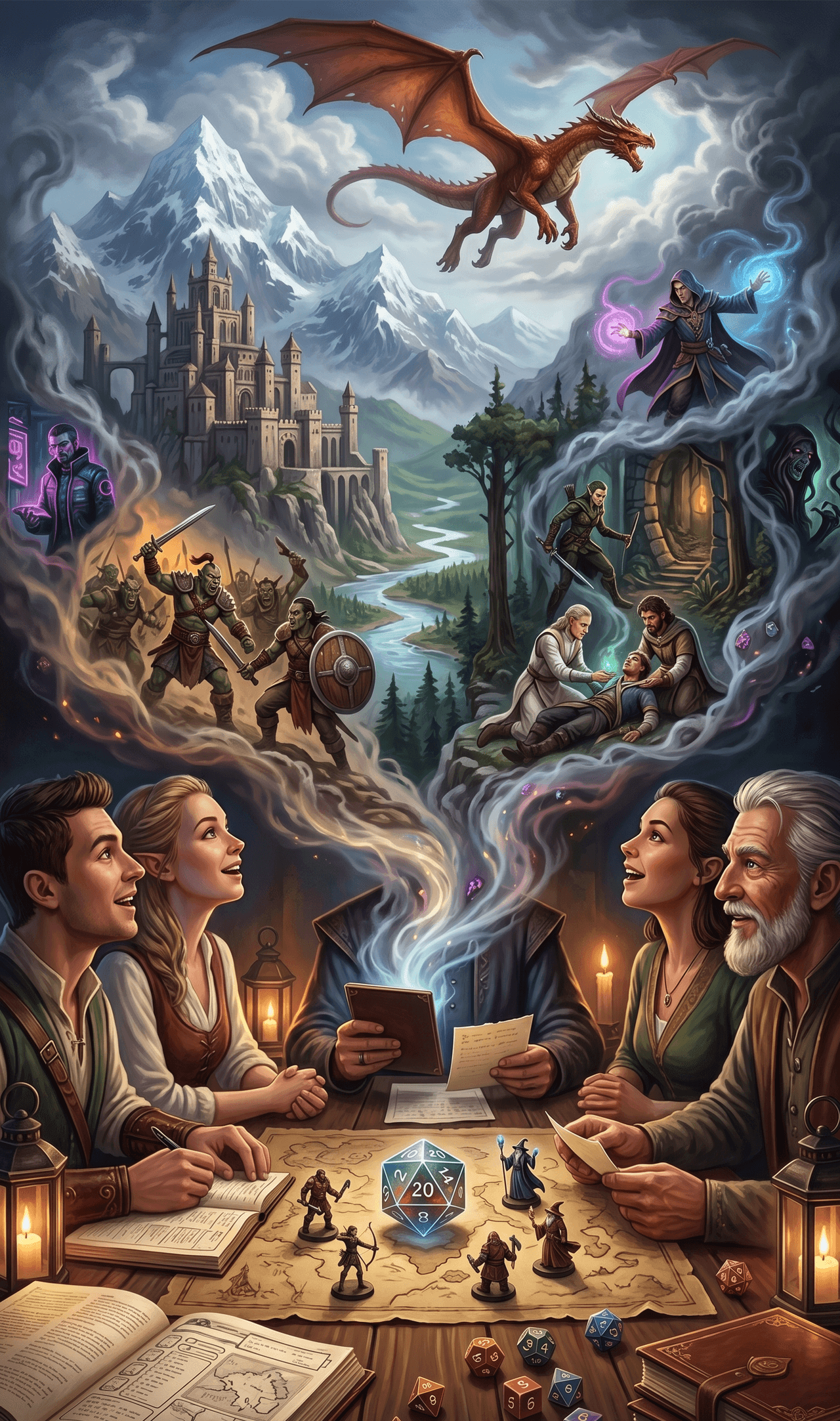
Masaüstü Rol Yapma Oyunu (görsel yapay zeka ile oluşturulmuştur)
Tabletop Role-Playing Games (TTRPGs) are a collaborative and social genre of games in which players come together within a shared narrative framework to embody characters in a fictional world. These games consist of a complex blend of chance, strategy, acting, storytelling, and exploration. The gameplay unfolds under the leadership of a referee and primary narrator known as the Game Master (GM) or Dungeon Master (DM). The Game Master constructs the game’s universe, manages non-player characters (NPCs), and presents various challenges for the players to overcome. Other participants each assume control of a single character they have created, responding to events within the story and making decisions that drive the narrative forward. The outcomes of characters’ actions are determined by their mechanical abilities and dice rolls. Game sessions typically last several hours, but regularly scheduled games have evolved into expansive narratives spanning months or even years.
The origins of tabletop role-playing games trace back to the 1910s as an extension of interest in wargaming. H.G. Wells’ 1913 work “Little Wars” laid the foundation for modern TTRPGs by detailing rules for war games played with lead miniatures. Initially based on real-world military units such as infantry and cavalry, these games gradually incorporated fantastical elements. Influenced by literary works such as J.R.R. Tolkien’s “The Hobbit” and “The Lord of the Rings,” fantasy wargames began to include fictional races and classes such as elves, dwarves, and wizards. Emerging in the 1970s and gaining widespread popularity in the 1980s, this game genre also became known as Fantasy Role-Playing Games (FRPs) due to its fantastical content.
As of 2024, the tabletop role-playing game market has reached a massive value of approximately $1.92 billion. This hobby experienced significant growth during the COVID-19 pandemic and is played by over 50 million Americans alone under the Dungeons & Dragons (D&D) system. Additionally, television productions such as “Stranger Things” and online game streams like “Critical Role” and “Dimension20” have solidified TTRPGs’ place in popular culture and expanded their recognition among broad audiences. As sociologist Gary Alan Fine emphasized in his academic work “Shared Fantasy,” these games create unique social worlds with their own norms and foster a strong subculture.
A TTRPG system is typically played by small groups of four to six people. Unlike video games, which feature pre-programmed visual boundaries or limited options, this system has no fixed constraints beyond imagination and the established rules. The game flow proceeds through mutual dialogue without a mandatory turn order. While the Game Master describes the current scene, players articulate how their characters respond using their own words. The role-playing element requires players to approach events in accordance with their character’s backstory, personality, fears, and moral values, applying empathy to make decisions.
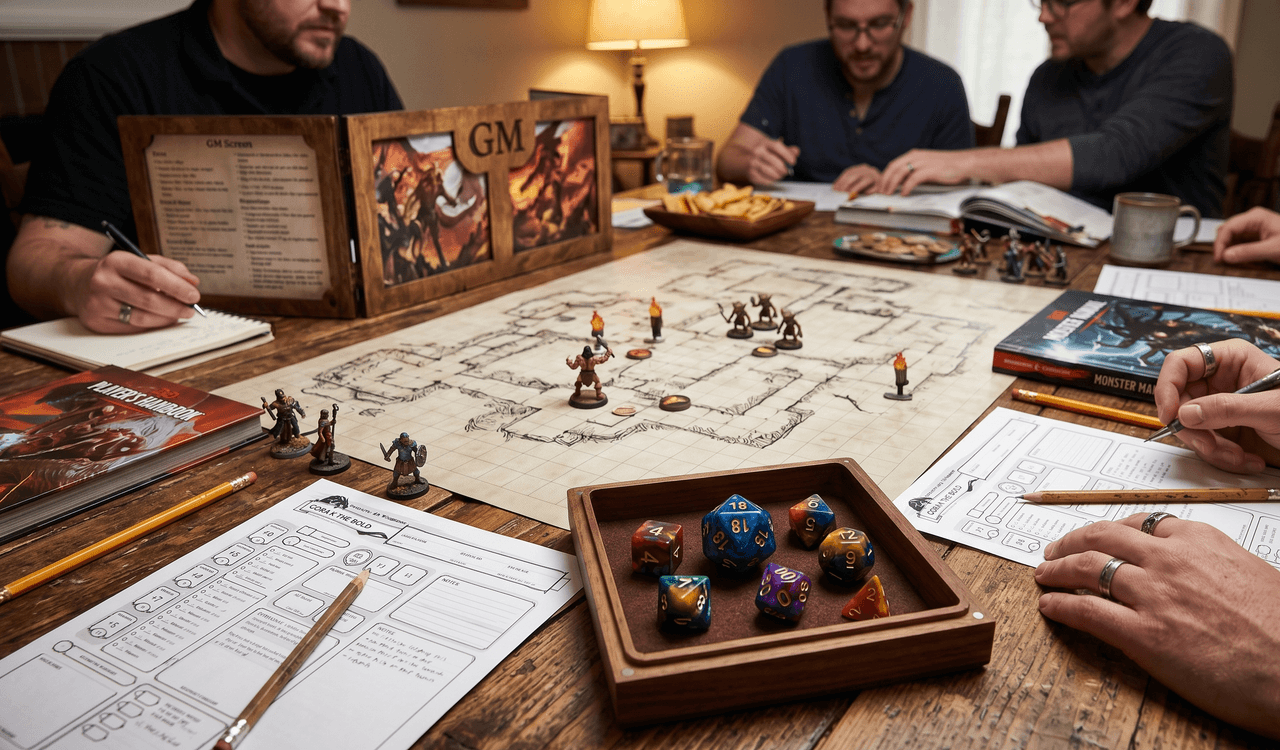
A group of people playing a tabletop role-playing game (generated by artificial intelligence)
Every action in the game is governed by a set of rules and mathematical constraints; these mechanics add realism to the fantastical narrative.
For example, rules may prevent a barbarian character from casting complex spells or restrict a paladin or knight from lying. A character’s abilities and limitations are agreed upon between the Game Master and the player and are applied consistently according to the chosen rule system.
Dice mechanics are used to introduce elements of probability and chance, heightening tension. The outcomes of uncertain actions—such as picking a lock, detecting a trap, or moving stealthily—are calculated by adding mathematical modifiers derived from the character’s attributes (intelligence, strength, dexterity, etc.) to the result of a dice roll. All random elements, including damage taken and enemy actions, are determined by the Game Master through dice rolls and recorded on damage tables.
Tabletop role-playing games use a variety of polyhedral dice to calculate probabilities in detail. Their primary functions are as follows:
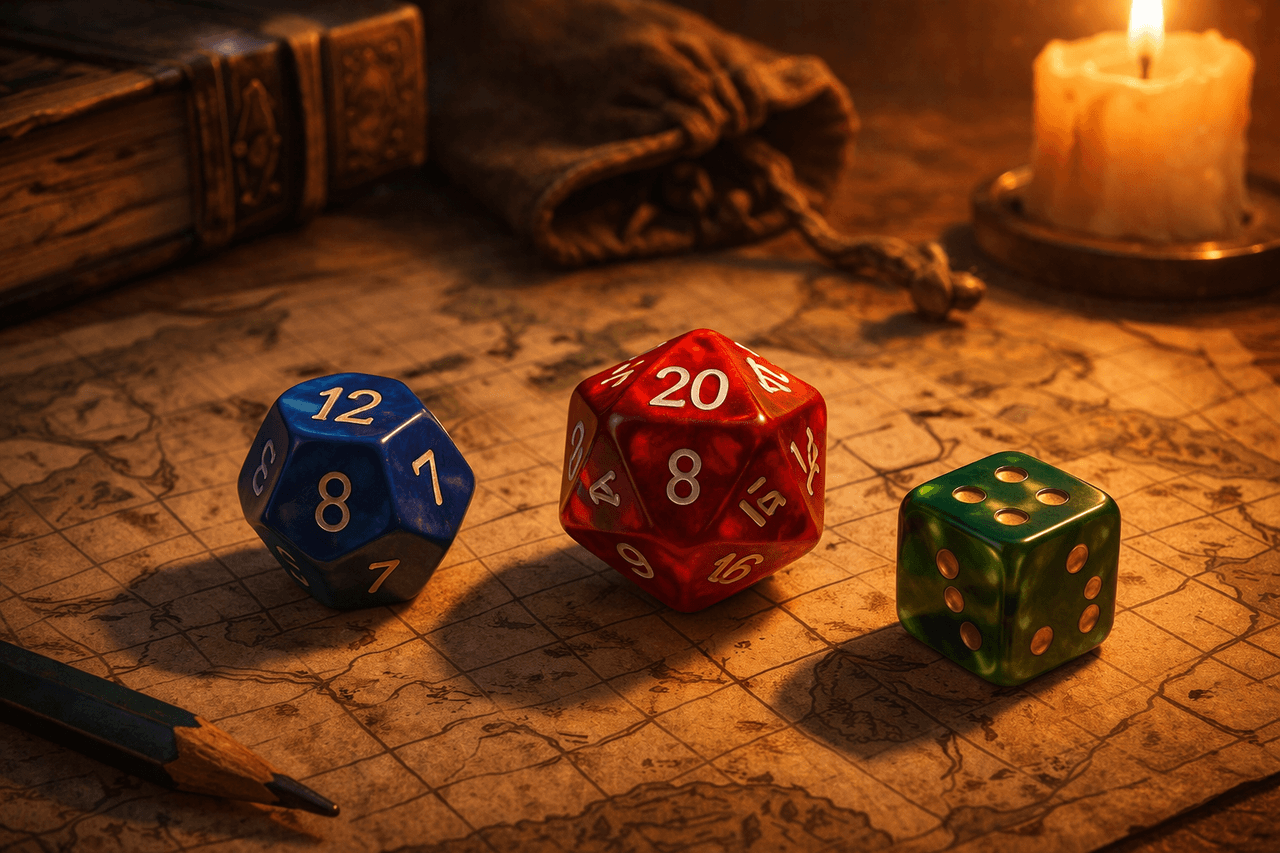
Example visual of dice appearances (generated by artificial intelligence)
Before beginning a game session, participants create entirely new characters tailored to the game’s setting. The character creation process begins with selecting a fantasy race such as an elf or dwarf and a specific class such as warrior, wizard, rogue, or healer. The chosen class permanently defines the character’s role, limitations, armor proficiency, and spellcasting capabilities within the game. Beyond mechanical choices, players develop the character’s physical appearance, detailed backstory, personal fears, and life motivations. All these numerical traits and personal details are recorded on a Character Sheet, which also tracks hit points and equipment inventory. As the story progresses, players earn experience points (XP) by solving challenging puzzles and defeating enemies, which they use to level up their characters and gain new abilities.
The TTRPG market hosts dozens of systems offering vastly different rule sets and atmospheres. Systems such as Dungeons & Dragons (D&D) and Pathfinder are set in high fantasy worlds filled with swords, magic, and dragons, placing heavy emphasis on combat and strategic map usage. In contrast, the Call of Cthulhu system, inspired by the literature of H.P. Lovecraft, emphasizes skill checks and challenging investigations to create a cosmic horror experience in which characters are prone to losing their sanity.
For those seeking a dystopian atmosphere, the Cyberpunk RED system presents a world where players battle colossal corporations in neon-lit future cities. For groups interested in complex heists within a gothic, dark industrial revolution setting, the Blades in the Dark system is used. Alongside established systems such as Vampire: The Masquerade, Shadowrun, and Ryuutama that offer distinct geographies, there are also independent systems like Kids on Bikes, which relax mathematical rules and focus entirely on storytelling and role-playing. Beyond multinational publishers such as Paizo, Magpie Games, and Modiphius, the industry remains dynamically evolving thanks to experimental indie projects funded through Kickstarter by individual creators.
For physical games played face-to-face at a table, several essential materials are required. Polyhedral dice with varying numbers of sides form the heart of the game. The “Player’s Handbook,” which contains comprehensive rules, item lists, and spells, prevents rule violations, while Starter Sets with simplified missions enable newcomers to learn the game quickly. Character sheets and blank scratch paper are used to track clues gained during play, dwindling spell slots, and accumulated damage. Ready-made scenario packages (Campaign Packs), written by professionals, can be acquired to shape the narrative, or the Game Master can build an entirely original story from scratch using only their notes and imagination. Beyond physical tables, digital tools integrated via software such as Discord, Slack, or Microsoft Teams now allow gaming groups to meet online and sustain their games continuously.
Accessed November 26, 2025. https://www.aa.com.tr/tr/kultur/ahlatta-acilan-kurslarla-geleneksel-tas-isciligi-yasatiliyor/3116279.
FRPNet. "FRP Nedir?" Accessed April 14, 2026. https://frpnet.net/rehber/frp-nedir
Good Games. "What Are Table Top Role Playing Games?" Accessed April 14, 2026. https://www.goodgames.com.au/blogs/articles/what-are-table-top-role-playing-games
Roll Initiative Con. "What Is TTRPG?" Accessed April 14, 2026. https://rollinitiativecon.nl/what-is-ttrpg/
TTRPG Insider. "What Is a TTRPG?" Accessed April 14, 2026. https://www.ttrpginsider.news/c/what-is-a-ttrpg
Typelish. “Masaüstü Rol Yapma Oyunları ve Zarlar.” Accessed April 14, 2026. https://typelish.com/@ecemsusarikaya/masaustu-rol-yapma-oyunlari-ve-zarlar
University of Missouri–St. Louis Libraries. “TTRPG.” Accessed April 14, 2026. https://libguides.umsl.edu/ttrpg
World Weave. "What Is Tabletop RPG?" Accessed April 14, 2026.

Masaüstü Rol Yapma Oyunu (görsel yapay zeka ile oluşturulmuştur)
No Discussion Added Yet
Start discussion for "Tabletop Role-Playing Game (TTRPG)" article
Historical Development and Origins
Core Dynamics and Mechanics
Dice Systems and Materials Used
Character Creation and Development
Game Systems and Genres
Required Materials