

This article was automatically translated from the original Turkish version.
+1 More
The Taurid meteor shower is an astronomical phenomenon observed when Earth passes annually through a stream of meteoroids orbiting the Sun during the autumn season. It is known for its slow-moving and bright meteors. The activity typically begins in late October and continues throughout November, sometimes extending into the first days of December.【1】The Taurid system distinguishes itself from other meteor showers by producing frequent but low-velocity meteorsand by the appearance of very bright fireballs known as bolides.【2】

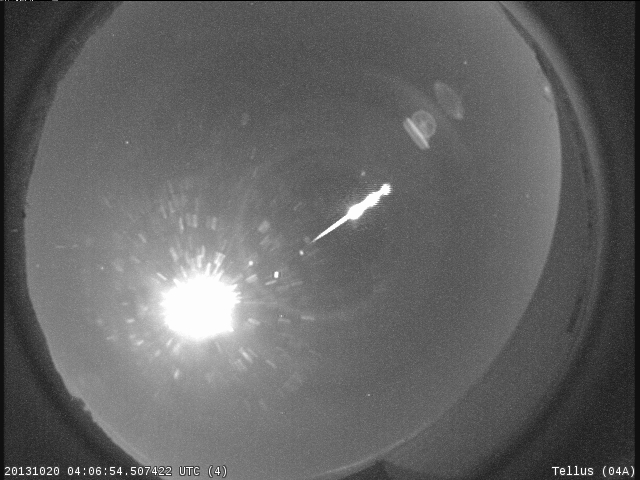
Taurid Meteor Shower (NASA)
Taurid meteors are characterized by relatively low entry velocities, which allow them to remain visible in the atmosphere for longer durations. Observational reports indicate that Taurid meteors frequently glow in yellowish or orange hues and leave long persistent trails. Although their hourly peak rates are not exceptionally high, the distinguishing feature of the shower is the brightness of its meteors.【3】 For this reason, the Taurids are defined as a meteor shower notable not for quantity but for producing bright and conspicuous meteors.
The Taurid system is studied as two main components: the Northern Taurids and the Southern Taurids. This distinction is based on differences in the apparent radiant positions of the meteors in the sky. While their observation periods overlap partially, the peak times of the two components show slight variations.
Scientific studies indicate that the Taurid meteor shower is associated with a broad meteoroid complex originating from a comet.【4】 This complex is described as a large-scale structure encompassing numerous small celestial bodies and particle streams sharing similar orbits around the Sun.【5】 Research has shown that the Taurid complex is not a single narrow stream but rather a dispersed particle cloud with regions of varying density formed over time.【6】
Meteors become more prominent after midnight, as the observer’s location on Earth turns more directly into the direction of Earth’s orbital motion. The low velocities of Taurid meteors make them easier to observe with the naked eye.
Early studies of the Taurid meteor shower gained momentum with the development of photographic recording techniques. These studies measured meteor velocities, brightness levels, trail lengths, and orbital parameters. Photographic observations enabled comparative analysis of meteor trajectories in the atmosphere and revealed that the Taurid system possesses distinct characteristics different from other meteor showers.【7】
[1]
NASA, “The Taurid Swarm Is Upon Us,” NASA, Access date: 14 March 2026, https://www.nasa.gov/blogs/watch-the-skies/2015/10/26/the-taurid-swarm-is-upon-us See also, Royal Museums Greenwich, “When and where to see the Taurid Meteor shower,” RMG, Access date: 14 March 2026, https://www.rmg.co.uk/stories/space-astronomy/taurid-meteor-shower-when-where-see-it-uk
[2]
NASA, “The Taurid Swarm Is Upon Us,” NASA, Access date: 14 March 2026, https://www.nasa.gov/blogs/watch-the-skies/2015/10/26/the-taurid-swarm-is-upon-us/
[3]
Royal Museums Greenwich, “When and where to see the Taurid Meteor shower,” RMG, Access date: 14 March 2026, https://www.rmg.co.uk/stories/space-astronomy/taurid-meteor-shower-when-where-see-it-uk
[4]
NASA, “The Taurid Swarm Is Upon Us,” NASA, Access date: 14 March 2026, https://www.nasa.gov/blogs/watch-the-skies/2015/10/26/the-taurid-swarm-is-upon-us/ See also, V. Porubčan, L. Kornoš and I. P. Williams, “The Taurid Complex Meteor Showers and Asteroids,” Contributions of the Astronomical Observatory Skalnaté Pleso 36 (2006): 103, Access date: 14 March 2026, https://ui.adsabs.harvard.edu/abs/2006CoSka..36..103P/abstract
[5]
V. Porubčan, L. Kornoš and I. P. Williams, “The Taurid Complex Meteor Showers and Asteroids,” Contributions of the Astronomical Observatory Skalnaté Pleso 36 (2006): 103, Access date: 14 March 2026, https://ui.adsabs.harvard.edu/abs/2006CoSka..36..103P/abstract
[6]
V. Porubčan, L. Kornoš and I. P. Williams, “The Taurid Complex Meteor Showers and Asteroids,” Contributions of the Astronomical Observatory Skalnaté Pleso 36 (2006): 103, Access date: 14 March 2026, https://ui.adsabs.harvard.edu/abs/2006CoSka..36..103P/abstract
https://ui.adsabs.harvard.edu/abs/2006CoSka..36..103P/abstract See also.
Fred L. Whipple and Salah El-Din Hamid, “On the Origin of the Taurid Meteors,” The Astronomical Journal 55 (1950): 185, Access date: 14 March 2026, https://ui.adsabs.harvard.edu/abs/1950AJ.....55R.185W/abstract
[7]
Fred L. Whipple and Salah El-Din Hamid, “On the Origin of the Taurid Meteors,” The Astronomical Journal 55 (1950): 185, Access date: 14 March 2026, https://ui.adsabs.harvard.edu/abs/1950AJ.....55R.185W/abstract See also
Fred L. Whipple, “Photographic Meteor Studies. III. The Taurid Shower,” Proceedings of the American Philosophical Society 83, no. 5 (1940): 711, Access date: 14 March 2026,. https://www.jstor.org/stable/985135?searchText=taurid+meteor&searchUri=%2Faction%2FdoBasicSearch%3FQuery%3Dtaurid%2Bmeteor%26so%3Drel&ab_segments=0%2Fbasic_search_gsv2%2Fcontrol&refreqid=fastly-default%3A9d88f90cdff4611726e78e8e8168725d

No Discussion Added Yet
Start discussion for "Taurid Meteor Shower" article
General Characteristics
Origin and Dynamic Structure
Scientific and Historical Studies