


This article was automatically translated from the original Turkish version.
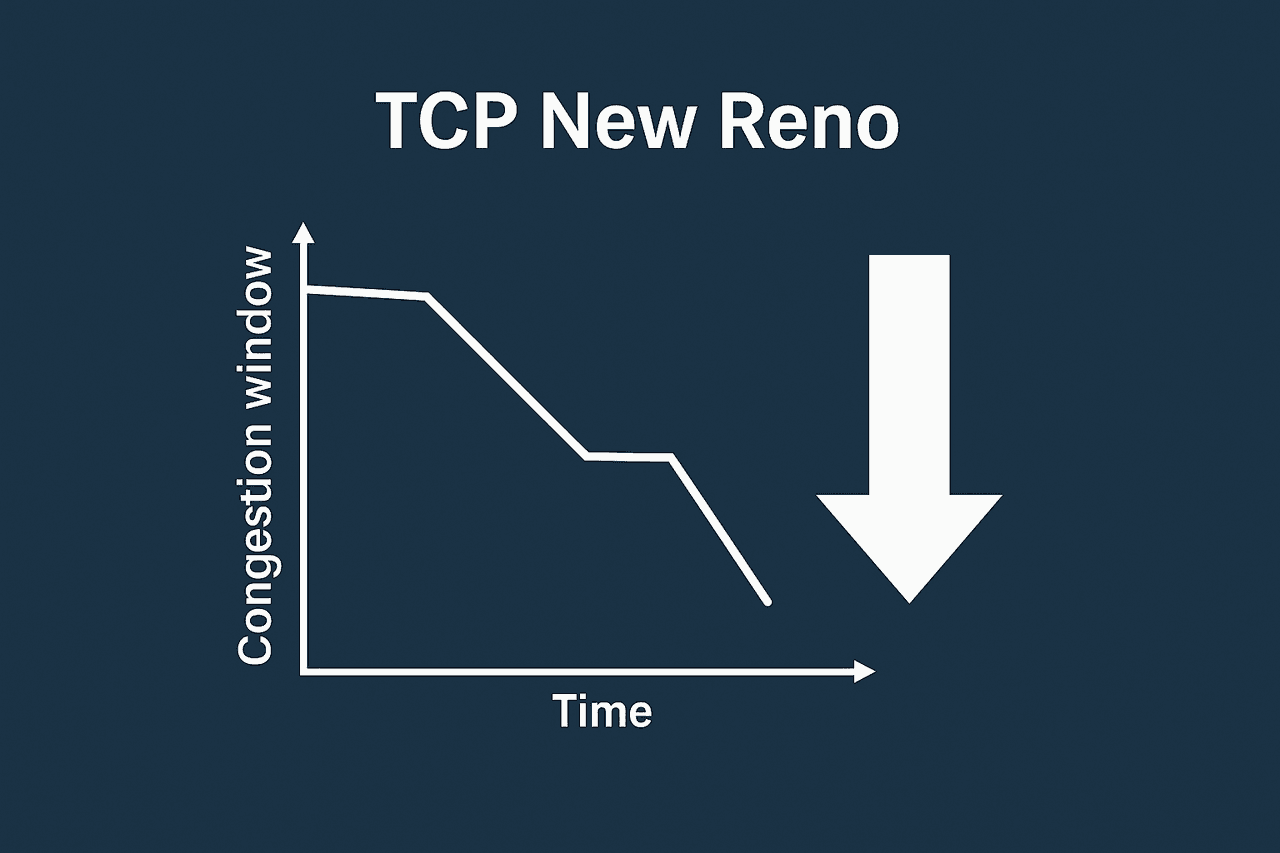
TCP New Reno
Protocol Developed | TCP Reno | ||||||||
|---|---|---|---|---|---|---|---|---|---|
Advantage(s) | Improved recovery in multiple segment loss | ||||||||
Publication Year | 1999 (according to RFC 2582) | ||||||||
Fast Recovery Feature | Continues until all lost segments are received | ||||||||
Application Area(s) | Wireless networks High-latency connections | ||||||||
One of the improvements implemented on the Transmission Control Protocol (TCP), TCP New Reno was developed to enhance the efficiency of congestion control, particularly in scenarios involving multiple segment losses. It addresses the shortcomings of TCP Reno by focusing on minimizing the impact of segment losses during data transmission. It is regarded as a significant step in improving TCP performance, especially in high-bandwidth and high-latency network environments.
While TCP Reno avoids excessive reduction of transmission rate during a single segment loss through its Fast Recovery algorithm, it loses effectiveness when multiple segment losses occur. TCP New Reno resolves this issue by introducing small but critical modifications to the Reno algorithm, enabling more efficient management of all losses within a single congestion window.
TCP New Reno, like TCP Reno, triggers the Fast Retransmit algorithm after receiving three Duplicate ACKs (DUPACKs). However, the key difference becomes apparent during the Fast Recovery phase. Upon entering Fast Recovery, TCP New Reno does not merely retransmit the segment believed to be lost; it also waits for a specific condition before exiting Fast Recovery: the newly received ACK must acknowledge the highest sequence number segment sent up to that point.
Thanks to this approach:

Fast Recovery process in TCP New Reno. The Fast Recovery phase continues until newly received ACKs confirm that all lost segments have been successfully retransmitted. (Drawn by YZ)
TCP Reno exits Fast Recovery with each new incoming ACK, whereas TCP New Reno only exits Fast Recovery after all lost segments have been successfully retransmitted and acknowledged. This mechanism ensures a more stable transmission flow in multiple loss scenarios and prevents unnecessary halving of the congestion window.
Various simulations and real-world internet tests have demonstrated that TCP New Reno provides superior data transmission performance compared to TCP Reno, particularly under moderate traffic conditions (for example, 20% to 50% traffic load).
However, in highly congested environments (60% to 70% and above), the performance difference between TCP Reno and TCP New Reno becomes significantly smaller.
The most notable advantages of TCP New Reno include:
Agung Hernawan, "Comparative Performance Testing of the Impact of ACK Loss in TCP Tahoe, TCP Reno, and TCP New Reno on the ns-2 Simulator", JITE Journal, 2023
Luigi A. Grieco and Saverio Mascolo, "Performance Evaluation and Comparison of Westwood+, New Reno, and Vegas TCP Congestion Control", Politecnico di Bari, Italy
İlkin Ulaş Balkanay, "Telsiz Ortamlardan Geçen TCP Bağlantıları İçin Yeni Bir Başarım Artırma Tekniği". Master's thesis, İstanbul Teknik Üniversitesi, 2005

TCP New Reno
Protocol Developed | TCP Reno | ||||||||
|---|---|---|---|---|---|---|---|---|---|
Advantage(s) | Improved recovery in multiple segment loss | ||||||||
Publication Year | 1999 (according to RFC 2582) | ||||||||
Fast Recovery Feature | Continues until all lost segments are received | ||||||||
Application Area(s) | Wireless networks High-latency connections | ||||||||
Purpose of Developing TCP New Reno
Working Principles of TCP New Reno
Fast Retransmit and Fast Recovery Phases
Segment Loss Management
Performance of TCP New Reno