


This article was automatically translated from the original Turkish version.
One of the most significant problems encountered in data transmission over computer networks is congestion. This issue reduces network efficiency and increases delays. TCP Vegas is a transmission control protocol developed to address this problem. Unlike traditional TCP protocols, TCP Vegas, proposed by Brakmo and colleagues, adopts a proactive rather than reactive approach to detecting congestion. This article examines in detail the structure, algorithms, and performance of TCP Vegas.
TCP Vegas is a TCP variant with more advanced congestion control mechanisms compared to TCP Reno. Its fundamental distinction lies in its ability to detect early signs of congestion by monitoring changes in transmission rate, rather than relying solely on packet loss.
TCP Reno typically detects congestion in response to three duplicate ACK messages. TCP Vegas, however, evaluates whether congestion exists in the network by comparing the expected transmission rate with the actual rate. If the actual rate is significantly lower than the expected rate, congestion is inferred and the window size is reduced. Otherwise, the window size is increased.
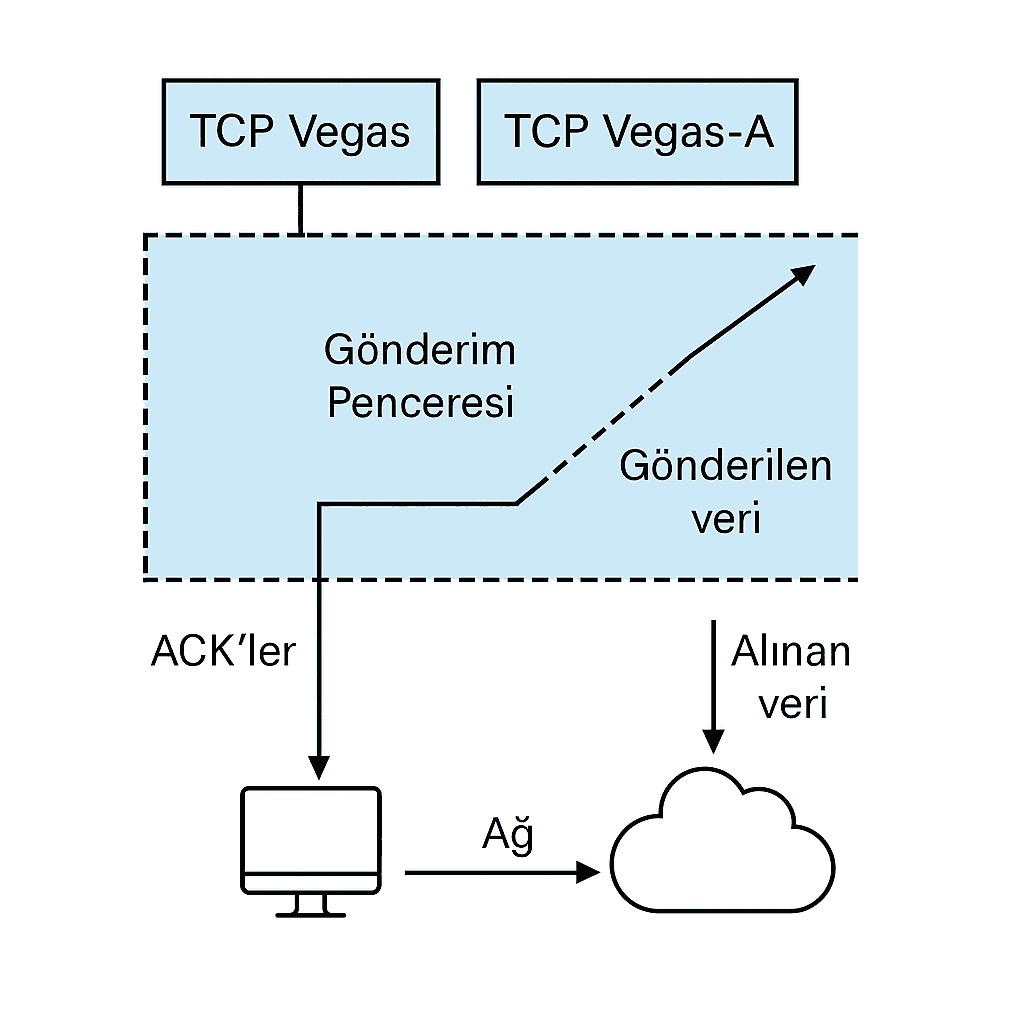
Representative TCP Vegas Mechanism, summarizing the core working principle of TCP Vegas. (Generated by artificial intelligence.)
The algorithms of TCP Vegas can be summarized as follows:
To address certain performance limitations identified in TCP Vegas, an extension called TCP Vegas-A has been proposed. This version provides a more adaptive window growth and reduction mechanism by using dynamically changing threshold values a and b instead of fixed parameters.

Responses of TCP Vegas and TCP Vegas-A to changes in RTT. Vegas-A has a more adaptive window growth strategy. (Generated by artificial intelligence.)
Brakmo, Lawrence S., and Larry L. Peterson. "TCP Vegas: End to end congestion avoidance on a global Internet." IEEE Journal on Selected Areas in Communications 13, no. 8 (1995): 1465-1480. Accessed Adresi.
Hengartner, Urs, Jürg Bolliger, and Thomas Gross. "TCP Vegas revisited." In *Proceedings IEEE INFOCOM 2000. Conference on Computer Communications. Nineteenth Annual Joint Conference of the IEEE Computer and Communications Societies (Cat. No. 00CH37064)*, vol. 3, pp. 1546-1555. IEEE, 2000. Accessed Adresi.
Srijith, K. N., Lillykutty Jacob, and Akkihebbal L. Ananda. "TCP Vegas-A: Improving the performance of TCP Vegas." Computer communications 28, no. 4 (2005): 429-440. Accessed Adresi.
Şimşek, Mehmet, and M. Ali Akcayol. "Bilgisayar Ağlarında Tıkanıklık Denetimi ve Çözüm Yöntemleri." Bilişim Teknolojileri Dergisi 1, no. 3 (2008). Accessed Adresi.

Key Features of TCP Vegas
Congestion Detection and Avoidance
Algorithms
TCP Vegas-A: An Adaptive Approach
Innovations in TCP Vegas-A