

This article was automatically translated from the original Turkish version.
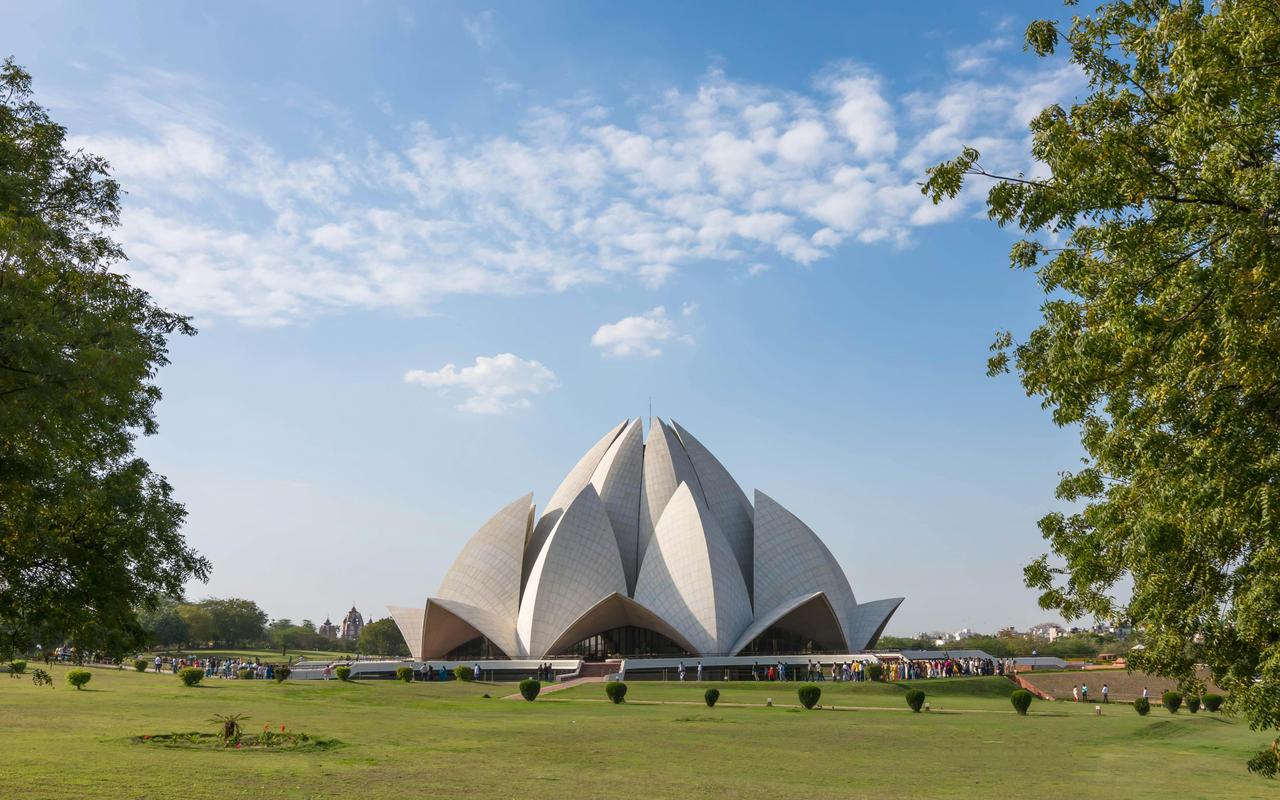
The Lotus Temple, located at New Delhi, is the principal place of worship for the Bahá’í community in the Indian subcontinent. Designed inspired by the lotus flower, the structure is an architectural masterpiece constructed to symbolize the core principles of the Bahá’í Faith—the oneness of God, the oneness of religion, and the oneness of humanity. Opened to the public in 1986, the temple attracts attention both within India and internationally due to its architectural form, symbolic design, and social contributions.
Lotus Temple (Bahá’ís of India)
The temple was designed by architect Fariborz Sahba. It consists of 27 marble-clad concrete shells arranged in three tiers of nine petals each. The inner petals encircle the prayer hall while the outer petals cover the entrance areas and external spaces. The marble cladding uses white marble quarried from Mount Pentelicus in Greece, with panels fabricated in Italy and assembled on site in Delhi.
The prayer hall has a diameter of 34 metres and a height of 33.6 metres. Located at the centre of the structure, it accommodates up to 2,500 worshippers. Natural light illuminates the interior through glass panels at the tops of the inner petals, while a natural ventilation system cools the space. Nine reflective pools surrounding the temple, evoking the floating petals of a lotus flower, enhance the architectural harmony.
The temple was structurally engineered to withstand Delhi’s seismic activity and hot climate. In addition to its natural ventilation system, 20 percent of the temple’s energy needs are met through solar panels, making it the first place of worship in Delhi to utilize solar energy.
The Bahá’í House of Worship is open to individuals of all faiths, serving as a space for prayer and meditation. According to Bahá’í writings, prayer is a direct spiritual dialogue with God and must be conducted without intermediaries. No statues, icons, clergy, or rituals are present within the temple. Worship consists of silent prayer and meditation.
Passages from the sacred texts of all major world religions may be read and prayers recited within the temple. The House of Worship fosters spiritual unity among diverse faiths by promoting oneness within diversity. It also embodies the Bahá’í commitment to social responsibility, hosting educational activities, community service initiatives, and programs that encourage youth participation.
Construction of the temple took approximately ten years and involved around 800 workers, including women, along with 40 engineers. Funding was provided through a donation of the life savings of Ardishír Rustampúr from Hyderabad. During a time when advanced machinery was limited, the highly complex concrete shell structure was built using traditional methods.
The concrete shells and marble cladding were shaped using custom molds to conform precisely to the temple’s geometric form. The inner petals feature hammered concrete surfaces, while the floor is covered in white marble. Walkways and staircases on the podium level are paved with red sandstone.
The temple draws attention not only for its architectural beauty but also for its embodiment of the principle of universal oneness. Within India’s multi-religious and multicultural society, it stands as a supra-religious place of worship. The temple physically manifests the Bahá’í concept of the Mashriqu’l-Adhkár—the “Dawning Place of the Remembrance of God”—integrating spiritual and social dimensions of the Faith.
Since its completion, the structure has been preserved essentially in its original form. Regular structural maintenance and conservation efforts are carried out. All plans, drawings, and documents have been archived, allowing direct comparison between the original design and the current state. The building was constructed to withstand earthquakes, storms, and environmental risks for at least 400 years.
Unlike other Bahá’í Houses of Worship around the world, the Lotus Temple stands out both in its structural form and symbolic representation. While sharing similar spiritual significance with Bahá’í holy sites in Haifa and Akka, Israel, it is architecturally more innovative. When compared with modern architectural landmarks such as the Sydney Opera House, it exhibits comparable creativity, engineering mastery, and symbolic power.
The temple has received numerous international awards for its architectural achievements, including:
Since its opening in 1986 until 2014, the Lotus Temple welcomed over 100 million visitors and is recognized as one of the most visited religious structures in the world. Located in south Delhi near Nehru Place, the temple has become a major religious and tourist attraction.
Bahá’í House of Worship. "Welcome to the Bahá’í House of Worship, New Delhi." Accessed July 15, 2025. https://bahaihouseofworship.in/.
Delhi District Magistrate (South East). "Lotus Temple, Delhi." Government of NCT of Delhi. Accessed July 15, 2025. https://dmsoutheast.delhi.gov.in/tourist-place/lotus-temple-delhi/.
Pexels. "Kent, Şehir, Sanat, Mimari." Photograph. Accessed July 22, 2025. https://www.pexels.com/tr-tr/fotograf/kent-sehir-sanat-mimari-4059538/.
UNESCO World Heritage Centre. “The Bahá’í House of Worship, New Delhi.” UNESCO World Heritage Centre. Accessed July 15, 2025. https://whc-unesco-org.translate.goog/en/tentativelists/5921/?_x_tr_sl=en&_x_tr_tl=tr&_x_tr_hl=tr&_x_tr_pto=tc.

No Discussion Added Yet
Start discussion for "Temple of the Lotus" article
Architectural Features
Religious and Cultural Significance
History and Construction Process
Social and Universal Value
Comparative Evaluation
Awards and Recognition
Visitor Statistics