This article was automatically translated from the original Turkish version.
Scientific Name(s) | Galerida cristata | ||||||||
|---|---|---|---|---|---|---|---|---|---|
Family | Alaudidae (Toygargiller) | ||||||||
Order | Passeriformes (Ötücü kuşlar) | ||||||||
IUCN Conservation Status | Asgari Endişe (Least Concern – LC) | ||||||||
Crested Lark (Alaudidae) is a songbird species. It is one of the most common and well-known lark species found in Türkiye.
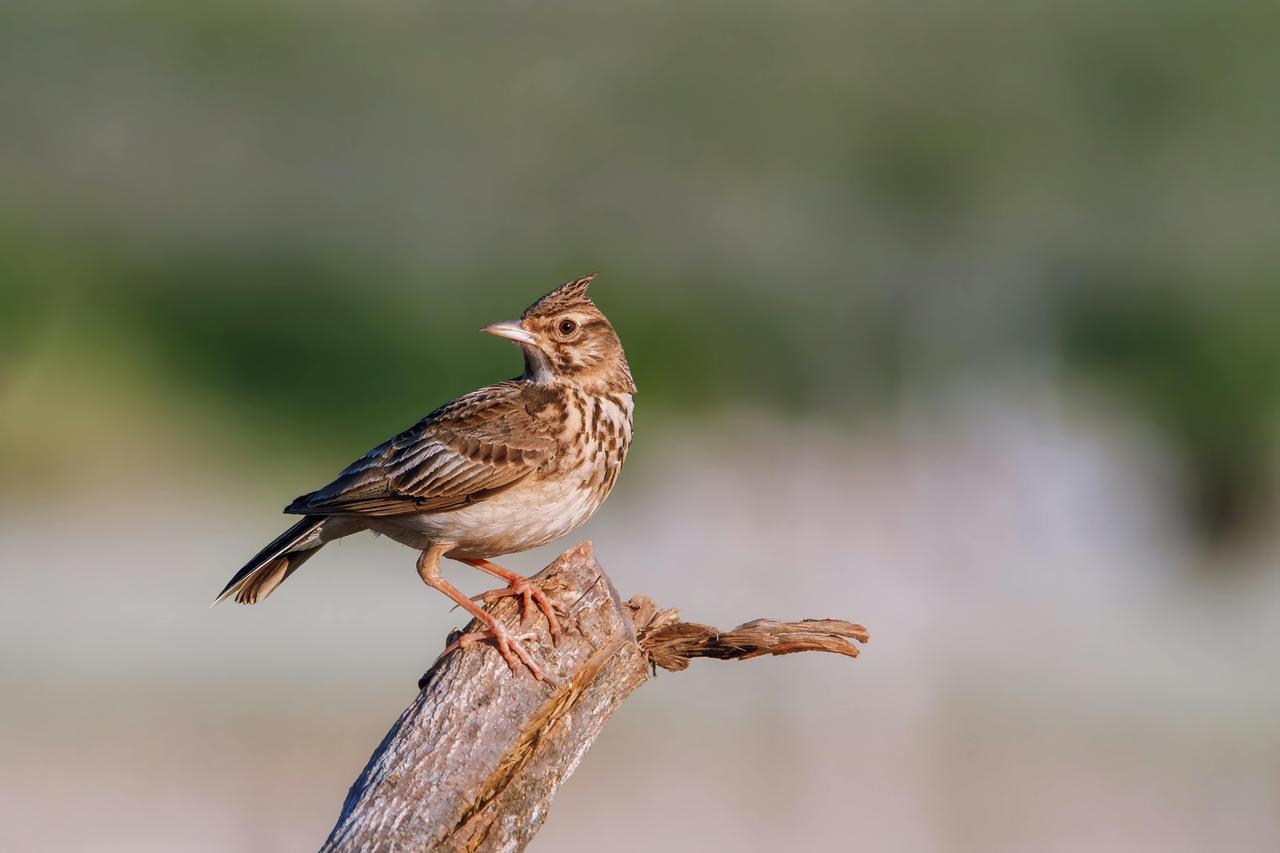
The Crested Lark can be easily identified by its large, stocky body and broad wings. Its most distinctive feature is its upright, pointed, and conspicuous crest; two feathers in particular extend sharply forward from the crest. The bill is long and thick, with a slightly downward-curved tip. The back is gray-brown, the upperwing coverts are dark brown, and the underwing is rust-colored (orange-brownish). The breast displays fine, dark streaks. The belly and undertail coverts are pale yellowish-pink. The base of the tail and central tail feathers are pale grayish, while the outer tail feathers are blackish with lighter edges.
Its flight is soft and undulating, with wingbeats resembling those of a butterfly. On the ground, it walks quickly in short, running steps. Although it is often seen in small groups, it may also be observed alone.

Crested Lark (pexels)
The Crested Lark is often confused with the Sky Lark (Alauda arvensis). However, the Sky Lark has a short, blunt crest that is usually inconspicuous. Its bill is thicker and more pointed, and its breast shows denser and more pronounced streaking. Juveniles can also cause confusion: Sky Lark chicks display a prominent white stripe along the side of the head and regular spotting on the back, whereas Crested Lark chicks have plainer, more uniform coloration.
The Crested Lark can be observed year-round in almost all regions of Türkiye. It is less frequently seen in the Eastern Black Sea region and occurs as a summer migrant across much of Eastern Anatolia. Its most common habitats are open areas, rural landscapes, and cultivated fields. It is predominantly found in treeless and dry environments.
It is frequently encountered along road edges during winter months. It builds its nest on the ground and typically lays two to three eggs.
The Crested Lark is an omnivore, feeding primarily on plant seeds and insects. During summer, it relies mostly on insects, while in winter its diet consists predominantly of seeds.
As a member of the order Passeriformes, this species forages mostly on the ground. When approached by vehicles or humans, it is more cautious than other larks and flees with short flights. Its wing posture and fluttering flight pattern are distinctive. It is usually observed in small groups of three to five individuals. It is not a migratory species; Türkiye hosts a resident breeding population throughout the year.
The Crested Lark (Galerida cristata) is listed as Least Concern (LC) on the International Union for Conservation of Nature (IUCN) Red List. This classification indicates that the species has a wide global distribution and a large population size, and therefore does not face a significant risk of extinction in the near future.
Ornito. "Tepeli Toygar." Ornito.org. Accessed August 16, 2025. https://www.ornito.org/Bird/Detail/459
Pexels. “Crested Lark (Galerida cristata) in Cemovsko Polyje JPG.” Pexels. Accessed August 16, 2025. https://www.pexels.com/tr-tr/fotograf/cemovsko-polyje-deki-galerida-cristata-21771999/
Pexels. “ucan hayvan tepeli toygar JPG.” Accessed August 16, 2025. https://www.pexels.com/tr-tr/fotograf/ucan-hayvan-sinek-ucmak-15258772/
İzkuş. "Tepeli Toygar." İzmir Kuş Cenneti. Accessed August 16, 2025. https://izmirkuscenneti.gov.tr/2022/12/05/tepeli-toygar/

Scientific Name(s) | Galerida cristata | ||||||||
|---|---|---|---|---|---|---|---|---|---|
Family | Alaudidae (Toygargiller) | ||||||||
Order | Passeriformes (Ötücü kuşlar) | ||||||||
IUCN Conservation Status | Asgari Endişe (Least Concern – LC) | ||||||||
No Discussion Added Yet
Start discussion for "Tepeli Toygar (Galerida cristata)" article
Physical Characteristics
Confusion with Similar Species
Distribution and Habitat
Diet
Behavior and Biology
Conservation Status