


This article was automatically translated from the original Turkish version.
Gazavât-ı Hayreddin Paşa is a gazavatnâme that chronicles the life, memoirs, and naval campaigns of Barbaros Hayreddin Paşa. The work is one of the most important sources on Ottoman maritime history, particularly providing detailed accounts of Ottoman activities in the Western Mediterranean.
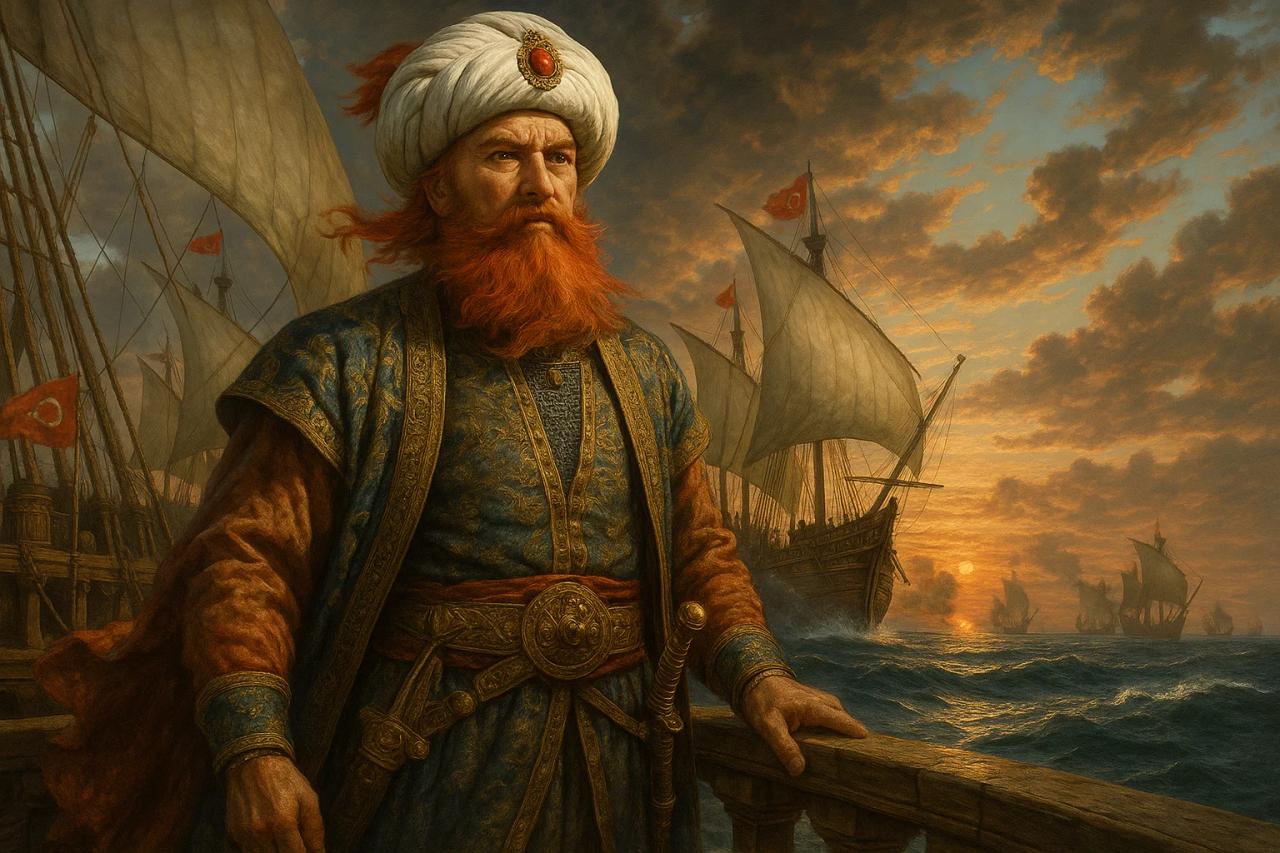
Representative Image of Barbaros Hayreddin Paşa (Generated by Artificial Intelligence)
The author of the work is the poet and naval officer Seyyid Murad, who served under Barbaros Hayreddin Paşa, participated in his campaigns, and incorporated his firsthand knowledge into the text. The work consists of two parts: the first completed in 1541 and the second in 1546. The composition was based primarily on Barbaros’s own narratives and recollections, and it was commissioned by Sultan Suleiman I. After completing the first part, Seyyid Murad presented a copy to Grand Vizier Rüstem Paşa and subsequently joined the Hungarian campaign, where he composed a historical account of that expedition in both verse and prose.
Gazavât-ı Hayreddin Paşa covers the life, naval campaigns, and Ottoman maritime policy of Barbaros Hayreddin Paşa. The following topics are addressed in the work:
Among the extant manuscripts of the work, the verse manuscript in the Topkapı Palace Museum Library (Revan Köşkü, no. 1291) and the second-part manuscript at the Bibliothèque Nationale in Paris (MS, Supplément Turc, no. 1186) are the most prominent. Additional prose manuscripts are held in various libraries. The work has been translated into multiple languages and published by numerous scholars throughout history:
Gazavât-ı Hayreddin Paşa is one of the most significant examples of the gazavatnâme genre. The work is not merely a record of naval campaigns but also holds literary value. Seyyid Murad not only conveyed Barbaros’s personal accounts but also employed a narrative style that indicates his direct eyewitness status. The text serves as a primary source on Ottoman naval history, political struggles in the Mediterranean, and Ottoman-Spanish conflicts. Moreover, it is regarded as an important document reflecting Kanuni Sultan Süleyman’s maritime policy. The second part of the work is especially significant for its compilation of the French campaign and imperial decrees.
Gallotta, Aldo. “Gazavat-ı Hayreddin Paşa.” *Türkiye Diyanet Vakfı İslâm Ansiklopedisi*. Accessed September 30, 2025. https://islamansiklopedisi.org.tr/gazavat-i-hayreddin-pasa.
Gallotta, Aldo. “Gazavat-ı Hayreddin Paşa.” Trans. Salih Akdemir. *Belleten* 45, no. 180 (October 1981): 473–500. https://dergipark.org.tr/tr/pub/ttkbelleten/issue/70722/1137701.
Gallotta, Aldo. “Seyyid Murad’ın ‘Gazavât-ı Hayreddin Paşa’ Adlı Eseri.” *Erdem* 4, no. 10 (1988): 127–164. Accessed September 30, 2025. https://dergipark.org.tr/tr/pub/erdem/issue/44560/552874.
Vatin, Nicolas. “Arabes et Turcs au Maghreb dans les années 1513–1520 d’après les Ġazavat-ı Ĥayrü-d-din Paşa.” *Osmanlı Araştırmaları* 40 (December 2012): 365–397. Accessed September 30, 2025. https://dergipark.org.tr/tr/pub/oa/issue/10938/130738.

No Discussion Added Yet
Start discussion for "The Campaigns of Hayreddin Pasha" article
Author and Composition
Content and Subject Matter
Manuscripts and Publications
Literary and Historical Value