

This article was automatically translated from the original Turkish version.
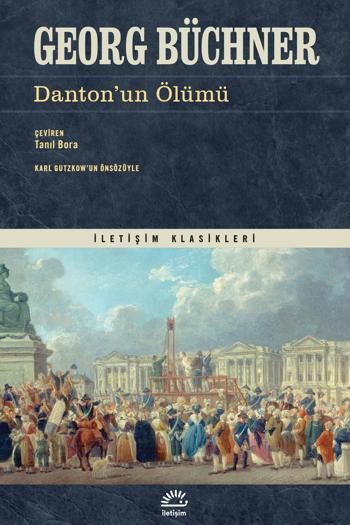
The Death of Danton is a four-act tragic play written by German author, medical doctor, and dramatist Georg Büchner (1813–1837), which lays bare the violent clashes and upheavals of the French Revolution. Composed in 1835 during the period when Büchner fled persecution by authorities and traveled to France, the play is regarded as one of the earliest and most significant examples of revolutionary theater.【1】
The action takes place in the spring of 1794, during the most intense phase of the French Revolution—the Reign of Terror—under the Jacobin dictatorship. The play centers on the political withdrawal of revolutionary leader Georges Danton and his growing questioning of the revolution’s bloody trajectory. Danton and his followers (the Dantonists) oppose Robespierre’s policy of terror, justified in the name of “virtue,” arguing that the mass executions and repression must end and that the Republic has now been firmly established. In contrast, Robespierre, the other powerful leader of the revolution, defends terror as inevitable to preserve the purity of the revolution and eliminate counter-revolutionaries. This fundamental ideological and political conflict leads to Danton being declared an enemy of the people by Robespierre and subsequently arrested.
The play unfolds in detailed, episodic scenes depicting Danton’s arrest, his determined yet hopeless defense before the Revolutionary Tribunal, and his tragic farewell to his wife Julie before ascending the guillotine. As Danton confronts the inevitability of his fate, he bears witness to the transformation of revolutionary ideals into a bloody dictatorship.
Although trained as a medical doctor, Georg Büchner spent his short life immersed in political struggle. In 1834 he founded the secret Society of Human Rights and authored the pamphlet “Der Hessische Landbote,” calling on the people to resist monarchical oppression. His political stance deeply influenced his artistic outlook, enabling him to transcend the literary, philosophical, and religious conventions of his time and reach a universal essence.
In this play, Büchner reflects his own inner unrest and political environment, identifying himself with the protagonist Danton and his fiancée Minna Jaegle with Danton’s wife Julie, thus engaging in both a personal and historical reckoning.
The central conflict of the play is the ideological and willful struggle between two opposing leaders of the revolution: Georges Danton and Maximilien Robespierre. This conflict interrogates the contradiction between the revolution’s ideals and the means—terror and violence—used to achieve them.
On one side stands Georges Danton, who enters a profound moral reckoning, believing that power has become corrupted. He is a flawed, human, fatalistic character who argues that the revolution’s bloody actions must cease. On the other side stands Maximilien Robespierre, who upholds absolute virtue and the Republic, using terror as a tool of governance. Robespierre’s famous declaration, “Virtue without terror is powerless; terror without virtue is murderous,”【2】 serves as a defining expression of the play’s thematic tension. Robespierre wields the power gained in the revolution’s name with despotic resolve.
In this work, Büchner treats the concepts of power, authority, and justice on a universal scale. By reflecting the reality that political justice in times of social upheaval typically serves the interests of those who make the laws, he explores how revolutionary ideals can transform into despotism.
The characters in the play are inspired by historical figures. Georges Danton, when he opposes Robespierre and demands an end to bloodshed, is accused by Robespierre of moral decay. Danton, through his fatalistic nature, is regarded as the only figure in the revolution who is not cast as a hero.
Maximilien Robespierre is portrayed as a flawless figure devoid of human weakness, elevated in the public eye, yet exercises power with despotic ruthlessness. Danton’s wife, Julie, is devoted and loving toward her husband; when his execution becomes inevitable, she chooses to die with him by committing suicide.
Camille Desmoulins (Danton’s friend) and Saint Just (Robespierre’s right-hand man) occupy opposing poles of the conflict. Desmoulins denounces Robespierre as a “bloody messiah” and opposes the revolution’s violent turn, while Saint Just, who plays a key role in securing Danton’s execution, normalizes violence and bloodshed as necessary for the revolution.
The Death of Danton is woven with a poetic language and texture; its dialogue exhibits a lyrical quality. Although some critics have labeled it the first documentary play, it is more widely accepted as a historical drama due to its fictionalized elements and the author’s interpretive perspective.
[1]
İletişim Yayınları, ''Danton'un Ölümü,'' iletisim.com.tr, Erişim 29 Ekim 2025, https://iletisim.com.tr/kitap/danton-un-olumu/10744
[2]
Can Yılmaz, "DANTON’UN ÖLÜMÜ” OYUNUNUN İKTİDAR VE ADALET KAVRAMLARI ÜZERİNDEN OKUNARAK SAHNELENMESİ," Yüksek Lisans Tezi, Mimar Sinan Üniversitesi Güzel Sanatlar Enstitüsü, 2019. Syf 41, https://tez.yok.gov.tr/UlusalTezMerkezi/tezDetay.jsp?id=3wLUTQWc3y4BPFwenYb52g&no=ZmDry5OFPkEIRbRNXTIQyw.

No Discussion Added Yet
Start discussion for "The Death of Danton (Book)" article
Summary of the Plot
The Author and the Work’s Context
Theme
Characters and Thematic Analysis
Literary and Artistic Features