


This article was automatically translated from the original Turkish version.
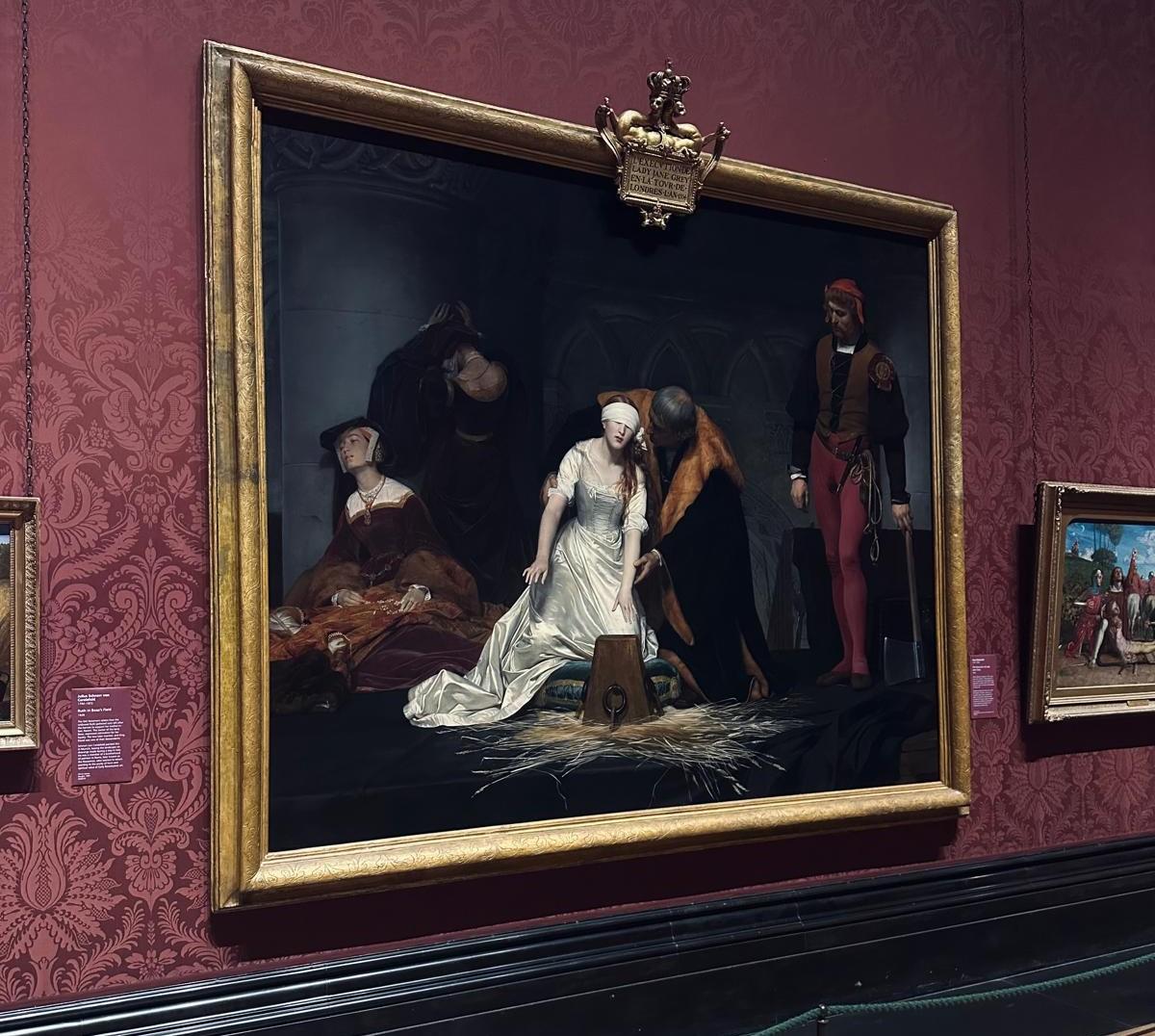
The Execution of Lady Jane Grey (Painting)
(Photo: Nisanur Emral)
Original Name(s) | The Execution of Lady Jane Grey | ||||||||
|---|---|---|---|---|---|---|---|---|---|
Painter | Paul Delaroche | ||||||||
Year of Production | 1833 | ||||||||
Technique | Oil on canvas | ||||||||
Dimension(s) | 297 × 246 cm | ||||||||
Location | London National Gallery | ||||||||
The Execution of Lady Jane Grey (Lady Jane Grey'in İnfazı), French painter Paul Delaroche completed in 1833 as an oil painting. The work depicts the moment of execution of Lady Jane Grey, the nine-day queen of England who was executed on 12 February 1554. It is currently part of the collection of the National Gallery in London. The painting captures the final moment as she is led to the scaffold, blindfolded and bound, her neck positioned for the axe.
The painting embodies both the academic historical painting tradition and the emotional melodrama characteristic of the Romantic period.

The Execution of Lady Jane Grey (Picrly)
The painting The Execution of Lady Jane Grey was completed by Paul Delaroche in 1833. Delaroche was known for his works within the 19th-century European tradition of historical painting, particularly those depicting dramatic historical events. He created this work as a reflection of the period’s fascination with historical narratives and tragic figures.
The painting was first exhibited at the Paris Salon in 1834. Following its exhibition, it attracted widespread attention and quickly gained recognition among European art circles. Throughout the 19th century, due to the high interest in historical painting, the work became one of Delaroche’s most famous pieces.
Paul Delaroche prepared the painting The Execution of Lady Jane Grey in his studio in Paris between 1832 and 1833. Before creating the work, the artist studied historical sources regarding Lady Jane Grey’s life and execution, particularly relying on written accounts from the Tudor period. However, rather than reproducing historical documents as literal visual references, Delaroche constructed a scene in accordance with the academic conventions of historical painting of his time.
The composition, arrangement of figures, and lighting were planned through preliminary sketches and drawings. To enhance the dramatic impact of the scene, Delaroche opted for a composition based on an enclosed interior setting, strong chiaroscuro contrasts, and a central focus on the main figure. Lady Jane Grey is rendered in light tones to draw the viewer’s gaze directly to the center of the composition.
The painting was executed in oil on canvas. Due to its large scale, the production process progressed in stages, with figures and background painted in separate layers. After completion, the work was prepared for exhibition at the 1834 Paris Salon.
The painting depicts the moment Lady Jane Grey, who had been placed on the throne amid political struggles during the Tudor dynasty and deposed nine days later, is led to the scaffold for execution. Lady Jane Grey was seen as a threat during Mary Tudor’s ascent to the throne, tried for treason, and executed on 12 February 1554. Delaroche’s work is a visual representation of this historical event.
In the painting, Lady Jane Grey is shown kneeling, blindfolded, as she is guided toward the execution block. The figure occupies the center of the composition. To the right, the executioner waits with his axe. To the left, two female attendants of Lady Jane Grey are portrayed expressing their emotional reactions to the scene. The background reveals an enclosed interior space. Light is concentrated at the center of the composition to highlight the main figure.
Paul Delaroche adopted a style consistent with the academic tradition of historical painting in this work. The figures are rendered with idealized anatomical proportions. The arrangement of light and shadow is designed to intensify the dramatic effect of the scene. The composition follows a theatrical staging principle. These characteristics place the painting among representative examples of 19th-century French historical painting.
Although the scene depicted in the painting is based on historical events, certain elements do not correspond exactly to documented facts. According to historical records, Lady Jane Grey’s execution took place in the open courtyard of the Tower of London. However, Delaroche constructed the scene as an enclosed interior space. Additionally, Jane’s white satin gown and physical portrayal reflect the artist’s aesthetic preferences rather than historical records. Therefore, the painting is understood not as a documentary record of the event but as the artist’s dramatic interpretation.
The painting was first exhibited at the Paris Salon in 1834. It received widespread attention throughout the 19th century but was temporarily removed from display in the 20th century as interest in historical painting declined. After a comprehensive restoration in 1975, it was returned to public exhibition and is now permanently on view at the National Gallery.
The Execution of Lady Jane Grey is regarded as one of the most famous depictions of an execution in 19th-century historical painting. The work is recognized not only as a visual representation of a historical event but also as a significant artistic achievement reflecting the aesthetic and narrative conventions of its time. Today, it is considered one of the principal references in both art historical literature and Tudor iconography.
Art UK. "The Execution of Lady Jane Grey." Art UK. Accessed December 8, 2025. https://artuk.org/discover/artworks/the-execution-of-lady-jane-grey-218531
Louvre Museum. “Paul Delaroche (1797–1856).” Louvre Museum. Accessed December 8, 2025. https://www.louvre.fr/en/explore/the-palace/paul-delaroche
Musée d’Orsay. “History Painting in 19th-Century France.” Musée d’Orsay. Accessed December 8, 2025. https://www.musee-orsay.fr/en/collections/works-in-focus
Picryl. "Paul Delaroche - The Execution of Lady Jane Grey." Picryl. Accessed December 8, 2025. https://picryl.com/media/paul-delaroche-the-execution-of-lady-jane-grey-9d3e20
The Victorian Web. "Paul Delaroche and Historical Painting." The Victorian Web. Accessed December 8, 2025. https://www.victorianweb.org/art/painting/delaroche
Web Gallery of Art. "Paul Delaroche: The Execution of Lady Jane Grey." Web Gallery of Art. Accessed December 8, 2025. https://www.wga.hu/frames-e.html?/html/d/delaroch/5delaroc.html

The Execution of Lady Jane Grey (Painting)
(Photo: Nisanur Emral)
Original Name(s) | The Execution of Lady Jane Grey | ||||||||
|---|---|---|---|---|---|---|---|---|---|
Painter | Paul Delaroche | ||||||||
Year of Production | 1833 | ||||||||
Technique | Oil on canvas | ||||||||
Dimension(s) | 297 × 246 cm | ||||||||
Location | London National Gallery | ||||||||
No Discussion Added Yet
Start discussion for "The Execution of Lady Jane Grey (Painting)" article
History
Production Process
Subject and Composition
Artistic Style
Historical Accuracy and Artistic Interpretation
Exhibition and Preservation
Place in Art History