


This article was automatically translated from the original Turkish version.
+1 More
(Yapay Zeka ile Oluşturulmuştur)
The Great Fire of London, a major urban disaster that destroyed central areas of London between Sunday 2 September and Thursday 6 September 1666. The fire consumed approximately 85 percent of medieval London within the Roman walls, covering 373 acres, as well as an additional 63 acres outside the walls. In total, 13,200 houses, 89 parish churches, 57 guildhalls, St Paul’s Cathedral, the Royal Exchange, the Guildhall, the Custom House and the city jails were completely destroyed or severely damaged during this period.【1】
In the 1660s London, with a population of approximately 350,000, was one of the largest urban centers in Europe. Buildings were constructed without urban planning, featuring timber frames, tar-covered surfaces and thatched roofs.【2】 Buildings constructed along narrow, winding streets had upper floors that overhung the road, extending nearly to the point of touching opposite structures. The summer of 1666 was exceptionally hot and dry, with a prolonged period without rain causing wooden structures to lose moisture and become highly flammable. With no motor vehicles in the city, large quantities of flammable hay and straw bales were stored near homes, in courtyards and in warehouses.

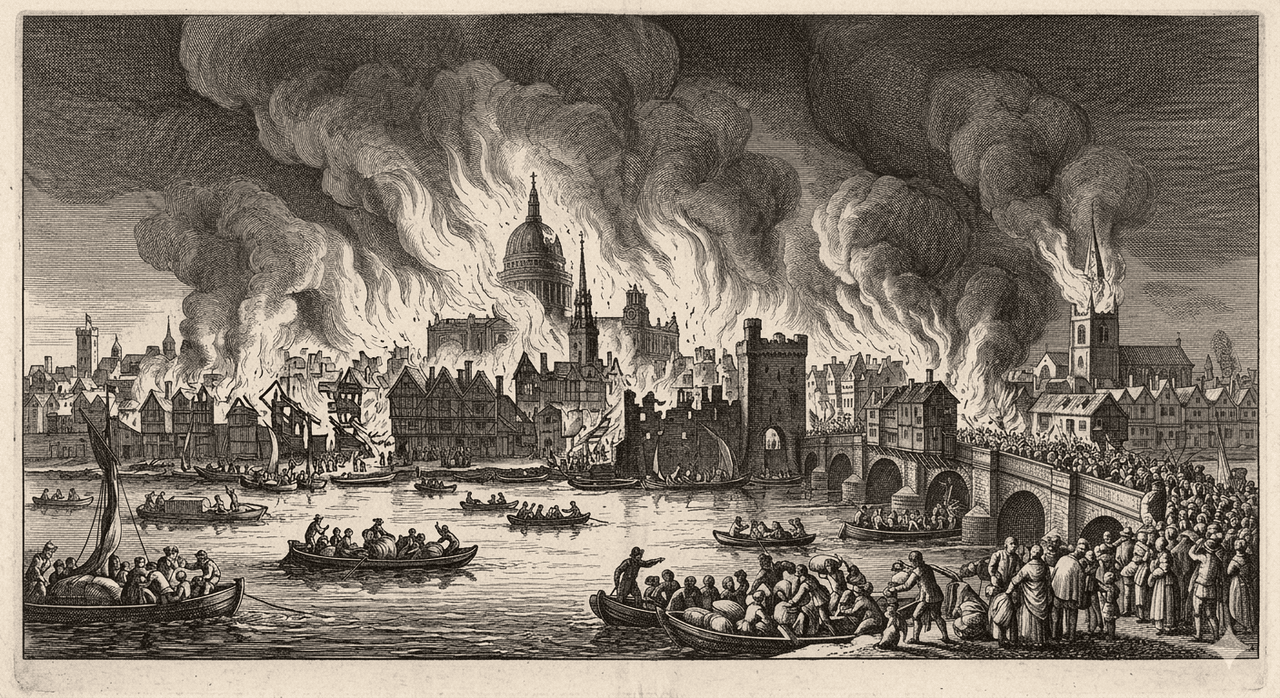
The Great Fire of London (Picryl)
The fire began at around 1:00 a.m. on Sunday, 2 September 1666, in the bakery of Thomas Farynor (Farriner), the royal baker, on Pudding Lane. Although Farynor claimed to have extinguished the oven, the fire reignited and within three hours the entire building was engulfed in flames. When Sir Thomas Bloodworth, then Lord Mayor of London, was awakened to be informed of the situation, he dismissed its severity and refused to intervene personally.【3】
Strong easterly winds carried embers from Pudding Lane to Fish Hill, and from there to warehouses along the River Thames filled with oil, tallow and other flammable materials. The fire did not spread to the south bank of the river; the primary reason was that a previous fire in 1633 had destroyed part of the buildings on London Bridge, creating a natural firebreak.【4】
In 1666 London had no organized fire brigade. Firefighting efforts relied on primitive equipment such as leather buckets, hooked poles, axes and low-capacity water sprayers. By the fourth day of the fire, half the city was ablaze.
The Great Fire of London 1666 (YouTube)
Samuel Pepys, Secretary to the Royal Navy, reported the situation to King Charles II and recommended demolishing buildings to create firebreaks. Following the king’s order, fire hooks were used to pull down houses, but the fire overcame these barriers. As a last resort, gunpowder stocks from the navy were used to blow up buildings along the fire’s path, creating wide firebreaks.
The noise from the explosions fueled unfounded rumors among the public that the French had invaded, causing panic. On Wednesday, 5 September, the wind subsided and the open areas created by the explosions enabled authorities to bring the fire under control; it was fully extinguished by 6 September.
Between 70,000 and 80,000 people were left homeless during the fire. Residents rushed to the River Thames to board boats or sought refuge in refugee camps such as Moorfields outside the city. Many citizens, including high-ranking officials like Samuel Pepys, attempted to protect their valuables by burying them, along with wine and cheese, in their gardens. Thousands of people from surrounding villages flocked to the area to witness the disaster, worsening the chaos. As St Paul’s Cathedral burned, lead roofing melted and flowed into the streets, causing the entire structure to collapse.【5】
Following the event, Robert Hubert, a mentally unstable French clockmaker, falsely confessed to having started the fire and was hanged. However, it was later established that Hubert had not yet arrived in England when the fire began.
Official records indicate that only six people died during the fire. However, it is known that many more perished in the aftermath due to a harsh winter and unsanitary conditions in temporary shelters. Material damage is estimated at between eight and ten million pounds sterling in contemporary currency. The loss of housing alone was valued at 3.2 million pounds sterling.【6】 The halt in commercial activity disrupted customs and market taxes, which were critical sources of state revenue.
After the fire, Parliament established the “Fire Court” to oversee the city’s reconstruction. This court functioned as a rapid arbitration mechanism without appeal to resolve disputes between property owners and tenants over construction costs.【7】 The Rebuilding Act, approved by the king in 1667, banned the construction of wooden buildings and mandated that all new structures be built of brick or stone.
Christopher Wren and Robert Hooke played key roles in the physical transformation of the city. Although wide street plans and grid layouts could not be fully implemented due to property rights and funding constraints, streets were widened and pavement systems were regulated. Nearly four hundred thousand bricks were used in the reconstruction of housing stock.【8】 By 1668, 1,450 homes had been completed; by the end of 1670, this number reached 6,000.【9】 The city acquired a new architectural identity through 51 new churches designed by Christopher Wren and the reconstruction of St Paul’s Cathedral.【10】 A monument, known as The Monument, was erected near Pudding Lane to commemorate the disaster.【11】
Birch, William Russell. "The Great Fire of London in the Year 1666." Picryl. 1792. Accessed March 6, 2026. https://picryl.com/media/william-russell-birch-the-great-fire-of-london-in-the-year-1666-a550bb
Cale, Catherine. "Burning Books: The Great Fire of London." *Talking Humanities* (blog). August 30, 2016. Accessed March 6, 2026. https://talkinghumanities.blogs.sas.ac.uk/2016/08/30/burning-books-the-great-fire-of-london/
HistoryPod. "2nd September 1666: The Great Fire of London began at a bakery in Pudding Lane." YouTube. Accessed March 6, 2026. https://www.youtube.com/watch?v=J2uPLJOsOTU
London Fire Brigade. "The Great Fire of London." Museum. Accessed March 6, 2026. https://www.london-fire.gov.uk/museum/london-fire-brigade-history-and-stories/fires-and-incidents-that-changed-history/the-great-fire-of-london/
University of Oxford Faculty of History. "Facing Catastrophe: The Great Fire of London." Accessed March 6, 2026. https://www.history.ox.ac.uk/facing-catastrophe-great-fire-london
[1]
University of Oxford Faculty of History. "Facing Catastrophe: The Great Fire of London." Erişim tarihi: 6 Mart 2026. https://www.history.ox.ac.uk/facing-catastrophe-great-fire-london
[2]
London Fire Brigade. "The Great Fire of London." Museum. Erişim tarihi: 6 Mart 2026. https://www.london-fire.gov.uk/museum/london-fire-brigade-history-and-stories/fires-and-incidents-that-changed-history/the-great-fire-of-london/
[3]
London Fire Brigade. "The Great Fire of London." Museum. Erişim tarihi: 6 Mart 2026. https://www.london-fire.gov.uk/museum/london-fire-brigade-history-and-stories/fires-and-incidents-that-changed-history/the-great-fire-of-london/
[4]
London Fire Brigade. "The Great Fire of London." Museum. Erişim tarihi: 6 Mart 2026. https://www.london-fire.gov.uk/museum/london-fire-brigade-history-and-stories/fires-and-incidents-that-changed-history/the-great-fire-of-london/
[5]
Cale, Catherine. "Burning Books: The Great Fire of London." Talking Humanities (blog). 30 August 2016. Erişim tarihi: 6 Mart 2026. https://talkinghumanities.blogs.sas.ac.uk/2016/08/30/burning-books-the-great-fire-of-london/
[6]
University of Oxford Faculty of History. "Facing Catastrophe: The Great Fire of London." Erişim tarihi: 6 Mart 2026. https://www.history.ox.ac.uk/facing-catastrophe-great-fire-london
[7]
University of Oxford Faculty of History. "Facing Catastrophe: The Great Fire of London." Erişim tarihi: 6 Mart 2026. https://www.history.ox.ac.uk/facing-catastrophe-great-fire-london
[8]
University of Oxford Faculty of History. "Facing Catastrophe: The Great Fire of London." Erişim tarihi: 6 Mart 2026. https://www.history.ox.ac.uk/facing-catastrophe-great-fire-london.
[9]
University of Oxford Faculty of History. "Facing Catastrophe: The Great Fire of London." Erişim tarihi: 6 Mart 2026.https://www.history.ox.ac.uk/facing-catastrophe-great-fire-london.
[10]
University of Oxford Faculty of History. "Facing Catastrophe: The Great Fire of London." Erişim tarihi: 6 Mart 2026. https://www.history.ox.ac.uk/facing-catastrophe-great-fire-london.
[11]
University of Oxford Faculty of History. "Facing Catastrophe: The Great Fire of London." Erişim tarihi: 6 Mart 2026. https://www.history.ox.ac.uk/facing-catastrophe-great-fire-london.


(Yapay Zeka ile Oluşturulmuştur)
No Discussion Added Yet
Start discussion for "The Great Fire of London" article
Urban Structure and Physical Conditions of the Era
Origin and Spread of the Fire
Firefighting Methods and Crisis Management
Social Response and Evacuations
Economic Losses and Statistics
Reconstruction and Legal Reforms