


This article was automatically translated from the original Turkish version.
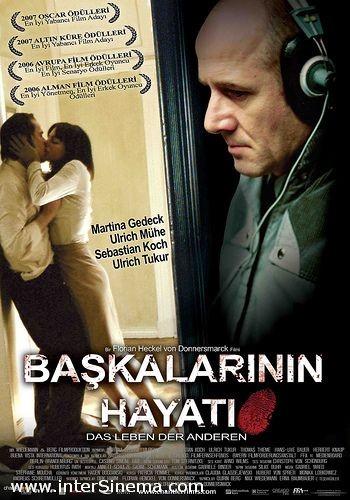
The Lives of Others (Film)
Director and Screenwriter | Florian Henckel von Donnersmarck | ||||||||
|---|---|---|---|---|---|---|---|---|---|
Year of Release | 23 March 2006 (Germany) | ||||||||
Lead Roles | Ulrich Mühe (Gerd Wiesler), Sebastian Koch (Georg Dreyman), Martina Gedeck (Christa-Maria Sieland) | ||||||||
Plot | It explores the moral transformation of Stasi agent Gerd Wiesler as he surveils playwright Georg Dreyman in 1980s East Germany and the regime's impact on individuals. | ||||||||
Award(s) | Numerous awards including the 2007 Academy Award for Best Foreign Language Film BAFTA and European Film Awards | ||||||||
The Lives of Others (German: Das Leben der Anderen) is a German drama film written and directed by Florian Henckel von Donnersmarck, released in 2006. The film is set in East Germany during the 1980s in the German Democratic Republic (GDR) and explores the culture of surveillance conducted by the Stasi (East Germany’s secret police) within the context of individual freedoms and moral dilemmas. The film has received widespread critical acclaim and has won numerous international awards.
Set in East Berlin in 1984, the film tells the story of Stasi officer Colonel Gerd Wiesler (Ulrich Mühe). As a loyal civil servant to the socialist regime, Wiesler is assigned to surveil playwright Georg Dreyman (Sebastian Koch) and his partner, actress Christa-Maria Sieland (Martina Gedeck). Although Dreyman does not openly oppose the regime, he is considered suspicious due to his influence within cultural circles. Wiesler installs hidden listening devices in the couple’s apartment and begins monitoring their daily lives. Over time, however, Wiesler’s surveillance leads him to question his own beliefs and the moral legitimacy of the regime. The film examines the tension between individual conscience, state control, and human relationships.
The Lives of Others Trailer (YouTube)
The Lives of Others is Florian Henckel von Donnersmarck’s first feature film. It was released in Germany on 23 March 2006. Produced by Wiedemann & Berg Filmproduktion and distributed in Germany by Buena Vista International, the film has a runtime of 2 hours and 17 minutes and is in the German language. Filming took place primarily in Berlin, using various locations and detailed set designs to recreate the atmosphere of East Germany during that era.
The film addresses the pressure exerted by totalitarian regimes on individuals, the psychological effects of a surveillance society, and the pursuit of personal freedom. Wiesler’s transformation represents a moral awakening, while the stories of Dreyman and Sieland reflect the regime’s impact on art and intellectual life. The film accurately portrays the political and social atmosphere of East Germany during the Cold War. Visually, the use of gray and cold tones emphasizes the bleakness of the era.
The Lives of Others received widespread positive reviews from critics. In 2007, it won the Academy Award for Best Foreign Language Film. It also received numerous awards at platforms such as the BAFTAs, the European Film Awards, and the German Film Awards. The film has been praised for its historical accuracy, strong performances, and its profound exploration of moral questions.
Filmed approximately 15 years after the fall of the Berlin Wall (1989), the film is grounded in historical realities revealed after the opening of the Stasi archives in East Germany. The Stasi’s practices of monitoring citizens and the psychological impact of this system form the foundation of the film.
Beyazperde. "Başkalarının Hayatı." Accessed May 21, 2025. https://www.beyazperde.com/filmler/film-111643/
IMDb. "The Lives of Others (2006)." Accessed May 21, 2025. https://www.imdb.com/title/tt0405094/
Sinemalar. "Başkalarının Hayatı." Accessed May 21, 2025. https://www.sinemalar.com/film/356/baskalarinin-hayati
YouTube. "The Lives of Others (Başkalarının Hayatı) | Fragman – TRT2." YouTube video. Accessed May 21, 2025. https://www.youtube.com/watch?v=-UsFedI5oak

The Lives of Others (Film)
Director and Screenwriter | Florian Henckel von Donnersmarck | ||||||||
|---|---|---|---|---|---|---|---|---|---|
Year of Release | 23 March 2006 (Germany) | ||||||||
Lead Roles | Ulrich Mühe (Gerd Wiesler), Sebastian Koch (Georg Dreyman), Martina Gedeck (Christa-Maria Sieland) | ||||||||
Plot | It explores the moral transformation of Stasi agent Gerd Wiesler as he surveils playwright Georg Dreyman in 1980s East Germany and the regime's impact on individuals. | ||||||||
Award(s) | Numerous awards including the 2007 Academy Award for Best Foreign Language Film BAFTA and European Film Awards | ||||||||
No Discussion Added Yet
Start discussion for "The Lives of Others (Film)" article
Plot
Production and Release
Cast and Characters
Themes and Narrative
Critical Reception and Awards
Cultural and Historical Context